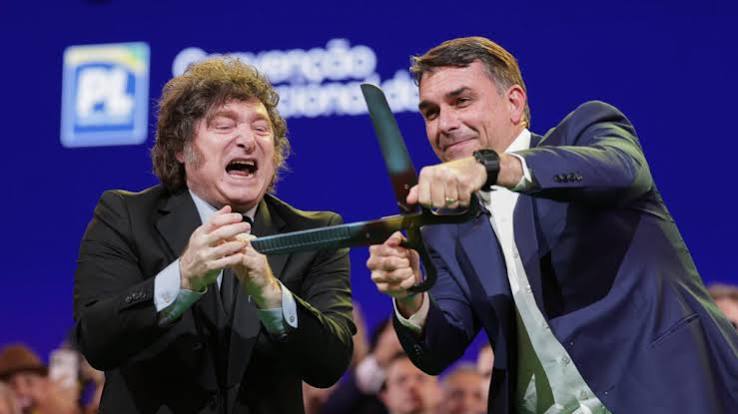
Argentina Brazil tension has escalated into a diplomatic crisis after President Javier Milei attacked Brazilian President Luiz Inácio Lula da Silva during a political event in São Paulo.
Milei called Lula a “thief” and a “convict” while speaking at an event supporting the presidential campaign of Flávio Bolsonaro, the son of former Brazilian President Jair Bolsonaro. The remarks triggered an immediate reaction from Brasília. Reuters
Brazil recalled its ambassador to Argentina, Julio Bitelli, for consultations. The government also summoned Argentina’s ambassador in Brasília to explain Milei’s comments, according to reports. RTÉ
The dispute has now moved beyond personal hostility between two presidents. It threatens to further damage relations between two of South America’s most important countries.
Argentina Brazil tension grows after Milei attacks Lula
Milei made the comments while supporting Flávio Bolsonaro’s presidential campaign in São Paulo.The Argentine leader also criticised Brazil’s left-wing government and expressed support for Bolsonaro’s political movement.
His speech directly placed him inside Brazil’s domestic political battle ahead of the country’s presidential election.Reuters reported that Milei described Lula as a “convict” and called the Brazilian government “thieving socialists”. He also presented Flávio Bolsonaro as the candidate capable of stopping Lula.
The remarks angered Brazilian officials. Brazil’s Foreign Minister Mauro Vieira described Milei’s statements as serious and unacceptable, according to Argentine media reports.
Why the Argentina Brazil tension is politically explosive
Milei’s intervention carries weight because Brazil and Argentina are major neighbours and key economic partners.The two countries share extensive trade ties and cooperate through regional institutions. Argentina also relies heavily on its relationship with Brazil, its largest trading partner, according to reports.
A prolonged diplomatic dispute could create problems beyond presidential rhetoric. Business groups, exporters and regional institutions may face greater uncertainty if the political conflict begins to affect bilateral cooperation.
The crisis also exposes a sharp ideological divide. Milei leads Argentina’s libertarian right. Lula remains one of Latin America’s most prominent left-wing leaders.
Milei and Lula have had a strained relationship
The latest confrontation follows years of tension between the two presidents.Milei and Lula have disagreed openly over economic policy, socialism and the political direction of Latin America. The Argentine president has also maintained close ties with Brazil’s conservative opposition.
Lula, meanwhile, has criticised Milei’s political approach and his public attacks on left-wing governments.The two leaders have avoided the kind of close personal relationship that often helps manage disagreements between neighbouring countries.
Reuters reported that neither leader has pursued an official meeting during Milei’s visits to Brazil.
That absence of direct political dialogue has made the Argentina Brazil tension harder to contain.
The dispute is tied to Brazil’s election politics
Milei’s comments came at a politically sensitive moment in Brazil.Flávio Bolsonaro has entered the presidential race as a conservative candidate.
His campaign seeks to challenge Lula and revive the political influence of the Bolsonaro family.
Milei’s appearance at the campaign event gave the Argentine president a direct role in Brazil’s political debate.His support for Flávio Bolsonaro also deepens his relationship with Brazil’s conservative movement.
That relationship could become more important if the Brazilian election turns into a close contest.For Lula, the attack offers a chance to present Milei as a foreign leader interfering in Brazilian politics.
For Milei, the confrontation reinforces his image as a regional leader of the political right.
Argentina Brazil tension could affect trade and regional cooperation
The political dispute comes despite strong economic links between the two countries.Argentina and Brazil remain central players in South American trade.
Their economic relationship has survived major ideological differences in the past.The current crisis could test that resilience.A diplomatic dispute does not automatically stop trade.
However, worsening political relations can complicate negotiations, regional coordination and efforts to resolve commercial disagreements.The two countries also share an interest in maintaining regional stability.
Their governments must manage issues involving energy, infrastructure, trade and wider South American cooperation.A prolonged breakdown in dialogue could make those discussions more difficult.
The crisis may remain political rather than economic
The immediate diplomatic response has focused on Milei’s language.
There is no indication from the latest reports that Brazil has announced major trade restrictions or economic retaliation against Argentina.That distinction matters.
Governments often separate diplomatic disputes from economic relations to protect businesses and citizens.The political damage, however, can still be serious.
Leaders who exchange personal insults may find it harder to negotiate when a genuine bilateral dispute emerges.
What happens next in the Argentina Brazil tension
The next stage will depend on whether both governments allow the dispute to escalate further.
Brazil may keep its ambassador away from Buenos Aires for a limited period before restoring normal diplomatic contact.
Argentina could also try to defend Milei’s comments as political speech while avoiding further steps against Brazil.Milei’s future statements will be closely watched. Any new attack on Lula or Brazilian institutions could trigger another response from Brasília.
The broader question is whether personal rivalry will continue to dominate relations between two countries that remain economically linked.
For now, the Argentina Brazil tension has turned a long-running ideological disagreement into a formal diplomatic confrontation. The crisis may eventually cool, but the political divide between Milei and Lula is unlikely to disappear soon.

Curated news reports, in-depth analysis, and special features by India’s Opinion editorial team.