
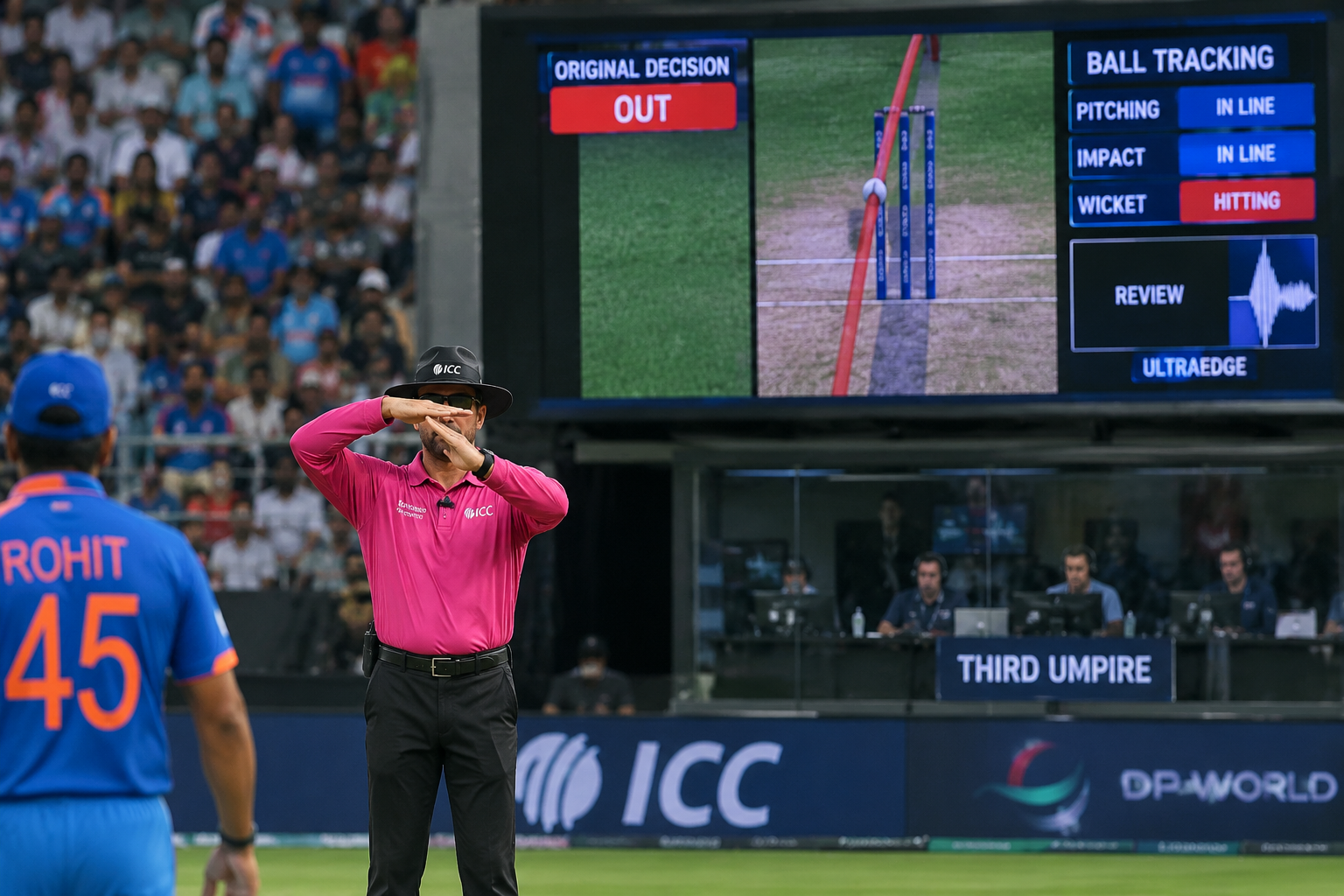
A cricket match can turn on a decision made in seconds. One appeal, one raised finger and suddenly a batter’s innings hangs on technology in a room away from the field.
That is where the Decision Review System, better known as DRS, enters the game.The system gives match officials access to video replays and approved technologies when reviewing certain decisions.
Players can also challenge eligible on-field decisions through a Player Review.But how DRS works is more complicated than simply watching a replay.
Several technologies can examine different parts of an incident. The third umpire then assesses the available evidence under the playing conditions before communicating the decision to the on-field umpire.
How DRS works during a cricket match
The first distinction is between a Player Review and an Umpire Review.
A Player Review begins when a team challenges an eligible decision made by an on-field umpire.
An Umpire Review happens when the on-field officials refer an incident to the third umpire under the relevant playing conditions.
In an ODI, for example, a captain can request a review of a relevant not-out decision, while the batter involved can request a review of an out decision.
The request must normally come within 15 seconds of the ball becoming dead.
The familiar television-style “T” signal tells the umpire that a player wants a review.Once the review starts, the third umpire examines the available evidence.
What happens inside the third umpire’s room?
The third umpire does not rely on one camera or one piece of technology.
Current ICC DRS requirements include approved ball-tracking technology and approved sound-based edge-detection technology.
The third umpire also has access to relevant replays and stump-microphone audio.
This explains why a review can involve several stages.The third umpire first establishes what happened as clearly as possible.
Depending on the incident, that can mean checking whether the ball hit the bat, whether a catch was clean, where the ball pitched or whether the ball would have hit the stumps.
The evidence required depends on the type of dismissal under review.
How DRS works for LBW decisions
LBW reviews are among the most technically complicated referrals.
The third umpire can use ball-tracking technology to examine three key points: where the ball pitched, where it struck the batter and where the ball was projected to travel.
These are commonly shown to viewers as Pitching, Impact and Wicket.
The technology reconstructs the ball’s trajectory and estimates whether it would have hit the stumps.
However, technology does not remove every element of judgment from an LBW review.
The ICC’s playing conditions recognise a category called Umpire’s Call for marginal decisions involving factors such as impact or the projected path of the ball.
That is why an LBW decision can sometimes remain unchanged even when the ball-tracking graphic appears extremely close to the stumps.
What is UltraEdge?
Sound-based edge detection helps officials determine whether the ball made contact with the bat.
Television viewers often see this technology through graphics associated with the term UltraEdge.
The principle is relatively straightforward. Microphones capture sound around the bat and ball, while video footage provides visual evidence.
The third umpire combines the available evidence rather than treating one graphic as an automatic answer.
ICC DRS requirements specifically recognise approved sound-based edge-detection technology as part of the system.
This can be particularly useful when a batter appears to have edged the ball but the contact is too subtle for the naked eye.
How DRS works for catches
Caught-behind decisions can require a different type of review.
The third umpire may examine slow-motion replays to determine whether the ball touched the bat.
The official can also use sound-based evidence when available.For difficult catches, the review may focus on whether the ball touched the ground before the fielder completed the catch.
This is one reason DRS requires multiple camera angles.A single television angle may hide the crucial moment.
Another camera can sometimes show whether the ball touched the ground or whether the fingers remained underneath it.
How DRS works for run-outs and stumpings
Run-outs and stumpings are among the clearest examples of technology assisting officials.
Special camera angles allow the third umpire to examine the batter’s position relative to the crease and the moment the wicket is broken.
The ICC’s DRS requirements specify multiple run-out camera positions as part of the minimum camera setup.
The third umpire can move through the footage frame by frame.The key question is often whether the batter had grounded the bat or had any part of the body behind the crease when the wicket was broken.
A difference of a fraction of a second can decide the result.
Why does Umpire’s Call exist?
Umpire’s Call remains one of the most debated parts of DRS.The system does not treat every marginal ball-tracking projection as an automatic reversal.
The ICC protocols specifically recognise Umpire’s Call when technology produces a marginal outcome for relevant LBW factors.
The reasoning is tied to the limits of prediction.Ball tracking reconstructs the likely path of a ball after it has been released.
When the projected result sits close to a defined boundary, the technology cannot always provide the kind of certainty required to overturn the original decision.
This means DRS is designed to correct clear errors while retaining the on-field umpire’s decision in certain marginal situations.
How many reviews does a team get?
Review allowances depend on the competition’s playing conditions.
Under the ICC men’s ODI protocol cited above, each team is allowed a maximum of one unsuccessful Player Review per innings.
A successful review does not count against that limit.That creates a tactical element.
Captains must decide whether the evidence is strong enough to challenge a decision.
A team can waste a review on a marginal appeal and later lose the opportunity to challenge a more obvious mistake.
DRS therefore affects strategy as well as officiating.
How DRS changed cricket
The modern review system has changed the relationship between players, umpires and technology.
The concept made its international debut in a series between India and Sri Lanka in 2008 before developing into the official DRS used today.
Its arrival gave teams a formal method to challenge certain decisions
.Before DRS, a wrong decision on the field could remain decisive even when television replays later suggested otherwise.
Today, eligible decisions can be reviewed during the match itself.
That has increased scrutiny of close calls while also creating new debates over technology, Umpire’s Call and the limits of video evidence.
How DRS works without replacing the umpire
The biggest misconception about DRS is that technology makes the final decision.
In reality, the system supports the officials.The third umpire reviews evidence and communicates the findings.
The on-field umpire remains responsible for applying the playing conditions and announcing the final decision.
The ICC describes DRS as a technology-based process designed to assist match officials with decision-making.
That distinction explains why the system does not simply turn every decision into a computer verdict.Technology provides evidence. Officials apply the rules.
Why DRS remains important
Understanding how DRS works changes the way viewers watch close decisions.
A review is not simply a replay. It is a structured process involving cameras, sound, ball tracking, playing conditions and human judgment.
The system has also evolved alongside cricket’s wider use of technology.
Modern ICC playing conditions require approved equipment and provide a defined framework for Player Reviews and Umpire Reviews.
For fans, the next time an umpire raises a finger and a captain forms the famous “T”, there is much more happening than what appears on the television screen.
The third umpire must establish the facts, assess the available technology and apply the rules within seconds or minutes.
That balance between technology and human judgment is what makes DRS one of cricket’s most influential modern innovations.

Umar Khan is a writer driven by curiosity and a passion for understanding the world. Through thoughtful analysis and evocative storytelling, he seeks to make complex ideas accessible, inspire meaningful conversations, and encourage fresh perspectives on the people, places, and issues that shape our shared future.