From the first general election held between 1951 and 1952 to the 2024 Lok Sabha election, India’s electoral history reflects the remarkable evolution of the world’s largest democracy. Over seven decades, India has experienced one-party dominance, coalition governments, regional political movements and the rise of new national political forces.
The electorate has expanded from around 173 million registered voters in the first election to nearly one billion today. Despite its size and diversity, India has conducted regular, peaceful elections that have enabled constitutional transfers of power on an unparalleled scale.
This IOX Data & Insights report explores every Lok Sabha election since Independence, highlighting the winners, voter turnout, parliamentary strength and the political milestones that have shaped modern India.
Key Takeaways
- India has conducted 18 Lok Sabha elections since Independence.
- Congress dominated national politics for nearly three decades after 1952.
- The 1977 election produced India’s first non-Congress government.
- Coalition governments became the defining feature of Indian politics between 1989 and 2014.
- The BJP emerged as India’s dominant national political party after 2014.
- Voter turnout has steadily increased over the decades, reflecting greater electoral participation.
Lok Sabha Elections Timeline (1952–2024)
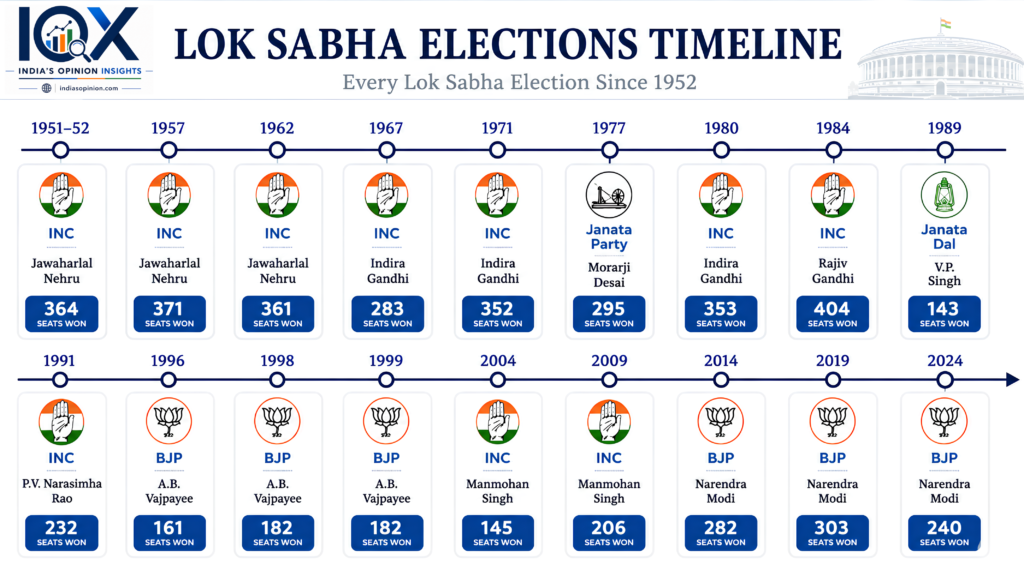
Caption: Timeline of every Lok Sabha election since 1952, highlighting the winning party, Prime Minister and seats won.
Four Political Eras of India’s Elections
Rather than viewing every election as an isolated contest, India’s parliamentary history can be divided into four distinct phases.
The Congress Era (1952–1967)
The first three general elections firmly established the Indian National Congress as India’s dominant political force. Led by Jawaharlal Nehru, Congress benefited from its role in the freedom movement and enjoyed nationwide organisational strength.
Opposition parties remained fragmented, while institutions such as the Election Commission demonstrated that free and fair elections could be successfully conducted in a newly independent nation.
The 1967 election marked the beginning of political competition. Although Congress retained power nationally, it suffered significant setbacks across several states, signalling the end of unquestioned political dominance.
IOX Insight: Congress won five consecutive Lok Sabha elections between 1952 and 1971, the longest uninterrupted period of single-party dominance in independent India.
The Indira Gandhi Years (1971–1984)
The 1971 election transformed Indian politics.
Campaigning on the slogan Garibi Hatao, Prime Minister Indira Gandhi secured an overwhelming mandate, strengthened further by India’s victory in the Bangladesh Liberation War.
The Emergency (1975–1977) dramatically altered the political landscape. In 1977, voters elected the Janata Party, ending Congress’s uninterrupted rule at the Centre for the first time.
Congress returned to power in 1980.
Following Indira Gandhi’s assassination in October 1984, Rajiv Gandhi led Congress to its biggest electoral victory, winning 404 seats, the highest tally achieved by any single party in Lok Sabha history.
IOX Insight: The 1984 election remains the only Lok Sabha election in which a single party secured more than 400 seats.
Coalition Politics (1989–2014)
Beginning with the 1989 election, India’s political landscape entered the coalition era.
Regional parties became increasingly influential, often determining who formed the government at the Centre.
Between 1989 and 1999, India held five general elections as political alliances shifted rapidly. During this period, the BJP steadily expanded its national footprint, while coalition governments led by both the NDA and UPA demonstrated that stable governance was possible without a single-party majority.
IOX Insight: Between 1989 and 2014, no single political party secured an outright majority in the Lok Sabha.
The BJP Era (2014–Present)
The 2014 election marked another turning point.
The BJP secured 282 seats, becoming the first party in three decades to win an outright parliamentary majority.
The party improved its performance further in 2019 by winning 303 seats.
Although the BJP emerged as the largest party again in 2024 with 240 seats, it relied on National Democratic Alliance partners to form the government, signalling the return of coalition politics.
Voter Turnout Through the Years
Voter participation has steadily increased over the decades, reflecting stronger democratic engagement and improvements in election administration.
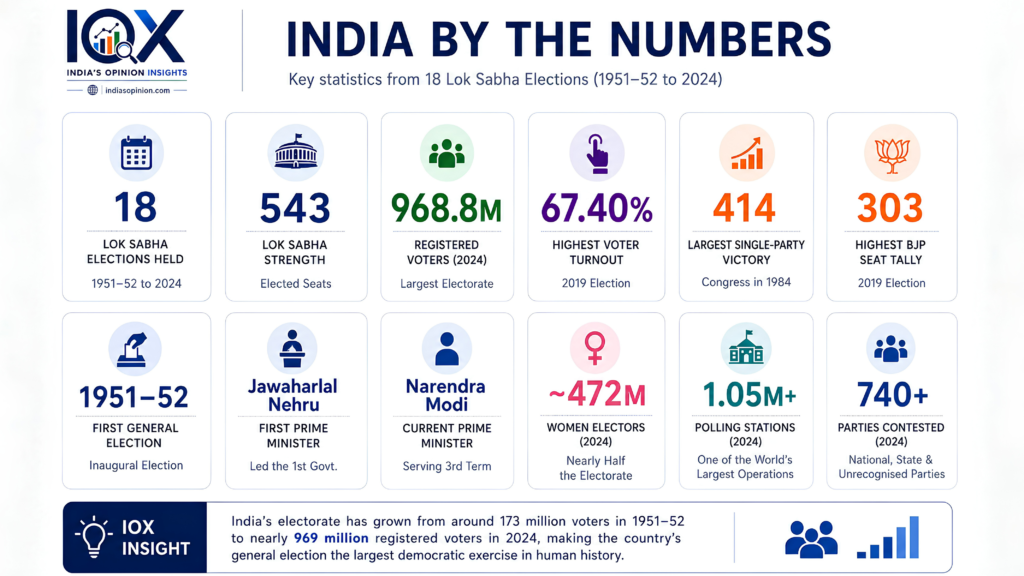
Between the inaugural election in 1951–52 and the 2024 Lok Sabha election, turnout increased from 45.67% to 66.33%, despite the electorate expanding by nearly 800 million voters.IOX Insight : The 2019 general election recorded India’s highest-ever voter turnout at 67.40%.
Interesting Facts
- India conducted its first general election over several months because of its vast geography and logistical challenges.
- The electorate has grown from approximately 173 million voters in 1951–52 to nearly 969 million in 2024.
- Electronic Voting Machines (EVMs) were introduced nationwide during the 2004 general election.
- Women now participate in elections at rates comparable to men across most states.
- Since 1989, regional parties have played a decisive role in government formation at the Centre.
Major Political Turning Points
1951–52: India successfully conducted its first democratic general election.
1967: Congress faced its first major electoral setback.
1977: The Emergency was rejected by voters, leading to India’s first non-Congress government.
1984: Congress secured the largest parliamentary majority in Indian electoral history.
1989: Coalition politics became the defining feature of national elections.
1998: The BJP-led NDA emerged as a stable national coalition.
2014: The BJP secured the first single-party majority in three decades.
2024: Coalition politics returned despite the BJP remaining the largest party.
Looking Ahead
India’s electoral landscape continues to evolve.
The next major developments—including the proposed delimitation exercise after 2026, demographic shifts, technological innovation in election management and changing political alliances—are expected to shape future Lok Sabha elections.
Understanding India’s electoral history is therefore essential not only for interpreting the past but also for anticipating the future of the world’s largest democracy.
Sources :
- Election Commission of India (ECI)
- Lok Sabha Secretariat
- Statistical Reports on General Elections

Data & Insights is India’s Opinion’s dedicated section for data journalism, election analysis, public policy, governance, economy, surveys and evidence-based reporting. Explore in-depth analysis, interactive charts, explainers and original research that turn complex data into meaningful insights.