
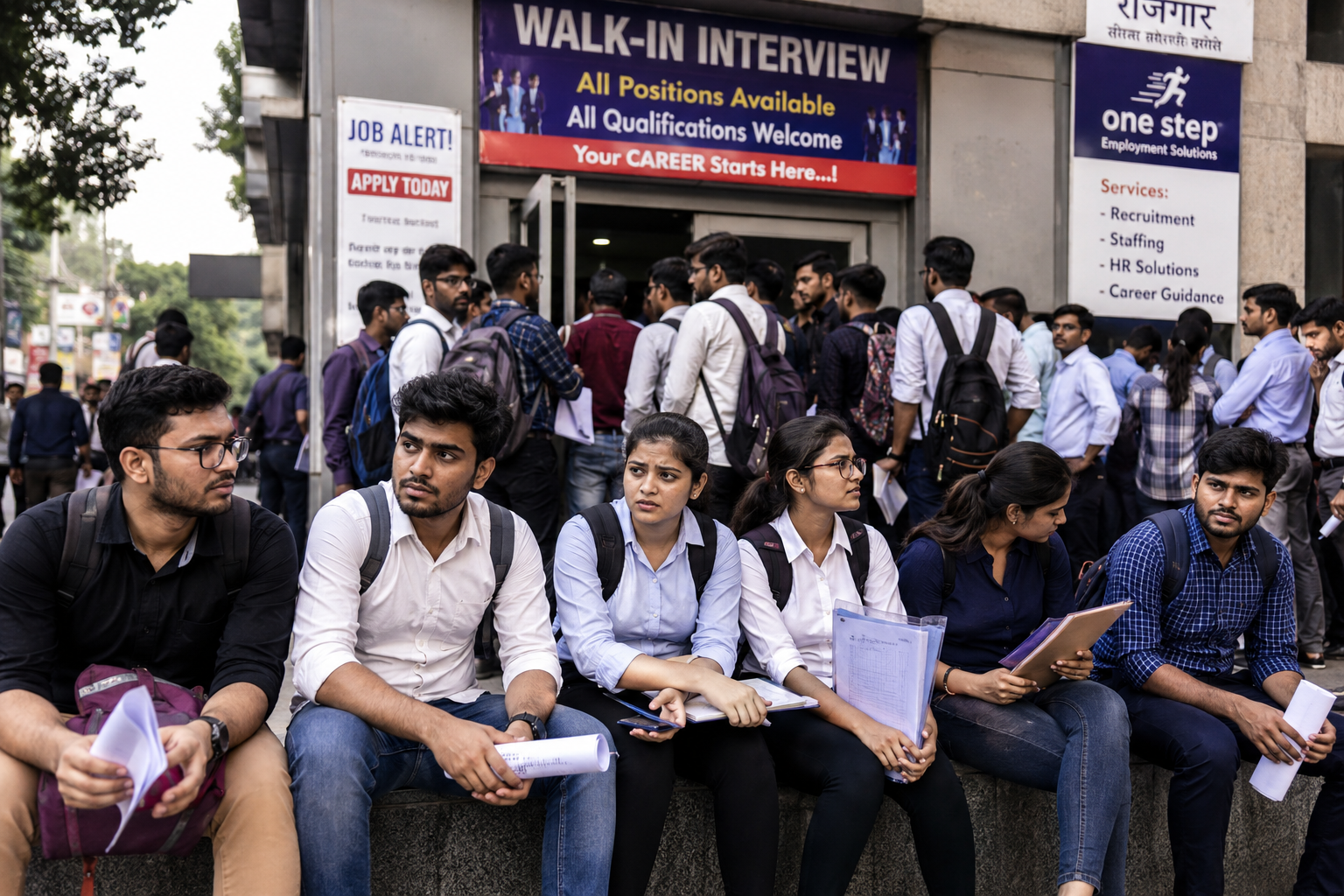
India’s economy continues to expand, yet millions of young people still struggle to find stable, well-paid work. That contradiction has made India youth unemployment one of the country’s most persistent economic and political challenges.
The latest available government labour data shows that unemployment has eased in some periods. Yet the broader problem extends beyond whether a person has a job. The quality of work, wages, job security and the match between education and employment remain major concerns.
For graduates, the frustration is particularly sharp. Years of education do not guarantee a job that matches their qualifications. Many compete for a limited number of formal positions, while others accept temporary, informal or low-paid work.
The result is a labour market where economic growth and personal opportunity do not always move together.
India youth unemployment remains high among educated young people
The International Labour Organization’s India Employment Report 2024, prepared with the Institute for Human Development, found that youth unemployment rose with educational attainment in the data examined for 2022.
The report recorded a youth unemployment rate of 13.2% among those aged 15 to 19 and 8.6% among those aged 25 to 29 in 2022. Urban youth faced higher unemployment than rural youth, with rates of 17.2% and 10.6%, respectively. ILO report
The figures reveal a difficult pattern. More education can improve long-term opportunities, but it does not automatically create a job immediately after graduation.Young people often spend years preparing for competitive examinations, professional courses and recruitment tests. When those opportunities remain limited, many face a long transition between education and employment.
Graduate unemployment in India reflects a skills and jobs mismatch
Employers often seek practical experience, technical abilities and communication skills. Many graduates, meanwhile, leave college with qualifications but limited exposure to workplace demands.This mismatch does not mean that young people lack ability. It often reflects a wider gap between what educational institutions teach and what employers need.
The ILO has also warned that young first-time jobseekers face a disadvantage because they compete against more experienced workers. It has highlighted the importance of employability skills and stronger links between education, training and the labour market. ILO report
For students from smaller towns, the challenge can be even greater. The best jobs often remain concentrated in major cities. Relocation brings additional costs, including rent, transport and living expenses.
That pressure pushes some graduates into jobs unrelated to their degrees. Others continue preparing for government recruitment examinations for years.
Why India’s economic growth has not solved the youth jobs crisis
India has recorded strong economic growth, but growth alone does not guarantee enough quality employment.
The central question is how quickly the economy can create productive jobs for the millions of young people entering the workforce. Industries that generate large numbers of formal jobs remain especially important for this transition.
The ILO’s global youth employment research has pointed to a wider problem across developing economies. Higher education can improve the quality of employment, but economies may still fail to create high-skilled jobs fast enough to absorb growing numbers of graduates.
India faces a similar tension. A young population can become an economic strength when people find productive work. Without enough suitable jobs, the same demographic advantage can create intense competition and frustration.
This explains why headline economic growth figures do not always match the experience of young jobseekers.
India youth unemployment is also a problem of job quality
The unemployment rate alone cannot explain India’s employment crisis.
A person may be counted as employed while working in a low-paid, temporary or irregular occupation. That job may provide income, but it may not offer security, benefits or a realistic path to career growth.
This distinction has triggered debate among economists about how India measures employment. Reuters reported in 2025 that several economists questioned whether official unemployment data fully captured underemployment and the difficulty of finding stable, well-paid work. The government has defended the credibility of its labour force surveys and their methodology. https://www.reuters.com/world/india/official-india-jobless-data-is-not-accurate-say-top-independent-economists-2025-07-22/
The debate matters because different measurements can produce different pictures of the labour market.A young graduate working occasionally may not be unemployed under a formal statistical definition.
Yet that person may still be searching for a stable job and struggling to earn enough.For policymakers, this gap between statistical employment and economic security remains crucial.
Urban youth face intense competition for limited formal jobs
Cities attract graduates because they offer more companies, institutions and professional opportunities. They also bring intense competition.
Government recruitment examinations, banking jobs, corporate positions and professional careers attract large numbers of applicants. A single vacancy can draw thousands of candidates.This competition creates long waiting periods for many young people. Some spend years preparing for examinations without entering the workforce.
Others move between short-term jobs while continuing to search for better opportunities.The problem becomes more difficult when wages fail to keep pace with education and living costs.Urban youth unemployment has also remained a concern in recent labour data.
Reuters reported that the unemployment rate for urban Indians aged 15 to 29 reached 19% in July 2025, while the rural youth rate stood at 13%, based on government data. https://www.reuters.com/world/india/official-india-jobless-data-is-not-accurate-say-top-independent-economists-2025-07-22/
The figures show the sharp difference between the availability of work and the number of young people seeking better opportunities.
Women face an additional employment barrier
Young women face another layer of difficulty.
India’s female labour force participation has increased in recent years, but women continue to face barriers linked to safety, unpaid care work, mobility and access to suitable jobs.
Reuters reported in 2025 that economists viewed India’s female labour participation as well below that of many other G20 economies. Experts also raised concerns that much of the increase has come through self-employment rather than formal salaried work. https://www.reuters.com/world/india/official-india-jobless-data-is-not-accurate-say-top-independent-economists-2025-07-22/
The issue affects the wider economy. When educated women cannot enter or remain in the workforce, the country loses skills and productive capacity.
Better transport, safer workplaces, childcare support and more formal employment opportunities could help reduce these barriers.
The government faces pressure to create better jobs
India’s employment challenge requires more than increasing the number of college graduates.
The country needs stronger links between education and industry. Vocational training must reflect actual employer demand. Apprenticeships can give young people workplace experience before they compete for permanent positions.
Manufacturing also remains central to the debate. A stronger industrial base could create more employment for workers with different levels of education and training.At the same time, services will continue to employ a large share of India’s workforce. The challenge is to expand sectors that offer productivity, wage growth and career progression.
The government has introduced several programmes aimed at improving skills and employment. Their long-term success will depend on whether training leads to real jobs rather than certificates alone.
What can reduce graduate unemployment in India?
Colleges need stronger industry partnerships and more practical training. Students need better access to internships and apprenticeships. Employers need clearer entry-level pathways for candidates without years of experience.
The economy also needs more businesses capable of creating formal employment at scale.A stronger focus on small and medium enterprises could help. So could investment in labour-intensive manufacturing, logistics, healthcare, tourism and other sectors capable of absorbing large numbers of workers.
The country must also improve the quality of labour market data. Accurate information can help policymakers identify whether the main problem is unemployment, underemployment, low wages or a shortage of suitable jobs.
India youth unemployment will remain a defining economic test
India’s young population gives the country a major opportunity, but that opportunity depends on employment.The challenge is no longer simply getting more young people into classrooms.
It is ensuring that education leads to useful skills, productive work and a reasonable chance of economic independence.The next phase of India’s growth will therefore be judged not only by GDP figures.
It will also be judged by whether a graduate can find a job, whether a young worker can earn a stable income and whether the economy can create enough opportunities for those entering the workforce each year.
Until that link becomes stronger, India youth unemployment will remain one of the country’s most closely watched economic issues.

Data & Insights is India’s Opinion’s dedicated section for data journalism, election analysis, public policy, governance, economy, surveys and evidence-based reporting. Explore in-depth analysis, interactive charts, explainers and original research that turn complex data into meaningful insights.