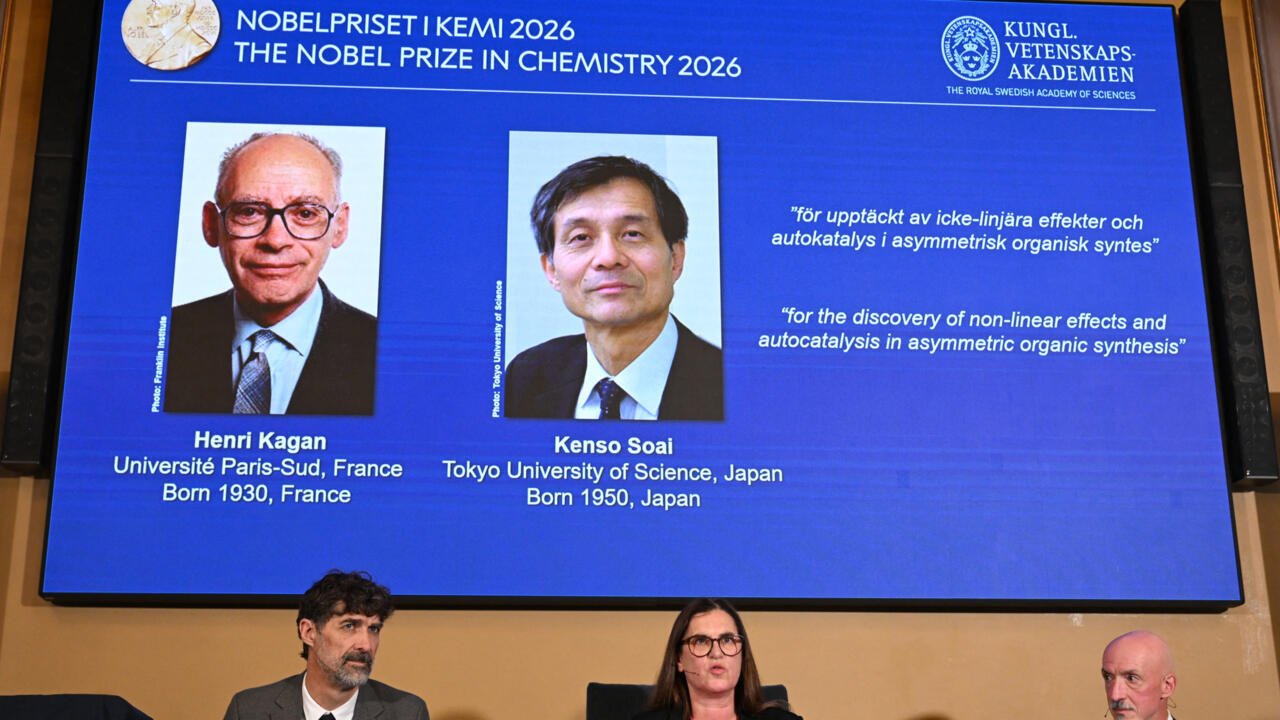
The 2026 Nobel Prize in Chemistry has been awarded to Henri B. Kagan and Kenso Soai for groundbreaking discoveries in molecular symmetry. The Royal Swedish Academy of Sciences recognized the pair on Wednesday for revealing how chemical processes favor a single mirror-image shape.
As detailed by NobelPrize.org, the laureates illuminated the mechanisms of non-linear effects and asymmetric autocatalysis. Their work bridges fundamental chemistry with the mystery of life’s origins. It also underpins modern techniques for designing safer prescription drugs.
The Great Mystery of Molecular Handedness
Many organic molecules are chiral. This means they exist in two forms that resemble left and right hands. In ordinary chemical synthesis, nature generates equal amounts of both twins. Yet biology tells a completely different story.
Reports from The Hindu highlight that Earth’s living systems are strictly homochiral. DNA, RNA, and protein chains rely exclusively on single-handed building blocks. For decades, scientists questioned how prebiotic Earth selected one form over the other. The research of Kagan and Soai proved that tiny initial fluctuations could trigger near-total dominance.
Kagan’s Defiance of Linear Chemical Rules
Henri B. Kagan conducted his seminal research at Université Paris-Saclay. In the 1980s, prevailing scientific dogma asserted that asymmetric catalysts behaved predictably in a linear ratio. Most researchers assumed that imperfect catalysts could only yield imperfect mixtures.
Coverage from The Indian Express shows how Kagan upended this belief. He discovered non-linear effects in catalytic reactions. Kagan demonstrated that subtle associations between chiral catalysts could amplify product purity dramatically. His models proved that low-purity starters could still deliver pure chemical outputs.
The Self-Multiplying Power of the Soai Reaction
Kenso Soai pushed this frontier further at the Tokyo University of Science. In 1995, he documented the first practical example of asymmetric autocatalysis in organic synthesis. In the reaction, the newly formed molecule acts as a catalyst for its own replication.
As noted by NDTV, this process creates a self-amplifying feedback loop. An imperceptible excess of one enantiomer rapidly snowballs into a single, pure product. Soai proved that even minor environmental triggers, such as circularly polarized light, could initiate this cascade. His experiments offered a plausible explanation for how life on Earth chose its molecular handedness.
Transforming Medicine and Industrial Chemistry
The practical ramifications of their discoveries are immense. In modern pharmaceuticals, two mirror-image molecules can produce radically opposite biological reactions. While one variant heals, its partner can cause dangerous toxicity.
Thanks to the methods developed by Kagan and Soai, pharmaceutical manufacturers can selectively produce the therapeutic molecule. This capability eliminates expensive separation stages and significantly enhances drug safety. Both laureates will share the 11 million Swedish kronor prize at the formal Nobel ceremony this December.

Curated news reports, in-depth analysis, and special features by India’s Opinion editorial team.