
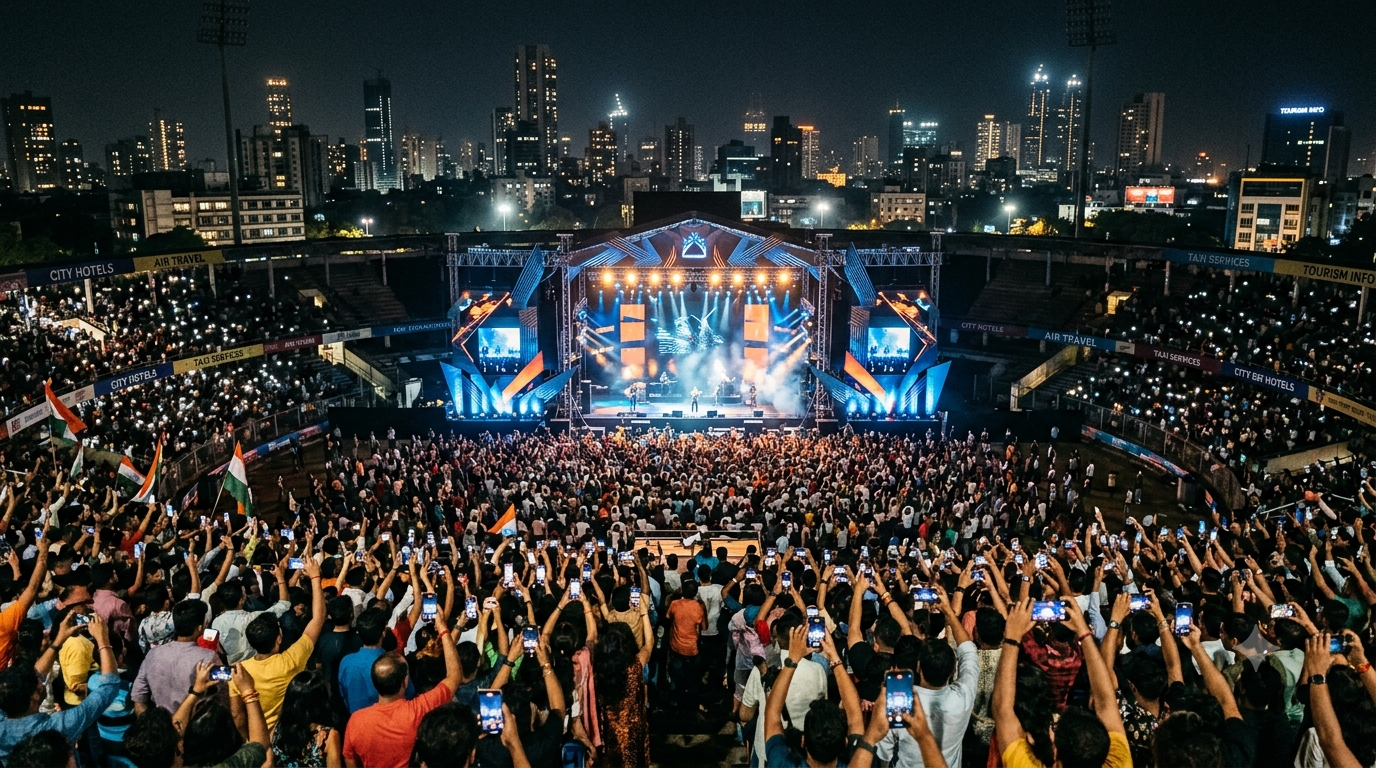
India’s entertainment industry is undergoing a major shift. For decades, films and television dominated the business. Streaming later transformed how audiences consumed entertainment.
Now, another category is gaining economic importance: live experiences.Concerts are no longer simply a night out for music fans.
They are becoming a major business involving ticketing, travel, hotels, restaurants, advertising, event management, security, technology and tourism.
The numbers show how quickly the sector is changing. India’s organised live-events sector was valued at around ₹14,500 crore in 2025, according to the Ministry of Information and Broadcasting.
The government expects the sector to reach about ₹19,600 crore by 2028.The broader media and entertainment industry also recorded strong growth in 2025.
FICCI and EY said India’s M&E sector grew 9% to ₹2.78 lakh crore, while organised live events grew 44%.So, what is driving India’s concert boom?
From concerts to economic ecosystems
A major concert creates spending far beyond the venue.A fan may purchase a ticket, travel to another city, book a hotel, use taxis or trains, eat at restaurants and buy merchandise.
That means the economic impact of a concert is spread across several industries.
The experience can be particularly valuable for cities trying to attract visitors.A major artist can effectively turn a concert into a temporary tourism event.
EY’s analysis of Diljit Dosanjh’s 2024 Dil-Luminati India Tour illustrates this effect.
The tour attracted more than 320,000 attendees across 13 cities and generated an estimated ₹943 crore in socio-economic impact.
EY said ₹553 crore of the impact came indirectly through travel, hospitality and tourism.
That is why governments and businesses are increasingly viewing concerts as an economic opportunity rather than simply entertainment.
From concerts to economic ecosystems
A major concert creates spending far beyond the venue.
A fan may purchase a ticket, travel to another city, book a hotel, use taxis or trains, eat at restaurants and buy merchandise.
That means the economic impact of a concert is spread across several industries.The experience can be particularly valuable for cities trying to attract visitors.
A major artist can effectively turn a concert into a temporary tourism event.EY’s analysis of Diljit Dosanjh’s 2024 Dil-Luminati India Tour illustrates this effect.
The tour attracted more than 320,000 attendees across 13 cities and generated an estimated ₹943 crore in socio-economic impact.
EY said ₹553 crore of the impact came indirectly through travel, hospitality and tourism.
That is why governments and businesses are increasingly viewing concerts as an economic opportunity rather than simply entertainment.
Why are people willing to spend so much?
One important factor is the changing way younger consumers spend money.
People have endless access to recorded music through streaming platforms.
They can watch films at home and consume entertainment on their phones.
A live concert offers something those services cannot reproduce: physical participation.
The audience is part of the event.There is the crowd, the atmosphere, the performance, the lighting and the feeling of being present at a major cultural moment.
A 2026 EY-Parthenon and BookMyShow report found that 78% of Indian consumers surveyed preferred spending on experiences rather than products.
That shift helps explain why people may be willing to spend hundreds or thousands of rupees on a few hours of live entertainment.
The rise of the travelling fan
Perhaps the most important change is that fans are increasingly willing to travel for concerts.
Diljit’s tour demonstrated that concert demand is not limited to India’s biggest metros.
Nearly half of the tour’s attendees came from Tier-II and Tier-III cities, according to EY.
This has significant implications.If an artist performs only in Mumbai, Delhi or Bengaluru, fans elsewhere may need to travel.
- Flights and trains
- Hotels
- Restaurants
- Local transport
- Shopping
- Tourism
- Event services
A concert can therefore generate economic activity across an entire city rather than only inside a stadium.
Why brands want to be at concerts
Concerts are also becoming increasingly attractive to advertisers.
Traditional advertising gives consumers a message.Live events allow brands to put themselves directly inside an experience.
A company can create a branded zone, interactive installation, photo opportunity or product experience.
According to the 2026 EY-Parthenon and BookMyShow report, 59% of surveyed live-event attendees recalled brands they interacted with at events, while 55% reported higher purchase intent after interacting with brands on-ground.
That helps explain why brands are spending more money around live entertainment.The audience is already emotionally engaged.For advertisers, that can be extremely valuable.
Ticket prices are only part of the story
The price of a concert ticket often attracts the most attention.But ticket sales represent only one component of the wider economy.
A large event can generate revenue through sponsorships, food and beverages, merchandise, hospitality packages, advertising and other commercial partnerships.
EY estimated that ticket sales accounted for about 80% of Diljit’s direct revenues during the Dil-Luminati India Tour, which sold more than 320,000 tickets.
The remaining economic impact came through a much broader ecosystem.
This distinction is important because a ₹3,000 ticket does not mean ₹3,000 is the full economic value created by that fan.
The fan may spend several times that amount on the entire trip.
Why international artists matter
India is also becoming increasingly attractive to global artists.Large international concerts demonstrate that Indian cities can host huge audiences and generate substantial economic activity.
Coldplay’s Ahmedabad concerts became a major example.EY estimated that the concerts attracted more than 222,000 fans and generated around ₹641 crore in economic impact for the city.
Such events can also improve a city’s reputation as an international entertainment destination.
That creates a potential long-term benefit.
Once promoters know that a city has suitable venues, hotels, transport and audiences, it becomes easier to bring other large-scale events there.
What happens next?
The concert economy is likely to become more sophisticated.More Indian cities could compete to host major tours.
Regional artists may increasingly perform large-format shows.Brands could invest more heavily in experiential marketing.
Technology may make ticketing, crowd management and personalised fan experiences more advanced.
And governments could increasingly treat major concerts as part of tourism and urban economic strategy.
The biggest opportunity may not be concentrated in Mumbai or Delhi.
India’s large population, expanding middle class and growing interest in experiences create an opportunity for cities across the country.
The bigger picture
India’s concert boom represents something larger than the popularity of a few superstar performers.
It reflects a broader change in consumer behaviour.People are increasingly willing to spend money on experiences they can participate in, rather than only products they can own.
A concert ticket buys more than music.It can mean a train journey, a hotel stay, a meal with friends, merchandise, social-media memories and the experience of being part of a crowd.
That is why concerts are becoming an economic story.India’s next entertainment boom may not happen on a cinema screen. It may happen inside a stadium.
Umar Khan is a writer driven by curiosity and a passion for understanding the world. Through thoughtful analysis and evocative storytelling, he seeks to make complex ideas accessible, inspire meaningful conversations, and encourage fresh perspectives on the people, places, and issues that shape our shared future.