A special National Investigation Agency (NIA) court in Chhattisgarh has awarded the death penalty to ten Maoist operatives. The landmark capital verdict addresses the infamous 2013 Jhiram Ghati ambush that wiped out the state’s senior Congress leadership. Special Judge pronounced the historic quantum of sentence on Wednesday in Jagdalpur amidst unprecedented security deployments. The court deemed the premeditated massacre a rarest of rare terrorist assault against Indian democratic governance, according to The Indian Express.
The decisive sentencing concludes thirteen years of complex investigative and judicial proceedings across the tribal Bastar region. The special anti-terror bench convicted all ten accused under charges of waging war, criminal conspiracy, and mass murder. The lethal highway ambush claimed twenty-nine lives, including prominent national and regional political stalwarts. Consequently, the judgment provides long-delayed judicial closure to grieving families and political workers across central India.
The Horrific 2013 Ambush in Darbha Valley
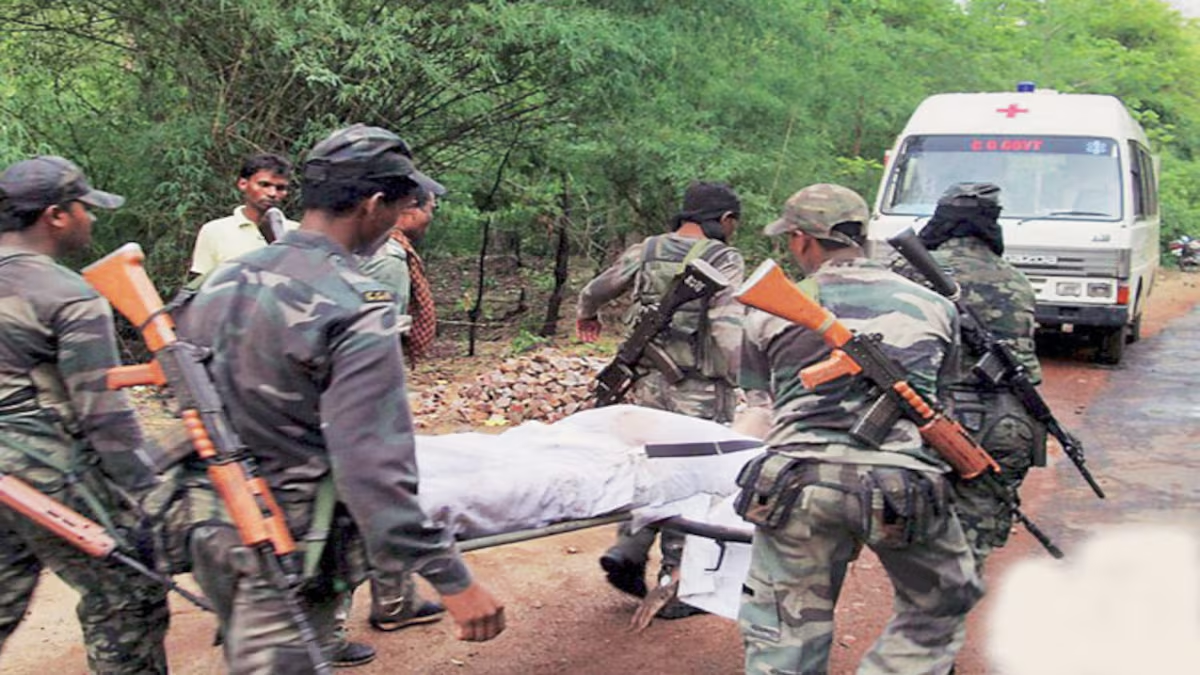
The bloody catastrophe unfolded on May 25, 2013, deep inside the forested ravines of Sukma district. A massive convoy of political leaders was returning from a statewide electoral campaign called the ‘Parivartan Yatra’. More than two hundred heavily armed Maoist insurgents triggered powerful landmines before raining bullets upon trapped vehicles. Furthermore, the guerrillas surrounded the convoy from surrounding elevated ridges, blocking all civilian escape routes, as detailed by The Quint.
The intense gunfire lasted for nearly two hours against outgunned state security escorts. The attackers combed through bullet-riddled vehicles to identify specific political dignitaries by name. Survivors testified that insurgents dragged targeted leaders onto the asphalt before executing them at point-blank range. Therefore, the assault represented one of the deadliest and most targeted insurgent strikes in modern Indian history.
Decimating an Entire Political Generation
The ruthless ambush virtually eliminated the frontline political leadership of the Chhattisgarh Pradesh Congress Committee. Foremost among the martyrs was Mahendra Karma, a fierce anti-Maoist tribal leader and founder of the Salwa Judum. The insurgents repeatedly shot and bludgeoned Karma after identifying him on the highway. In addition, attackers executed state party president Nand Kumar Patel and his young son Dinesh Patel.
Veteran freedom fighter and former Union Cabinet minister Vidya Charan Shukla suffered multiple critical bullet wounds during the firefight. Emergency medical teams airlifted Shukla to New Delhi, where he succumbed to fatal internal injuries days later. Former legislator Uday Mudaliyar and several dedicated party functionaries also lost their lives defending colleagues. Consequently, the strike caused catastrophic institutional trauma that permanently altered Chhattisgarh’s political trajectory, as noted by Jansatta.
A Protracted 13-Year Investigation and Trial
The central government transferred the high-profile massacre case to the National Investigation Agency shortly after the attack. Federal investigators gathered ballistic evidence, forensic explosives data, and testimonies from hundreds of surviving eyewitnesses. Furthermore, agency detectives tracked down fugitive cadres through coordinated operations spanning Chhattisgarh, Telangana, and Odisha. Investigators successfully reconstructed the entire criminal conspiracy hatched by senior Central Committee commanders of the outlawed CPI (Maoist).
The legal proceedings encountered multiple procedural challenges, witness intimidations, and jurisdictional appeals over the ensuing decade. Prosecutors examined crucial forensic evidence and wireless communication intercepts to establish the accused operatives’ direct battlefield participation. Meanwhile, defense lawyers argued that authorities had implicated local tribal villagers on circumstantial grounds. However, the special court affirmed that documentary and eyewitness evidence conclusively proved the convicts’ direct culpability.
Rarest of Rare: Court Imposes Capital Punishment
The special NIA court concluded that the offenders executed a cold-blooded and barbaric conspiracy against sovereign democratic institutions. The bench noted that the calculated slaughter of political leaders and security personnel shocked the collective national conscience. Furthermore, the court emphasized that such ideological terrorism leaves zero scope for judicial leniency or reformative rehabilitation. Therefore, the special judge sentenced all ten convicts to be hanged by the neck until dead.
The court also slapped substantial monetary fines under various sections of the Unlawful Activities (Prevention) Act. Prison officials immediately shifted the condemned convicts under high-security solitary confinement inside Jagdalpur Central Jail. Furthermore, the court forwarded case records to the Chhattisgarh High Court for statutory confirmation of the

Curated news reports, in-depth analysis, and special features by India’s Opinion editorial team.