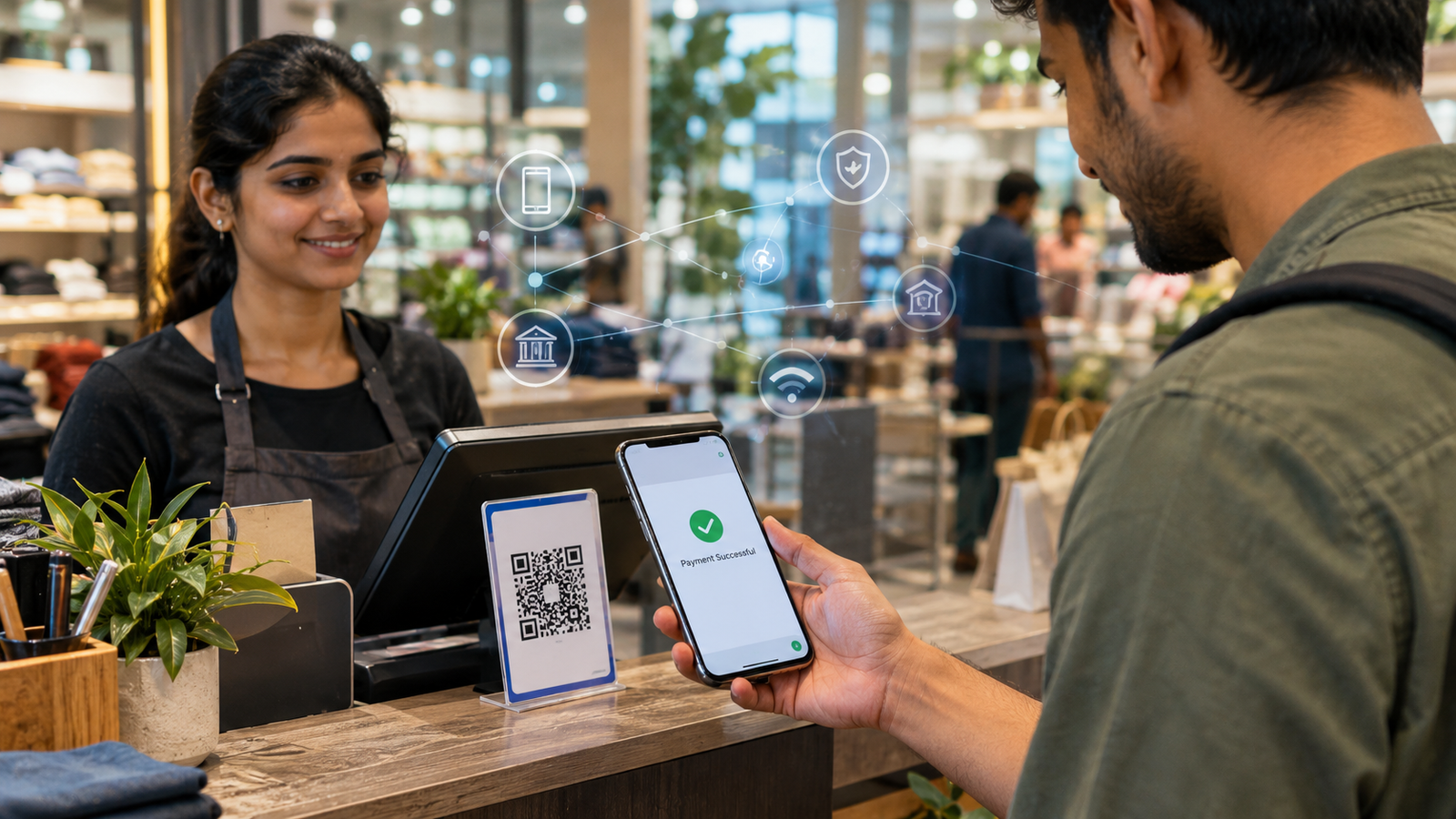
India’s Unified Payments Interface is entering a new phase. From October 15, 2026, selected UPI payments made to merchants above ₹2,000 will attract a Merchant Discount Rate, or MDR. The charge will generally be 0.4% of the transaction value, while several categories will have separate rates or exemptions.
The change does not mean consumers will suddenly have to pay a UPI fee every time they scan a QR code. Instead, the new MDR is a charge within the merchant payment ecosystem. The government has also directed banks to ensure that merchants do not pass the charge directly to customers. Additionally, UPI apps are prohibited from imposing platform fees or hidden charges. The policy matters because UPI has become one of India’s most widely used payment systems. In August 2026 alone, UPI processed about 24 billion transactions worth $311 billion.
What are the new UPI charges?
The basic rule is relatively straightforward. For regular person-to-merchant, or P2M, transactions above ₹2,000, the MDR will be 0.4% from October 15.
For example, a ₹3,000 merchant payment would generate an MDR of ₹12. A ₹50,000 payment would generate ₹200. For transactions of ₹75,000 or more, the charge will be capped at ₹300.
The important distinction is that MDR is not the same as a consumer convenience fee.
The charge is applied within the payment ecosystem, rather than being presented as a separate fee to the person making the purchase.
Person-to-person UPI transfers will remain free, regardless of the amount transferred.
Payments to merchants of ₹2,000 or less will also remain outside the standard MDR framework.
Will customers have to pay for UPI?
For ordinary consumers, the immediate answer is no.
The government has advised banks to ensure merchants do not pass the MDR cost to customers.
UPI application providers have also been prohibited from imposing platform fees or hidden charges on users.
However, the practical impact will depend partly on how businesses respond.
The government can prohibit a direct transfer of the MDR to customers. However, businesses make their own decisions about pricing and operating costs.
The Indian Express reported that NPCI expects merchants to absorb the relatively small processing cost as part of normal business expenses.
This distinction is important because headlines about “UPI charges” can otherwise create the impression that consumers will be charged whenever they use UPI.
What about payments to friends and family?
There is no change to normal person-to-person payments.
If someone sends ₹5,000 to a friend or transfers ₹20,000 to a family member, the transaction will remain free under the new framework.
The MDR applies primarily to qualifying merchant transactions, where UPI is being used to pay for goods or services.
Are all merchant payments above ₹2,000 charged?
No.
The framework contains several special categories.
Payments involving services such as railways, telecommunications, insurance, fuel and certain utility payments will have a flat MDR of ₹5 rather than the standard 0.4% rate.
Educational transactions and some agricultural-input payments are also covered by special treatment.
Capital-market payments, including transactions involving mutual funds, securities, stockbrokers and dealers, will attract an MDR of 0.02%, capped at ₹300 per transaction.
Recurring payments through UPI mandates or AutoPay, including some OTT subscriptions and recurring investments, are also excluded from MDR under the framework described by NPCI.
What happens to small merchants?
The framework provides a separate exemption for small merchants.
Merchants receiving up to ₹1 lakh a month through UPI QR-code payments into their personal bank accounts will be treated under the Person-to-Person-Merchant, or P2PM, category. These merchants will not face MDR.
According to the framework, if a merchant’s UPI inflows exceed ₹1 lakh a month for three consecutive months, the merchant can be moved into the regular P2M category.
This distinction is particularly relevant for street vendors and micro-businesses that use QR codes for small-value payments.
The government has also said that UPI QR payments to merchants in rural and semi-urban locations will not attract fees under the specified framework.
What does this mean for India’s digital-payment system?
The introduction of MDR marks a significant change in the economics of UPI.
UPI has been built around scale, convenience and low transaction costs.
The new framework preserves those characteristics for person-to-person transfers and smaller merchant payments while introducing charges for selected higher-value transactions.
For payment companies and banks, MDR creates a new source of revenue. For merchants, it introduces a new operating cost for qualifying transactions.
Consumers, the government’s stated policy is that the cost should not appear as a separate UPI fee.
The bigger question will be how the system performs after October 15.
Transaction volumes, merchant behaviour, payment-company revenues and competition with cards and other payment methods will provide evidence about whether the new structure changes how businesses accept digital payments.
For now, the key point is simple: UPI is not becoming a paid service for everyone.
From October 15, selected merchant transactions above ₹2,000 will enter a new MDR framework. Meanwhile, person-to-person payments and many everyday low-value transactions remain free.

Umar Khan is a writer driven by curiosity and a passion for understanding the world. Through thoughtful analysis and evocative storytelling, he seeks to make complex ideas accessible, inspire meaningful conversations, and encourage fresh perspectives on the people, places, and issues that shape our shared future.