Every time an Indian customer scans a QR code and enters a UPI PIN, money can move between bank accounts within seconds. Yet the process behind that familiar payment is more complicated than the simple screen suggests.
UPI has become a central part of India’s digital payment system. The system allows users to make bank-to-bank payments through participating applications without entering full bank account details for every transaction.The National Payments Corporation of India, or NPCI, operates the UPI infrastructure.
The Reserve Bank of India oversees India’s payment system framework. Together with banks and payment service providers, they form the network behind the payment button millions of people use every day.
How UPI works from your phone to the bank
The easiest way to understand how UPI works is to follow a normal QR-code payment.
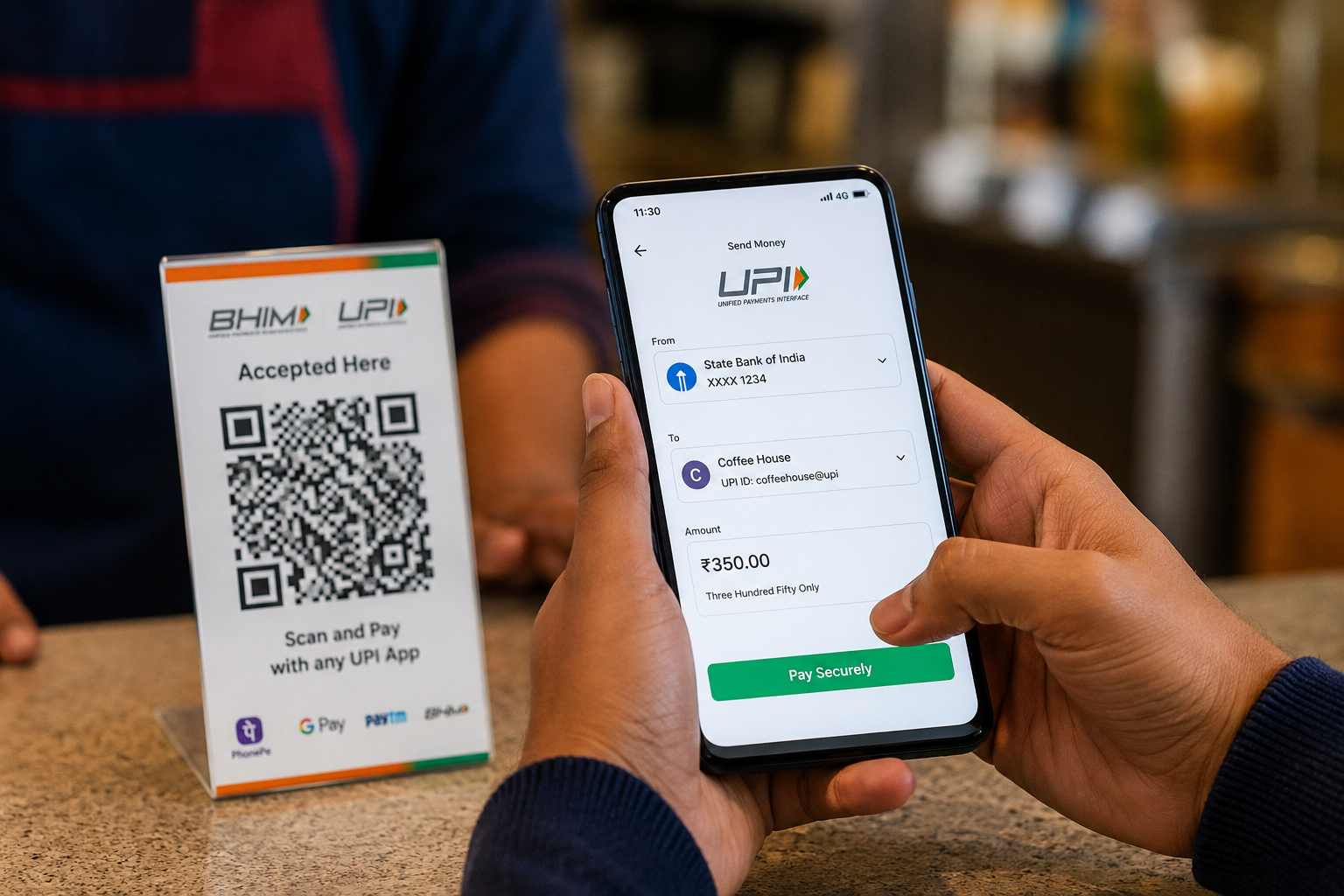
Imagine a customer buying a ₹500 meal at a restaurant.The customer opens a UPI-enabled app and scans the restaurant’s QR code.
The app identifies the payment details linked to that QR code.The customer checks the recipient information and enters ₹500.The payment then requires authentication.
In the traditional UPI flow, the customer enters a UPI PIN to authorise the transaction.The request travels through the UPI ecosystem and reaches the relevant banks.
The payer’s bank verifies the transaction and, if authorised, debits the customer’s account.The receiving bank then credits the merchant’s account.
The customer and merchant receive confirmation when the transaction succeeds.
NPCI describes UPI as an instant bank-to-bank payment system that can use identifiers such as a UPI ID, mobile number or QR code.
Who actually handles a UPI payment?
A common misconception is that the UPI app itself holds the user’s money.
It generally does not.UPI connects bank accounts rather than functioning like a conventional prepaid wallet.
RBI describes UPI as an infrastructure that can bring multiple bank accounts into a single mobile application while supporting payment routing between participating banks.
Several participants can be involved in a transaction.The customer’s bank maintains the account and authorises the debit.
The recipient’s bank receives the funds.The UPI application provides the interface through which the customer initiates the transaction.
NPCI operates the underlying UPI network and rules that allow participating institutions to communicate.
This separation is one reason a customer can use a UPI application while keeping money in a bank account.
Why UPI does not require your account number every time
One of UPI’s biggest advantages is its use of simpler payment identifiers.
Users can pay through a UPI ID or scan a QR code instead of manually entering a bank account number and IFSC code for every small transaction.
The QR code contains payment information that allows the application to identify the intended recipient.
This reduces typing and can lower the risk of entering incorrect account details.
RBI has also highlighted the ability of UPI users to verify beneficiary information before completing transactions.
That convenience helped UPI become suitable for everyday payments, from small shops to online purchases.
How UPI became India’s payment backbone
UPI was launched by NPCI in April 2016.The initial system was developed as a unified interface for online payments.
NPCI’s launch material said the system was designed to support immediate push and pull transactions while simplifying digital payments.
The system has expanded dramatically since then.Its growth was helped by widespread smartphone use, bank-account penetration, cheap mobile data and the expansion of QR-code payments.The underlying design also made interoperability possible.
A customer using one participating UPI application can generally pay a merchant using another participating UPI application, provided the relevant banks and services support the transaction.
That interoperability helped prevent the market from becoming completely divided into isolated payment networks.
Is UPI the same as a digital wallet?
No.This distinction matters when explaining how UPI works.
A traditional digital wallet stores a balance within the wallet system, subject to its rules and limits.
UPI normally accesses money held directly in a linked bank account.
When a user pays through UPI, the payment instruction results in money being debited from the bank account and transferred through the payment system.
RBI has specifically described this distinction between UPI and wallets in its explanation of India’s payment architecture.
That structure also means users do not normally need to load money into a UPI wallet before making a payment.
What protects a UPI payment?
Authentication is a key security layer.
The UPI PIN is confidential and should never be shared with another person.
Users should also understand an important rule: receiving money does not require entering a UPI PIN.
A PIN is normally required when the user authorises a payment from their account.
Fraudsters sometimes exploit confusion around this process by sending fake payment requests or persuading victims to approve transactions.
Users should therefore check the recipient and amount before authorising a payment.
NPCI also supports transaction reporting and complaint mechanisms through participating UPI applications.
UPI is also changing beyond PIN payments
The system is no longer limited to its original payment model.
NPCI has introduced additional authentication options, including on-device biometric authentication for eligible UPI transactions.
Its 2025 framework initially provided for biometric authentication as an alternative to the UPI PIN for transactions up to ₹5,000, subject to implementation by participating banks and applications.
NPCI has also expanded UPI-related features for international merchant payments.
Its UPI Global Acceptance service allows eligible users to make QR-based payments at participating international merchants directly from Indian bank accounts through supported UPI applications.
These developments show that UPI is becoming more than a simple domestic QR payment system.
What UPI means for India’s economy
The importance of how UPI works goes beyond convenience.Digital payments can reduce reliance on cash and make electronic transactions easier for consumers and businesses.
RBI has described India’s payment infrastructure as a major part of the country’s digitalisation and financial inclusion efforts.
For small businesses, QR payments can reduce the need to handle large amounts of physical cash.
For consumers, instant bank transfers can simplify everyday purchases and bill payments.
The system also gives policymakers and financial institutions a platform for developing new payment products.But rapid digital adoption brings new challenges.
Fraud prevention, system reliability, privacy and consumer awareness will remain important as payment volumes increase.
What happens when a UPI payment fails?
A failed transaction does not always mean that money has been permanently lost.
The transaction may show as pending, failed or successful depending on what happens across the participating systems.
If money is debited but the recipient does not receive it, the transaction may require reconciliation between the banks and payment infrastructure.
Users should avoid immediately repeating a transaction without checking its status.They should also use the complaint or dispute facility provided by their UPI application or bank when necessary.
Why understanding UPI matters
Understanding how UPI works makes everyday digital payments easier to use safely.
The process begins with an instruction from the customer but involves banks, payment applications and NPCI infrastructure behind the scenes.
The customer’s money remains connected to the bank account rather than sitting inside the UPI interface as a conventional wallet balance.
That architecture helped UPI become one of India’s most visible digital public infrastructure projects.Its next phase will involve international payments, new authentication methods and continued efforts to improve security.
The basic experience may remain simple: scan, check, authenticate and pay.
Behind those few taps sits a payment network designed to connect India’s banks and make instant digital transactions work at scale.

Umar Khan is a writer driven by curiosity and a passion for understanding the world. Through thoughtful analysis and evocative storytelling, he seeks to make complex ideas accessible, inspire meaningful conversations, and encourage fresh perspectives on the people, places, and issues that shape our shared future.