In a stunning breakthrough, two workers were pulled alive from a subterranean hydropower tunnel in Nepal. The men had been trapped for nine long days under 170 metres of mud and rock.
The successful operation was conducted at the Upper Trishuli 3A Hydropower Project along the swollen Trishuli River. The incident was triggered by catastrophic monsoon deluges and flash floods on August 26.
The two survivors were identified as mechanical foreman Sanjay Sah, aged 30, and mechanical supervisor Kabir Maharjan. Both men were safely evacuated on Friday.
Furthermore, the recovery has rekindled hope for dozens of laborers who remain trapped across Himalayan power projects.
The Moment the Deluge Struck
Torrential floods were unleashed across the mountainous Trishuli River basin late last month. Massive landslides were triggered along the slopes. Consequently, thousands of tons of mud and gigantic boulders were swept into the hydropower complex.
Warnings were sounded across the plant when the initial water surge appeared. Sanjay Sah stayed behind to ensure other crew members were alerted. Most workers were successfully evacuated.
However, before Sah could escape, the primary entrance was completely sealed by cascading debris. Maharjan was trapped alongside him in the deep gallery. Subsequently, both men were enveloped in total darkness 170 metres beneath the mountain surface.
How the High-Stakes Rescue Was Executed
For nearly six days, the tunnel entrance could not even be located beneath the debris. The portal was buried under mounds of sludge and broken boulders.
Consequently, high-resolution satellite imagery and structural engineering blueprints were analyzed by emergency planners. Heavy machinery, industrial water pumps, and controlled micro-blasts were utilized to carve an access path.
The joint mission was spearheaded by the Nepal Army and the Armed Police Force (APF). In addition, specialized tunnel engineering teams were dispatched from India and China to assist local personnel.
Eventually, faint tapping sounds and muffled voices were detected through drainage pipelines. A seven-member elite search team was immediately mobilized.
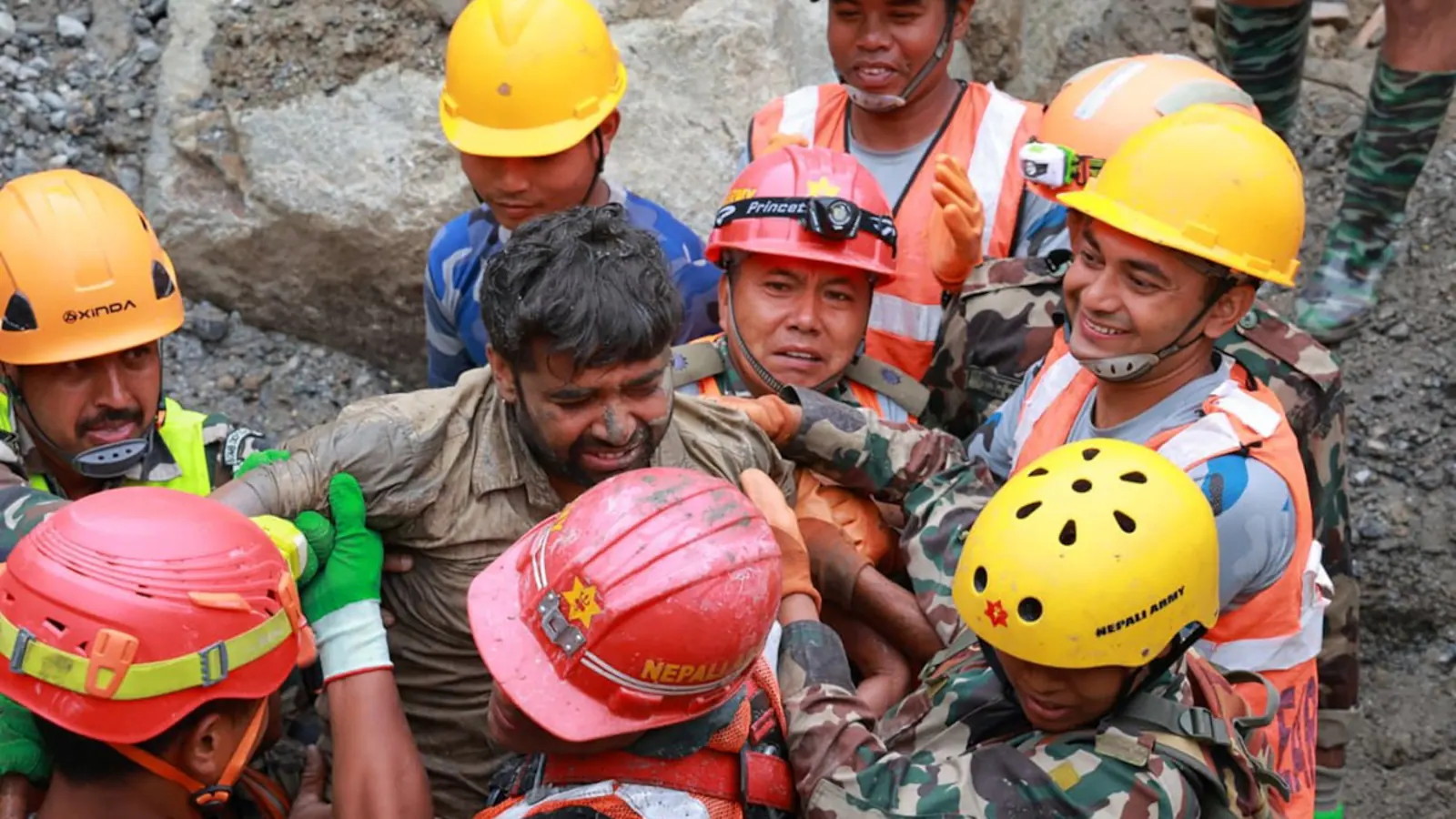
Rescuers were forced to crawl on their stomachs through narrow, sludge-filled passages measuring barely 10 to 15 metres. Once the inner section was breached, the two men were found huddled on an elevated platform.
Immediately, oxygen masks were fitted onto their faces. They were carried out on stretchers and transported to a nearby field hospital for stabilization, according to reports in The Kathmandu Post.
Enduring Nine Days in Subterranean Darkness
Survival under such conditions was considered virtually impossible by medical specialists. Yet, life was sustained inside a stable underground air pocket.
Ventilation was partially maintained through intact conduit shafts. Meanwhile, trickling groundwater was collected in helmets to stave off severe dehydration.
Continuous prayers were offered by the men during their confinement. Sah later revealed that chants were recited constantly to maintain mental resilience. Hypothermia and exhaustion were endured in pitch-black conditions until help arrived.
Renewed Hope for Missing Himalayan Laborers
The breakthrough has sparked immense optimism across the disaster zone. Over 500 workers are still feared trapped in subterranean chambers across 12 damaged hydropower facilities in the region.
Specifically, extensive rescue operations are currently directed toward the Rasuwagadhi hydropower station. Over 40 workers are believed to be isolated inside an underground powerhouse chamber at that location.
Because oxygen pockets preserved life in Trishuli 3A, similar survival conditions are now anticipated elsewhere. Therefore, round-the-clock excavation is being pushed forward by international and military teams.
The extraction of Sah and Maharjan has been hailed as a landmark triumph of persistence, coordination, and human endurance.

Curated news reports, in-depth analysis, and special features by India’s Opinion editorial team.