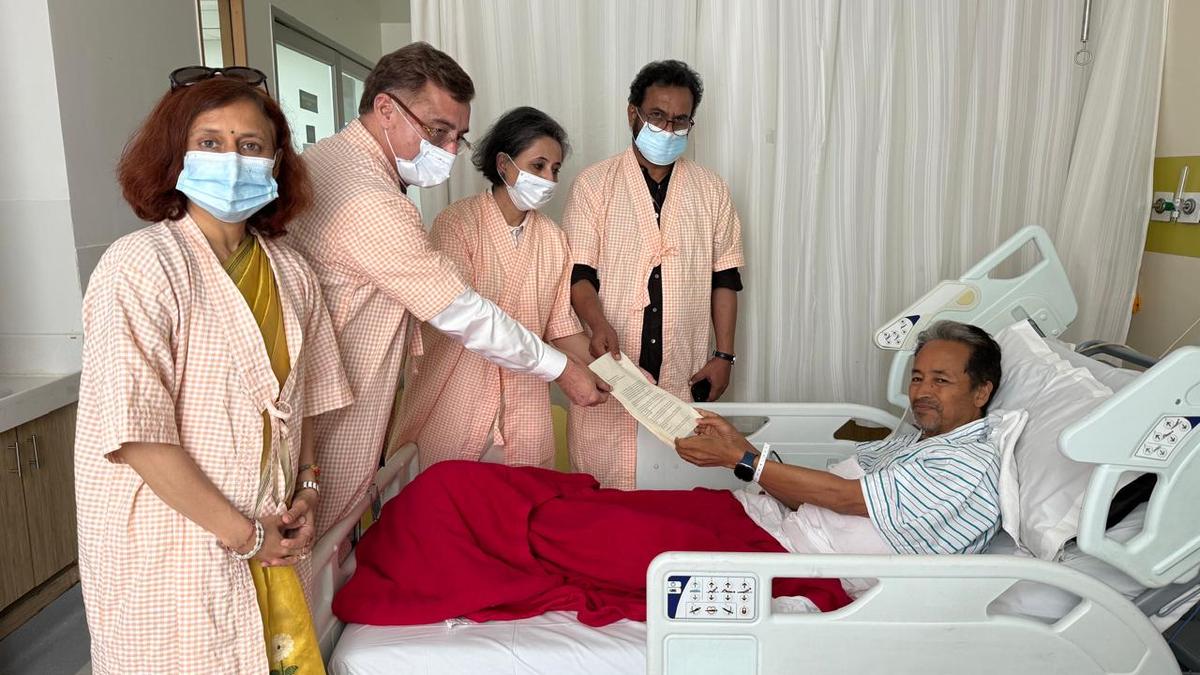
Sonam Wangchuk’s 26-day hunger strike came to an end late Thursday night. The activist broke his fast at Medanta Hospital in Gurugram, in the presence of Union Ministers JP Nadda and Jitendra Singh, along with senior leaders of the Apex Body of Leh-Ladakh.
“Just now in the presence of Union Ministers Sh. JP Nadda, Dr. Jitendra Singh and the senior leaders of Apex Body of Leh Ladakh I finally broke my fast after 26 days,” Wangchuk posted on X. He added that 65 members of parliament from different political parties had visited him or signed letters urging him to end the strike.
What the government promised
Wangchuk said the decision followed “a long negotiation on various conditions and in view of possible violence in the country.” He said he would detail the conditions in a separate video, but the broad terms have since emerged.
The Centre gave a written assurance that cases against students would be withdrawn if they had not turned violent, and that peaceful protesters at Jantar Mantar or those who joined the July 20 parliamentary march would face no legal action.
The government also committed to positively considering compensation for the families of NEET aspirants who died by suicide following the paper leak, and to holding a detailed parliamentary discussion on the leak and broader education reforms.
CJP relieved, but not backing down
Cockroach Janta Party founder Abhijeet Dipke welcomed the development but made clear the movement was far from over. “We are relieved and grateful that Sonam sir has ended his hunger strike after 26 days,” Dipke wrote on X, thanking him for his “extraordinary courage and sacrifice.”
Dipke said CJP’s protest at Jantar Mantar would continue until Education Minister Dharmendra Pradhan resigns.
Thousands of CJP supporters continue to rally at the protest site and in cities across the country, in what has become one of the biggest challenges to the government since its 2024 re-election.
Modi’s first public remarks
Hours before Wangchuk broke his fast, Prime Minister Narendra Modi addressed the paper leak issue publicly for the first time. In a post on X, he wrote, “I am deeply aware that a paper leak is no ordinary lapse; it is an injustice that inflicts severe distress upon millions of aspiring students and their families.”
He said the government had acted swiftly over the past two and a half months, and that those responsible had been arrested.
Modi said the government’s immediate priority had been ensuring students did not lose an academic year. Re-examinations for roughly 22 lakh candidates were conducted in a short span, with results declared on July 19.
He also announced that the Union Cabinet would consider a draft law on Friday proposing fast-track courts and stricter punishment for those involved in exam paper leaks, saying the government was “not satisfied” with re-examinations alone.
In a later post, after Wangchuk ended his fast, Modi wrote, “I urge Sonam ji to follow his daily routine as advised by the doctors and regain his weight as soon as possible,” adding that he prayed for his health.
The Delhi High Court moved in parallel with the government’s announcements. Late Thursday night, it designated Judge Anu Grover Baliga as Special Judge of the fast-track court set up to handle criminal cases arising from paper leaks and the use of unfair means in public examinations.
CJP set to meet ministers Friday
A government source said a CJP delegation is scheduled to meet ministers on Friday at 12:30 pm. The venue has not been disclosed, and CJP has not yet commented on the planned meeting.
The road to Thursday’s breakthrough was not smooth. The Jantar Mantar site saw repeated bouts of unrest through the week, including police baton-charges and the use of tear gas on Monday as demonstrators tried to march toward Parliament.
Human Rights Watch and Amnesty International both criticised the government over what they called excessive use of force by police and the suspension of mobile internet services in the area.
With Wangchuk’s fast over and Friday’s cabinet meeting expected to take up the fast-track courts legislation, the coming days will test whether the government’s written assurances translate into concrete action on compensation, parliamentary debate and Pradhan’s political future.
CJP’s insistence on continuing its protest despite Wangchuk’s resolution signals that Friday’s ministerial meeting is unlikely to be the movement’s final word.

Curated news reports, in-depth analysis, and special features by India’s Opinion editorial team.