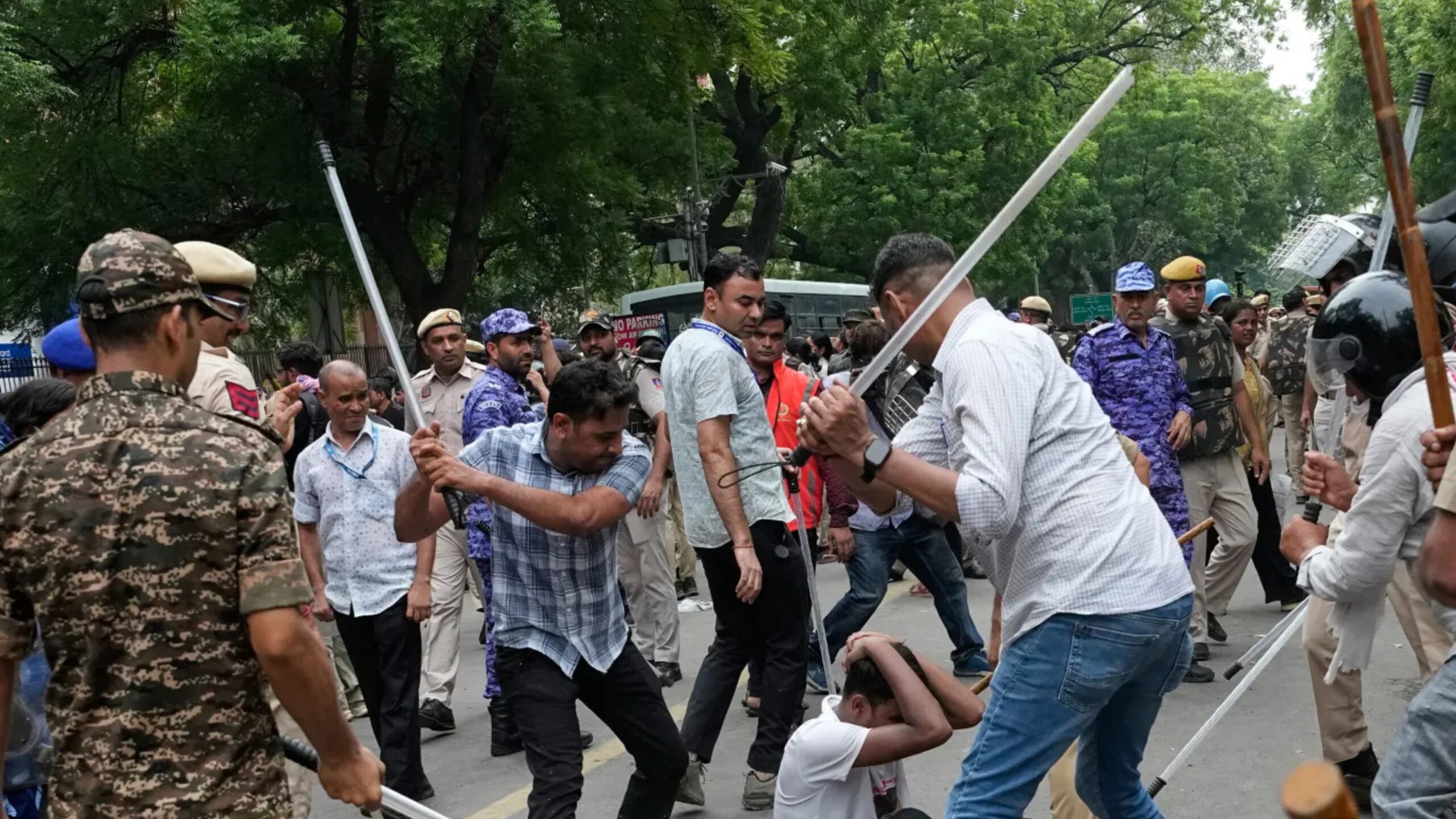
Videos from the recent CJP protest in Delhi have triggered a debate that goes beyond a single demonstration. Footage circulating on social media appeared to show men in civilian clothing carrying lathis and restraining protesters alongside uniformed Delhi Police personnel. Questions soon followed. Were they police officers? Can police legally operate without uniforms? If they use force, are they required to identify themselves?
Delhi Police has maintained that the men were personnel from specialised units deployed for law and order duties. Civil liberties groups, lawyers and opposition leaders have argued that the absence of visible identification weakens accountability and makes it difficult to investigate allegations of excessive force. The controversy has brought renewed attention to an issue that has surfaced repeatedly during major protests in India over the past decade.
The answer is more complex than a simple yes or no. Indian law permits police officers to work in plain clothes in many situations. At the same time, constitutional principles, Supreme Court reforms and international policing standards all point towards greater transparency when coercive powers are exercised in public.
Are police officers allowed to work in plain clothes?
Yes.
There is no central law that requires every police officer in India to remain in uniform while performing official duties. Plainclothes policing has long been part of Indian law enforcement. Officers from Crime Branch, Special Cell, Anti Terrorism Squads, intelligence units and surveillance teams frequently operate without uniforms because investigations often require discretion.
Many senior police officers also attend meetings, conduct inquiries or supervise operations in civilian clothing.
The legal question, however, changes when officers are involved in crowd control, arrests or the use of force during public protests.
What happened during the Delhi protest?
During the CJP protest in Delhi, videos showed several men in civilian clothing carrying batons and appearing to assist uniformed personnel in detaining protesters. The visuals quickly spread online, with critics asking whether unidentified individuals were exercising police powers without accountability.
Delhi Police later clarified that those seen in plain clothes were police personnel attached to specialised units and were officially deployed for security duties. Police officials also said such deployments are neither new nor illegal.
That explanation has not ended the debate. Legal experts argue that the issue is less about whether officers can wear civilian clothes and more about whether citizens should be able to identify officers exercising force in public spaces.
Does the law require officers to display name badges?
India does not have a single nationwide law requiring every police officer to display a name badge at all times.
Uniform regulations are generally governed by state police manuals, service rules and departmental standing orders. These rules differ across states.
In practice, uniformed police personnel are expected to display name plates or identification numbers as part of their official uniform. Questions become more complicated when officers are deployed without uniforms.
Because policing is a State subject under the Constitution, operational guidelines vary between police organisations.
What has the Supreme Court said?
Although the Supreme Court has not issued a blanket order specifically on plainclothes policing during protests, several landmark judgments have stressed transparency, accountability and professionalism in policing.
The Court’s landmark judgment in Prakash Singh v. Union of India (2006) laid down wide-ranging police reforms aimed at insulating policing from political interference and improving accountability.
Separately, the Supreme Court has repeatedly held that police powers must satisfy constitutional protections under Articles 14, 19 and 21 of the Constitution, which guarantee equality before law, fundamental freedoms and protection of life and personal liberty.
Legal experts argue that these constitutional principles become difficult to enforce if officers exercising coercive powers cannot later be identified.
Why does identification matter?
Police officers possess powers that ordinary citizens do not. They can detain people, use reasonable force under specified circumstances, disperse unlawful assemblies and make arrests.
Whenever such powers are exercised, accountability becomes central to maintaining public confidence.
If allegations of excessive force arise, victims, witnesses, courts and oversight agencies need to determine which officer was responsible. Visible identification makes that process easier.
Without identifiable officers, investigations often depend entirely on internal police records, CCTV footage or departmental inquiries.
Human rights organisations argue that this creates unnecessary barriers for independent scrutiny.
What do international standards say?
International policing standards generally favour visible identification during public order operations.
The United Nations Code of Conduct for Law Enforcement Officials and the UN Basic Principles on the Use of Force and Firearms emphasise accountability whenever force is used by law enforcement agencies.
Many democratic countries require officers engaged in crowd control duties to display badge numbers or other forms of identification, even when wearing protective equipment.
Implementation, however, differs widely across jurisdictions.
Is plainclothes deployment unusual in India?
No.
Indian police have frequently deployed plainclothes personnel during elections, religious gatherings, intelligence operations, anti terrorism investigations and VIP security.
Officers in civilian clothing often monitor crowds, gather intelligence, identify suspects or respond to emerging security threats before uniformed personnel intervene.
What is less common is widespread public attention on plainclothes personnel actively participating in crowd control, particularly when videos of the operation become widely circulated.
Could there be legal challenges?
If citizens believe unlawful force has been used, they may approach courts, human rights commissions or police complaint authorities.
Courts examining such cases generally focus on whether the force used was lawful, proportionate and necessary, rather than whether an officer wore a uniform.
At the same time, the inability to identify individual officers can complicate investigations into alleged misconduct.
Several legal scholars have suggested that India should adopt clearer nationwide standards requiring visible identification for officers involved in public order policing, irrespective of whether they wear uniforms.
Why this debate is likely to continue
The Delhi protest has reopened an old debate about the balance between operational flexibility and public accountability.
Police organisations argue that specialised deployments sometimes require officers to remain in civilian clothing for security reasons. Civil liberties advocates counter that once officers begin exercising coercive powers in public, citizens should know who is acting on behalf of the State.
As protests become increasingly documented through smartphones and social media, questions surrounding police identification are likely to reach courts, policymakers and police leadership more frequently. Whether India eventually adopts uniform national standards or leaves the issue to individual states will shape the next phase of this debate.

Curated news reports, in-depth analysis, and special features by India’s Opinion editorial team.