Two days after landing on the FBI’s most wanted list, a Punjab-linked gangster ran out of road, literally, at the edge of the United States’ northern frontier.
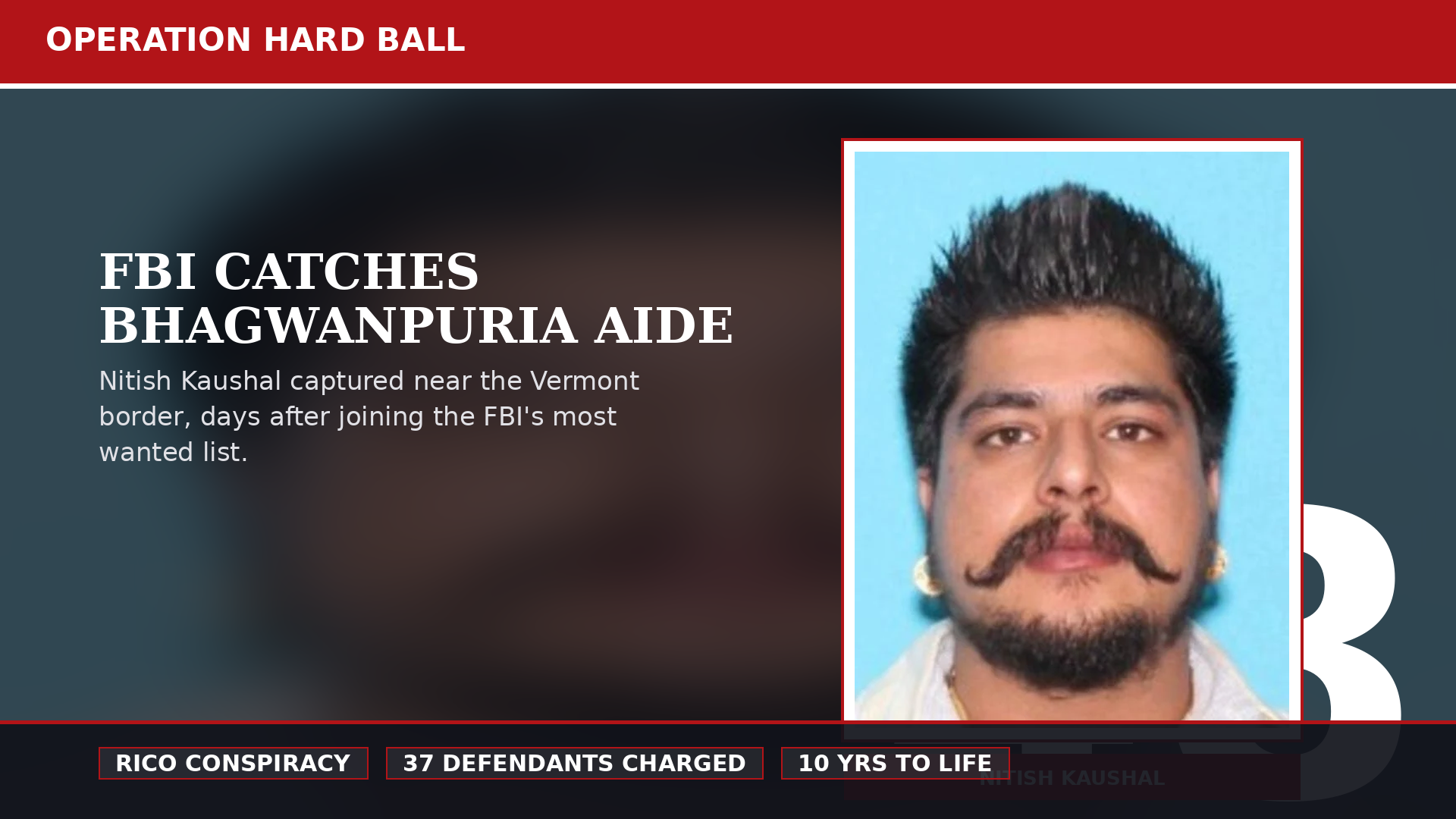
The FBI confirmed on Thursday that Nitish Kaushal, an alleged operative of the Jaggu Bhagwanpuria Organised Crime Group, was captured early that morning in Vermont, just south of the Canadian border.
The FBI’s Albany field office credited US Border Patrol personnel with helping apprehend the fugitive, who the bureau’s Los Angeles office had wanted. In a post on X, the Albany office thanked its Border Patrol partners for their role in securing the capture and said it remained committed to working with them going forward.
The arrest closes out, at least for now, a manhunt that barely lasted 48 hours in the public eye but had roots stretching back weeks. Kaushal, who investigators say also went by the alias “Lala,” was named to the FBI’s most wanted list on July 15. A move that turned a routine fugitive case into a headline story linking Punjab’s gang underworld to America’s northern frontier.
Why the Vermont arrest matters
Fugitives tied to India-based organised crime networks rarely surface in places like Vermont, a state better known for its dairy farms and proximity to Montreal than for cross-border criminal traffic.
That geography is precisely what makes the arrest significant. Investigators have long flagged the US-Canada border, particularly its quieter stretches in the northeast, as a route exploited by smuggling networks moving people, drugs and cash between the two countries.
Kaushal’s capture near that corridor suggests he may have been attempting to cross into Canada, where several Bhagwanpuria-linked figures are believed to operate.
The case against Kaushal
According to the FBI’s wanted notice, Kaushal is accused of participating in a criminal enterprise involved in murder, kidnapping, drug trafficking, extortion, weapons trafficking, money laundering and human smuggling.
The bureau describes the Bhagwanpuria group as a transnational criminal organisation that originated in Punjab and operated in California’s Central District and beyond, and alleges that Kaushal personally carried out acts of violence on the gang’s behalf, including kidnappings and assaults.
A federal arrest warrant was issued against him on June 25, 2026, by the US District Court for the Central District of California after he was charged with Racketeer Influenced and Corrupt Organizations (RICO) Conspiracy.
That charge alone carries steep consequences. Under US federal sentencing guidelines for RICO conspiracy tied to violent racketeering activity, most of the individuals charged in this case, Kaushal included, face a mandatory minimum of 10 years in federal prison, with a statutory maximum stretching to life imprisonment.
A bigger operation behind one arrest
Kaushal’s case did not emerge in isolation. He is one of 37 defendants named across three separate federal indictments as part of Operation Hard Ball, a coordinated crackdown by US, Canadian and European law enforcement targeting three organised crime networks with roots in Punjab.
The groups led by Lawrence Bishnoi, Ravinder Singh Dhanda and Jaggu Bhagwanpuria. The operation involved 34 search raids, 23 of them in Sacramento and 11 in Los Angeles, during which agents seized roughly 1,000 kilograms of cocaine, a kilogram of heroin, $40,000 in cash and 12 firearms.
Assistant Director in Charge of the FBI’s Los Angeles Field Office, Patrick Grandy, said the coordinated operation struck at the heart of three brutal transnational organisations that had terrorised families, exploited communities and taken lives through ruthless violence in the United States.
The operation’s highest-profile target remains Lawrence Bishnoi, the jailed Punjab gangster whose network US prosecutors have also linked to the 2023 killing of Khalistani separatist Hardeep Singh Nijjar in Surrey, British Columbia. Nijjar was shot dead outside a gurdwara in June 2023, and the case has since strained diplomatic relations between India and Canada.
Of the 37 people charged, several dozen were arrested in the initial sweep, but Kaushal was among roughly a dozen who remained at large, prompting the FBI to escalate his case to its most wanted list before tracking him down in Vermont.
A cop turned alleged accomplice
One thread in the case has drawn particular attention in Punjab. US prosecutors have accused Gurinderjit Singh Nagra, a police officer who served as Station House Officer at the Tanda police station in Hoshiarpur district, of assisting an extortion scheme tied to the Bhagwanpuria network.
The allegation, that a serving Punjab police officer worked as a gang associate to extort roughly $400,000 from a Los Angeles-based family, has fed into a broader concern among Indian and American investigators alike. that some organised crime networks operating out of Punjab retain the ability to compromise local law enforcement, giving them cover even as their leaders sit behind bars.
That pattern, gang leadership operating from Indian prisons while foot soldiers and financiers run operations abroad, has become a defining feature of how Punjab-origin crime syndicates function in 2026.
It also explains why cases like Kaushal’s carry weight beyond the individual charge sheet. Each arrest offers investigators a potential thread to pull on the financial and communication networks linking prison cells in Punjab to street-level operatives in California, Vancouver and now, it appears, the Vermont woods.

Curated news reports, in-depth analysis, and special features by India’s Opinion editorial team.