
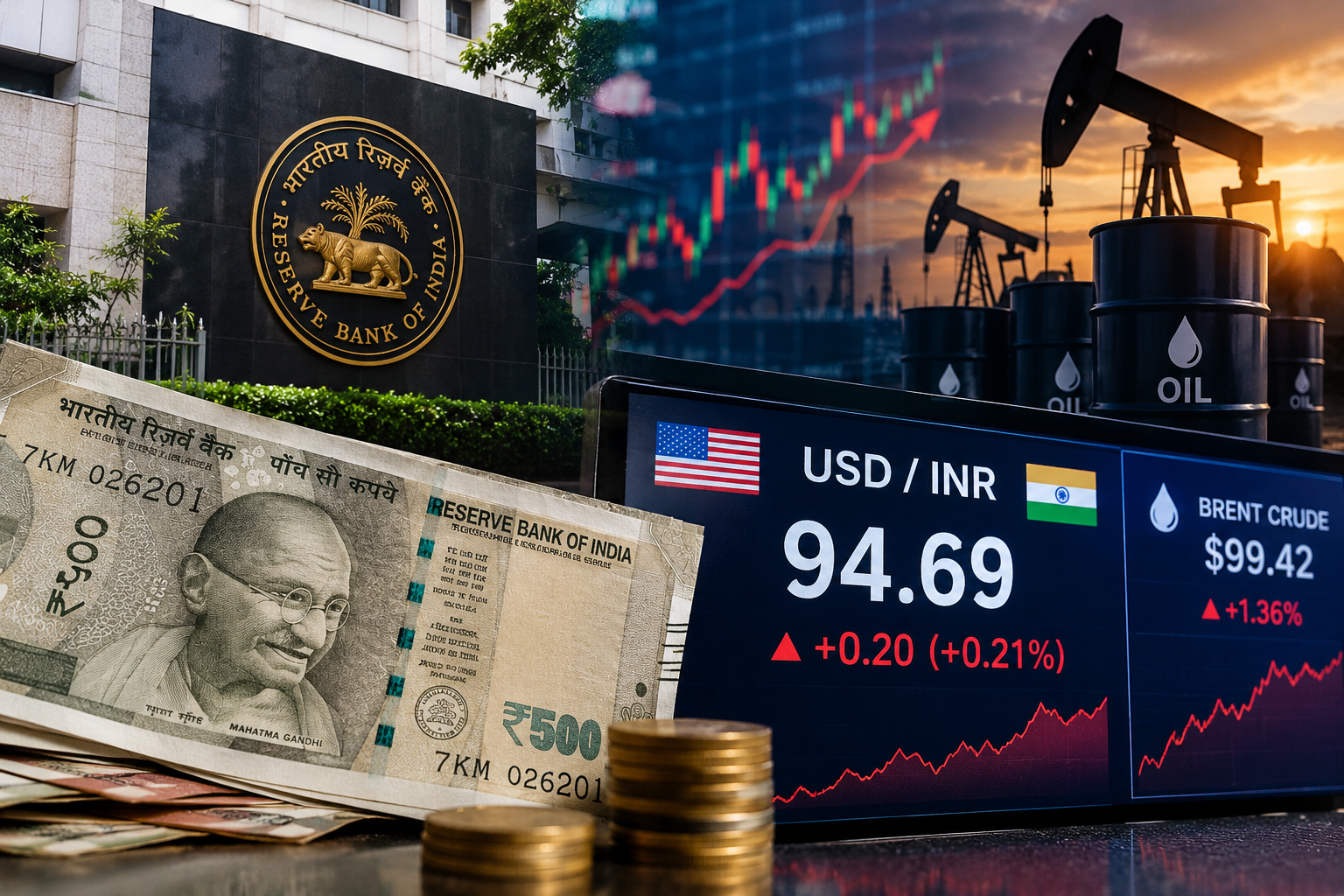
The Indian rupee slipped past the 94.50-per-dollar mark on September 8 as rising crude oil prices increased pressure on India’s currency.
The move comes despite continued intervention by the Reserve Bank of India in the foreign-exchange market.Reuters reported that the rupee traded at around ₹94.69 per U.S. dollar, down about 0.2% from the previous close.
State-run banks were seen selling dollars around the 94.70 level, which traders believed reflected RBI intervention.The development matters because India imports most of the crude oil it consumes.
A weaker rupee can therefore make dollar-priced commodities more expensive in domestic currency.For households and businesses, the currency’s value can eventually affect fuel prices, transportation costs, imported goods and production expenses.
Why the Indian rupee is under pressure
The Indian rupee is facing renewed pressure as crude oil prices climb.Brent crude moved close to $100 a barrel on September 8, reaching its highest level since late July.
Rising oil prices increase demand for dollars from Indian importers because international oil transactions are largely denominated in the U.S. currency.
That creates a difficult equation for India’s foreign-exchange market.When importers need more dollars, demand for the U.S. currency rises.
If dollar demand exceeds available supply, the rupee can weaken.The RBI can intervene by selling dollars from its foreign-exchange holdings.
Such intervention can slow the decline, although it does not permanently remove the economic pressures affecting the currency.
How the RBI is supporting the currency
The Indian rupee has received substantial support from the central bank in recent weeks.
Reuters reported on September 7 that bankers estimated the RBI sold between $8 billion and $15 billion during the week ending September 4.
The estimates came from bankers who were not authorised to speak publicly about the central bank’s market activity.
The intervention helped the rupee reach about ₹94.2850 per dollar on September 3, its strongest level in more than two months at that point.
The central bank has also benefited from increased dollar inflows linked to policy measures involving overseas foreign-currency deposits and borrowing.
India’s foreign-exchange reserves stood at $740.8 billion on August 21, according to Reuters.
JPMorgan estimated that reserves had subsequently moved above $750 billion.
Large reserves give the RBI greater capacity to respond when the currency faces sudden pressure.
Why oil matters so much to India
The relationship between the Indian rupee and crude oil is especially important because India remains heavily dependent on imported energy.
When crude prices rise, Indian refiners and other importers need more dollars to purchase the same amount of oil.
That can increase pressure on the country’s trade balance.Higher oil prices can also affect the wider economy.
Fuel is an input for transport, manufacturing, agriculture and logistics. A prolonged increase can therefore raise costs across several sectors.
The effect on consumers depends on global prices, domestic fuel pricing, taxes, exchange rates and government policy.
A weaker currency can add another layer of pressure if oil prices remain elevated.
What does a weaker rupee mean for consumers?
A decline in the Indian rupee does not automatically mean that every product becomes more expensive.
The impact depends on how much of a product’s cost comes from imported goods and how companies manage currency fluctuations.
Electronics, machinery, industrial components and some raw materials can become more expensive when their dollar-denominated costs rise.Fuel is another important channel.
If international oil prices rise at the same time as the rupee weakens, the pressure on India’s import bill becomes stronger.
However, the final effect on retail prices depends on several factors.
Companies may absorb part of the increase, while government taxes and domestic pricing policies can also influence what consumers ultimately pay.
Exporters can benefit from a weaker currency
The Indian rupee has another side to its story.
A weaker currency can make Indian goods and services relatively cheaper for overseas customers when prices are converted into foreign currencies.
Exporters that earn dollars but incur many costs in rupees can benefit from a weaker exchange rate.
Information technology companies, pharmaceutical exporters, textile manufacturers and other businesses with significant overseas revenue may therefore receive some advantage.
The benefit is not universal.Companies that depend heavily on imported machinery, components or raw materials may see their costs rise at the same time.
The overall effect depends on a company’s revenue and cost structure.
Could the rupee weaken further?
The direction of the Indian rupee will depend on several factors rather than one market indicator.
Crude oil prices will remain important.
Foreign investment flows, U.S. interest-rate expectations, India’s trade balance and domestic economic growth will also influence demand for the currency.
The RBI’s intervention strategy will matter as well.
Reuters reported that traders expected the rupee to remain around the ₹94.50 to ₹95 range in the near term, although market conditions can change quickly.
That is a market assessment, not a guaranteed forecast.Currency markets can react sharply to changes in oil prices, global interest rates and investor sentiment.
What the rupee’s movement tells us
The latest Indian rupee movement shows how closely India’s domestic economy remains connected to global commodity and financial markets.
The country has built substantial foreign-exchange reserves and the RBI has demonstrated its willingness to intervene.
But central-bank intervention cannot determine the global price of oil or completely control international capital flows.
The currency will continue to respond to those forces.For consumers, the most important question is whether a weaker rupee combines with higher oil prices for long enough to create broader inflationary pressure.
For policymakers, the challenge is to maintain orderly currency markets without using reserves unnecessarily.
For investors and businesses, the focus will remain on oil prices, foreign capital flows and the RBI’s response.
The Indian rupee is therefore likely to remain a closely watched indicator in the weeks ahead.
Its next move will depend not only on domestic economic conditions, but also on how global energy markets and international capital flows evolve.

Umar Khan is a writer driven by curiosity and a passion for understanding the world. Through thoughtful analysis and evocative storytelling, he seeks to make complex ideas accessible, inspire meaningful conversations, and encourage fresh perspectives on the people, places, and issues that shape our shared future.