
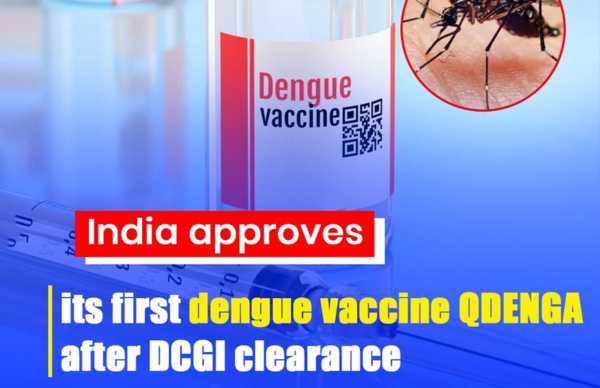
India now has its first approved vaccine against dengue. The Drug Controller General of India (DCGI) has granted marketing authorisation to QDENGA, developed by Takeda Biopharmaceuticals India. This marks the country’s first vaccine-based tool against a disease that has relied for decades on mosquito control alone.
Takeda called the approval a major step in India’s fight against dengue, a mosquito-borne disease that infects millions of people every year.
Who can take it, and how
QDENGA is approved for people aged 4 to 60 years. It can be given regardless of whether a person has previously been infected with dengue. This distinction sets it apart from earlier dengue vaccines.
Unlike some other dengue vaccines, QDENGA does not require pre-vaccination screening. Eligible individuals can receive it without first being tested for past infection. The vaccine is given as two doses, three months apart, through a subcutaneous injection.
Why the timing matters
The approval comes as India continues to carry one of the world’s heaviest dengue burdens. Cases have risen sharply over the past two decades, driven by urbanisation, climate change, shifting mosquito habitats and population growth. According to Takeda, reported dengue cases in India have increased more than elevenfold over that period.
Official figures recorded 121,824 dengue cases and 131 deaths in 2025. However, experts believe actual infections run far higher since many cases go unreported. Early surveillance data for 2026 already shows a steady rise.
How the vaccine works
QDENGA is a live-attenuated tetravalent vaccine, built to protect against all four dengue virus serotypes: DENV-1, DENV-2, DENV-3 and DENV-4.
It uses a weakened Dengue Serotype-2 virus as its genetic backbone. Additionally, it contains components from the other three serotypes engineered in to generate broader immune protection.
The DCGI’s approval rests on Takeda’s global clinical programme. This programme involved more than 28,000 participants across 19 Phase I, II and III trials. In addition, there was a dedicated Phase III study conducted in India.
The company’s pivotal TIDES trial spanned over 20,000 participants across eight dengue-endemic countries. This trial showed 80.2 percent efficacy against virologically confirmed dengue one year after the second dose.
What the approval means for India
Dengue poses a public health threat across more than 125 countries. India alone accounts for nearly a third of the global burden. For Takeda, the approval opens access to one of the world’s largest dengue-endemic markets and builds on a manufacturing partnership with Indian vaccine producer Biological E.
For India, it marks a shift from being primarily a supplier of routine vaccines. Now, India is becoming a manufacturing base for next-generation ones addressing global health challenges.
Regulatory approval is only the first step. How widely QDENGA reaches India’s population will now depend on pricing and manufacturing scale-up. It will also depend on decisions on whether it gets folded into any public immunisation programme. These are questions that will shape the vaccine’s real-world impact on a disease that shows no sign of slowing down.

Curated news reports, in-depth analysis, and special features by India’s Opinion editorial team.