
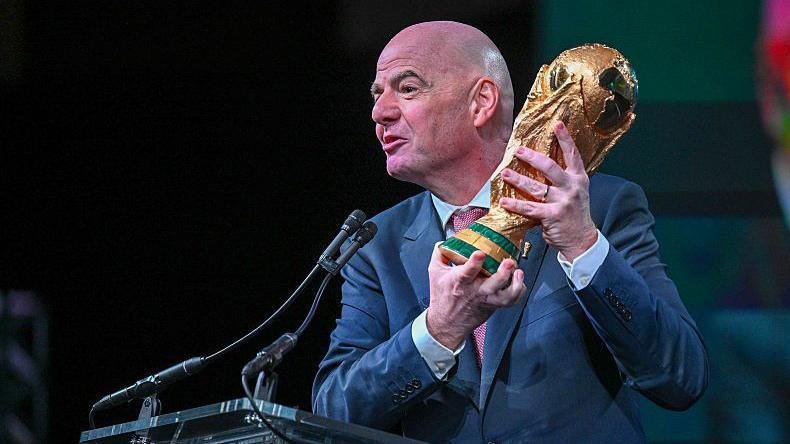
FIFA World Cup investment plan collapses after backlash
FIFA has abandoned its controversial FIFA World Cup investment plan. A wave of opposition from European football authorities and other stakeholders threatened to deepen a major dispute over the future of the sport.
The proposal, announced only days earlier, would have created a new FIFA-owned commercial subsidiary called FIFA Forward Enterprise.
The company was designed to bring together commercial rights and tournament operations. It also aimed to raise as much as $4.2 billion from private investors.
The reversal represents a sharp setback for FIFA President Gianni Infantino. He had presented the proposal as a way to unlock more money for football development. Instead, the plan triggered concerns about transparency, private ownership and the long-term control of the World Cup.
Why FIFA World Cup investment plan faced resistance
Under the original proposal, outside investors would have purchased minority, non-controlling interests in FIFA Forward Enterprise. FIFA said it would retain majority control and exclusive authority over competitions, sporting decisions, regulations and the international match calendar.
FIFA argued that the structure could generate more than $10 billion in football development funding over four years.
The organisation proposed increasing its regular FIFA Forward allocation to $20 million for each of its 211 member associations during the 2027-30 cycle. This compares with the current budgeted $8 million.
The FIFA World Cup investment plan also included an optional mechanism that could provide member associations with up to $20 million each in additional capital for projects such as stadiums, training centres and other football infrastructure. That financial argument failed to convince several of FIFA’s most influential partners.
UEFA and its 55 national associations strongly rejected the proposal. European football officials argued that the World Cup should not become an investment product and criticised the way FIFA developed the proposal. The disagreement went beyond Europe.
Reports said other confederations, including Concacaf and the Asian Football Confederation, also expressed opposition to the plan. That left FIFA facing resistance across several parts of the global football structure.
FIFA’s financial argument
The FIFA World Cup investment plan emerged at a time when the governing body is already generating enormous revenues from its major tournaments.
FIFA’s own 2027-30 budget projects record revenue of $14 billion. The organisation says it expects to reinvest $13.9 billion during that cycle, with more than 89% of planned investment directed towards football-related activities.
That financial position raised an obvious question among critics: why should FIFA bring private capital into its commercial operations when it already has substantial tournament revenues and reserves? FIFA’s answer was that private investment could accelerate the expansion of commercial rights and allow development funding to reach member associations more quickly.
The organisation also stressed that investors would hold only minority interests and would not control football’s sporting decisions.
The proposal therefore was not simply about raising cash. It reflected a broader attempt to reorganise how FIFA manages and monetises its commercial business.
Governance became the central dispute
The controversy quickly moved beyond questions about money.Critics focused on how the proposal was developed and communicated. FIFA presented the structure as subject to approval from a majority of its member associations and the FIFA Council.
Yet opponents argued that the process had not involved adequate consultation with football’s wider governing community. FIFA’s own announcement said the administration had begun a consultation process and would proceed only after securing the required approvals.
It also said potential investors would be selected according to governance and strategic criteria. Those assurances did little to calm the dispute.
FIFA chief operating officer Kevin Lamour publicly criticised the proposal, while senior adviser Carlos Cordeiro resigned amid the controversy.
Their objections added an internal dimension to what had initially appeared to be a disagreement between FIFA and external football organisations.
The FIFA World Cup investment plan consequently became a test of Infantino’s leadership as much as a debate about commercial strategy.
What the plan could have changed
The proposed structure would have placed a substantial part of FIFA’s commercial activity inside a dedicated company. FIFA said this would include broadcasting, sponsorship, ticketing, licensing and tournament operations.
FIFA’s stated objective was to increase the value of those rights and distribute more of the resulting income across the global game. There was a practical argument behind that approach.
Football development remains uneven between countries, and many national associations depend heavily on FIFA funding for infrastructure, coaching, competitions and grassroots programmes.
The organisation pointed to the progress of nations such as Cabo Verde and Curaçao at the 2026 World Cup as evidence that long-term development spending can broaden the competitive base of international football.
Yet critics feared that private investors could eventually gain greater influence over commercial decisions, even if FIFA formally retained sporting control.
That concern was amplified by the absence of detailed public information about the proposed company’s future valuation, assets and commercial arrangements.
What happens after the FIFA World Cup investment plan?
The immediate proposal is now off the table, but the underlying financial question has not disappeared. FIFA still wants to increase development funding and extract more value from its commercial rights.
Its 2027-30 budget already sets out an ambitious spending programme, while the organisation has repeatedly argued that football’s global growth should generate greater resources for smaller associations.
The next challenge will be finding a structure that commands wider support.
For Infantino, abandoning the FIFA World Cup investment plan may prevent a direct confrontation with UEFA and other stakeholders. However, it does not end the debate over how football’s enormous commercial value should be controlled and distributed. The dispute has exposed a deeper fault line in the sport.
FIFA wants to maximise the global economic value of its competitions, while many of its partners want stronger guarantees that commercial expansion will not weaken collective governance.
How those competing interests are reconciled could shape FIFA’s financial and political direction well beyond the 2026 World Cup.

Curated news reports, in-depth analysis, and special features by India’s Opinion editorial team.