
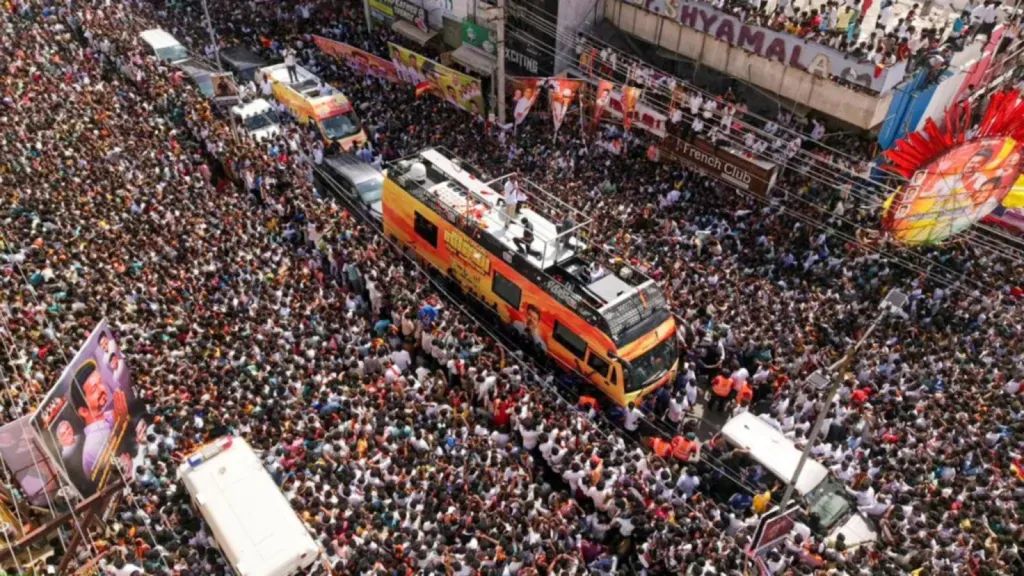
In a major legal setback for Tamil Nadu Chief Minister C. Joseph Vijay, the Madras High Court struck down the government’s decision to provide public jobs to the families of 41 victims killed in last year’s Karur rally stampede.
A Division Bench comprising Justices C.V. Karthikeyan and R. Sakthivel ruled that executive compassion cannot override constitutional guarantees.
The judges held that granting government appointments outside statutory frameworks violated Articles 14 and 16 of the Constitution. These articles ensure equality before the law and equal opportunity in public employment.
Executive Powers Cannot Exceed Constitutional Limits, Rules Court
The ruling came less than three weeks after the court had temporarily permitted the Tamilaga Vettri Kazhagam (TVK)-led government to issue provisional appointment orders.
However, following detailed hearings on public interest petitions filed by Madurai lawyer Theeran Thirumurugan, the Bench concluded that the appointments failed constitutional scrutiny.
Addressing the state’s reliance on executive authority under Article 162, the judges emphasized that executive power cannot operate unfettered. The court observed that allowing unchecked executive action would lead to public chaos and undermine established recruitment processes.
Violation of Equal Opportunity and Existing Waitlists
The High Court highlighted that compassionate appointments are strictly governed by statutory rules and waiting lists for families of government servants who die in harness.
Bypassing that mechanism for civilian tragedies would unfairly penalize those already awaiting employment under valid schemes. Moreover, the Bench warned that upholding the Karur orders would set a precedent. This could trigger similar demands across other disasters such as fireworks explosions, industrial accidents, and road crashes.
The judges noted that while state excesses—such as police firings—have historically justified employment relief, civilian rally incidents lack a comparable constitutional basis.
Alternative Rehabilitation Suggested Over Public Employment
Advocate General Vijay Narayan defended the decision as an exceptional, conscious humanitarian policy to support grieving families who lost breadwinners.
The court remained unpersuaded, noting that monetary compensation remains the legal standard for civilian accidents. Instead of distributing government jobs, the Bench suggested that the state could fully fund technical education, skill development, and entrepreneurship training for the affected kin.
The judges noted that such initiatives would build self-sufficient leaders without compromising the constitutional principles of fair public recruitment.

Curated news reports, in-depth analysis, and special features by India’s Opinion editorial team.