
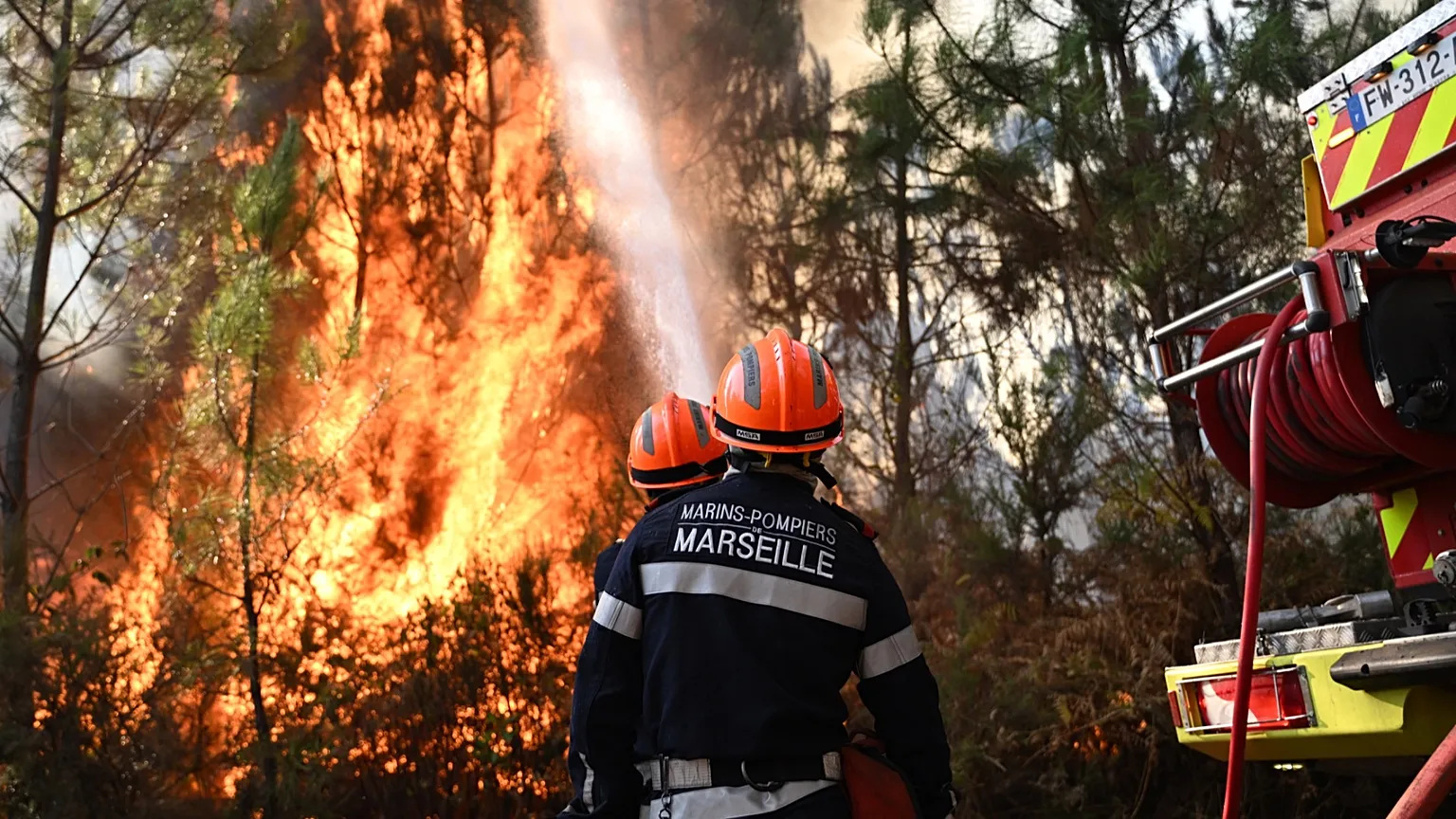
Southern Europe is burning again, and this time the fires are behaving differently. Firefighters in Spain and France have spent the past week battling blazes more ferocious and more erratic than anything they’ve tackled before, some large enough to generate their own weather systems.
Since the start of 2026, wildfires have scorched roughly 118,737 hectares across the EU, an area close to the size of Luxembourg, across nearly 962 separate fires. More than 20,000 of those hectares burned in July alone, as extreme heat and bone-dry vegetation turned Spain, Portugal, France and Greece into active fire zones.
At least 10,500 people have had to evacuate, including around 5,000 from France’s Pyrenees region, with further mass evacuations in Spain and Greece as fire fronts pushed toward populated areas.
The Science Behind the Scale
Two rapid studies released this week by World Weather Attribution put numbers on what scientists had already suspected: climate change didn’t just contribute to these fires, it made them dramatically more likely.
The researchers found that human-caused warming made the hot, dry conditions behind Spain’s record-sized inferno 20 times more likely to occur. In France, it doubled the odds of the extreme fire weather that fed the flames.
The trend isn’t new, but it’s accelerating. Warming over the past 26 years has tripled the odds of severe fire-risk conditions in Spain and pushed up the chances in France by 40 percent, according to the same analysis.
Events of this intensity, the researchers estimate, now strike central Spain once every six years and southwest France once every 20 years, far more often than the historical baseline would predict.
France’s own record books tell part of the story. The country just recorded its hottest June since records began, surpassing the previous benchmark set during the devastating 2003 heatwave.
Scientists found that temperatures this extreme were between 10 and hundreds of times more likely to occur in 2026 than they would have been back in 2003.
Fires That Feed Themselves
What makes this year’s fires especially hard to contain isn’t just their size, it’s their behaviour. Some blazes in France and Spain grew intense enough to create their own localised weather systems.
A phenomenon that lets fires generate the wind and instability needed to spread even faster, making them nearly impossible to predict or corral using conventional firefighting tactics.
Matthew Jones, an independent research fellow at the University of East Anglia’s School of Environmental Sciences, points to a broader pattern driving this: global warming is producing sharper swings between wet and dry extremes, something he calls a “whiplash effect.”
A wet winter followed by an intensely dry summer, then a run of consecutive heatwaves, leaves vegetation primed to burn in a way that older climate patterns didn’t produce nearly as often.
Fires Breaking Out Together, Not Just Bigger
Andreia Ribeiro, a climate scientist at Germany’s Helmholtz Centre for Environmental Research, flags a dimension of this crisis that gets less attention than raw fire size: synchronicity. “When wildfires break out simultaneously across different regions, it becomes clear that human-induced climate change is not only increasing the likelihood of more extreme fires, but also their synchronicity,” she said.
“And that comes with a real cost, as overlapping fire extremes makes it harder for countries to co-operate and share firefighting resources with each other when that support is needed most.”
Clair Barnes, a research associate in extreme weather and climate change at Imperial College London’s Centre for Environmental Policy, frames this year’s fires as part of a clear pattern rather than a fluke.
“What we’re seeing in France and Spain isn’t just bad luck; it is a clear sign of the escalating impact of anthropogenic warming,” she said, pointing to the specific sequence behind this year’s disaster: a wet winter that fuelled vegetation growth, followed by an intensely dry summer and repeated heatwaves that turned that same vegetation into fuel.
A Continent Still Recovering From Its Worst Year
This year’s fires land on a continent still absorbing the lessons of 2025, Europe’s worst wildfire year on record. Those fires killed 20 people, forced 80,000 evacuations, and burned more than a million hectares.
A separate World Weather Attribution study found that 2025’s fires burned 22 percent more intensely than they would have without climate change, driven partly by a roughly 14 percent drop in winter rainfall since the pre-industrial era.
That same study found that weeklong stretches of hot, dry air, the exact conditions that prime vegetation to burn, are now 13 times more likely than before industrialisation.
In response, the EU stood up a continentwide rapid reaction force of 300 firefighters, drawn from across all 27 member states and designed for swift deployment wherever fires flare up.
EU Climate Commissioner Wopke Hoekstra called the unit “a huge step forward compared to some five years ago,” while acknowledging it will likely need more personnel and equipment as fire seasons keep intensifying.
Authorities in Spain and France said midweek that some fires had stabilised, but warned conditions could deteriorate again as Europe heads into its fourth heatwave of the year. The EU has already flagged a growing fire risk further east in Greece and Italy, suggesting this crisis is far from contained.
With climate scientists now able to attribute specific fire outbreaks to warming in near-real time. And with 2025’s records already broken well before this year’s fire season peaks, the real test ahead is whether Europe’s expanded firefighting capacity can keep pace with fires that are growing more frequent, more intense, and more likely to strike multiple countries at once.

Curated news reports, in-depth analysis, and special features by India’s Opinion editorial team.