
The idea that our universe may not be the only one sounds like science fiction. Yet multiverse theory has emerged from serious questions in modern cosmology and quantum physics.
Scientists have strong evidence that our universe expanded from an extremely hot, dense early state about 13.8 billion years ago. They also have evidence supporting a brief period of rapid cosmic inflation in the early universe. What remains uncertain is what caused inflation and whether it could have produced more than one universe.
That distinction matters. There is currently no confirmed observation of another universe. The multiverse remains a collection of theoretical possibilities that researchers continue to debate.
What does multiverse theory actually mean?
The term multiverse theory does not describe one single scientific model.Instead, it refers to several ideas suggesting that reality could contain more than the observable universe.
Different models arrive at this possibility through different physical arguments.One of the best-known ideas comes from cosmic inflation. Inflation proposes that the early universe underwent an extraordinarily rapid expansion.
NASA says observations of the cosmic microwave background are consistent with inflation, although scientists still do not know what physical process drove it.Some inflationary models allow inflation to continue in distant regions even after it ends locally.
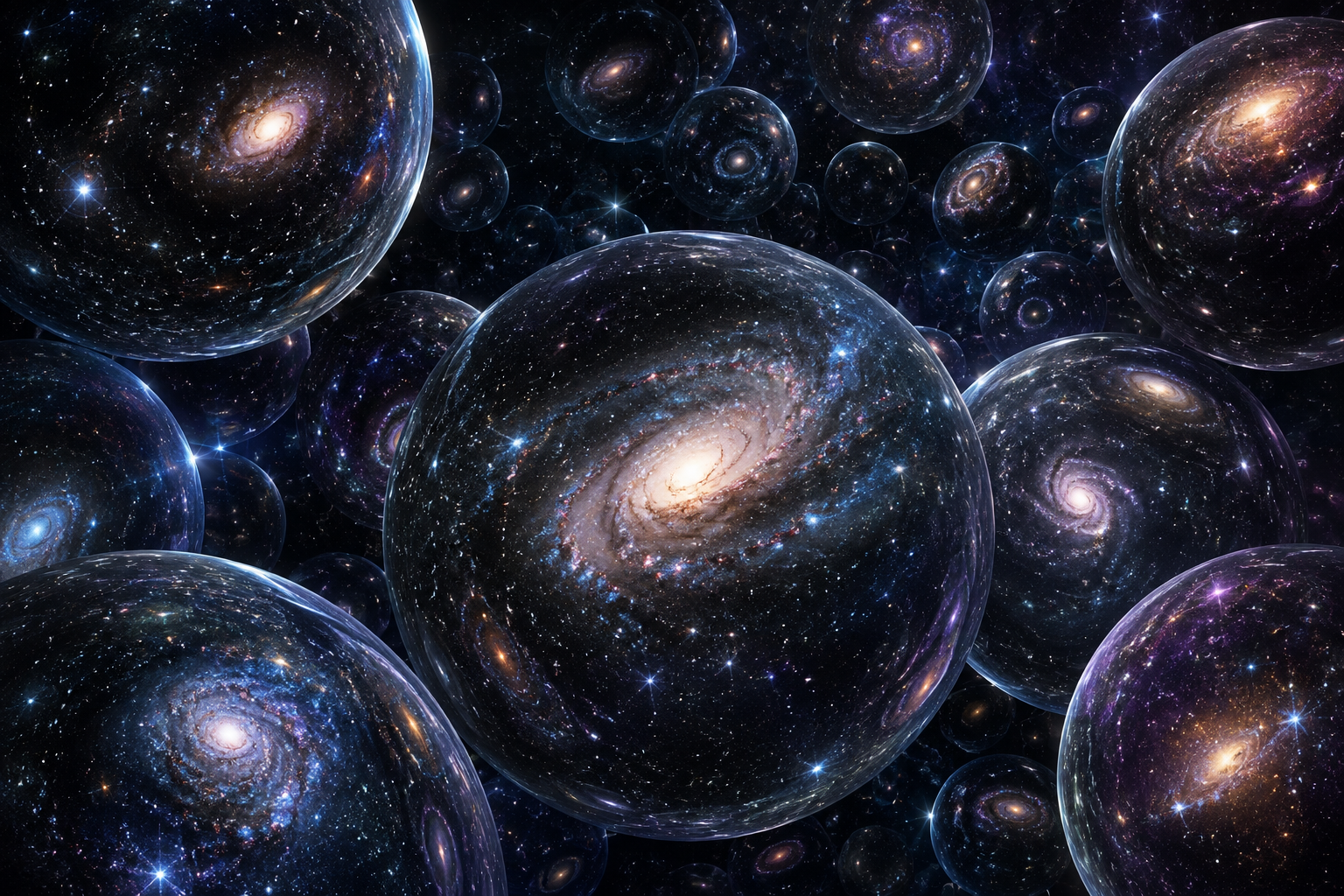
This creates a possible “eternal inflation” scenario, in which separate regions could form bubble-like universes.In that picture, our observable universe could be one bubble inside a much larger inflating structure.
How inflation could lead to multiple universes
Imagine a rapidly expanding cosmic background. In some regions, inflation ends and produces a universe like ours. In other regions, inflation continues.
The regions where inflation stops can behave like separate cosmic bubbles. Some theoretical models suggest these bubbles could have different physical properties.
Researchers have studied whether collisions between such bubbles might leave detectable patterns in the cosmic microwave background. A 2011 study published in Physical Review Letters examined this possibility using WMAP data. The researchers did not find evidence that required adding bubble collisions to the standard cosmological model.
That result illustrates the central problem with the multiverse theory. Scientists can construct mathematical models that allow other universes, but finding direct observational evidence is far more difficult.
What evidence do scientists actually have?
The strongest evidence concerns inflation, not the multiverse itself.The cosmic microwave background provides a record of the young universe.
NASA describes it as one of the key observational windows into the inflationary era. Measurements show that the universe is extremely close to geometrically flat on the largest scales, while tiny density variations eventually developed into galaxies and clusters.
Those findings support important predictions associated with inflation.They do not prove that inflation produced other universes.This is one of the most important distinctions when discussing the multiverse theory.
Evidence for a physical theory that may permit a multiverse is not the same as evidence that other universes actually exist.Scientists therefore continue to search for signatures that could distinguish different inflationary models.
Could other universes have different laws of physics?
Some versions of the multiverse propose that different cosmic regions could have different physical conditions.The idea becomes particularly interesting when researchers consider the values of fundamental constants.
Why do the laws of physics have the specific properties we observe?Some theoretical frameworks suggest that different regions of a larger multiverse could settle into different physical states.
Our universe would then represent one possible configuration.This idea has attracted attention because it could offer a way to discuss questions such as why certain constants appear finely suited to the formation of stars, galaxies and complex chemistry.But the argument remains controversial.
A possible explanation is not automatically a scientific confirmation. Researchers still need testable predictions that distinguish a multiverse model from competing explanations.
Multiverse theory and quantum physics
The multiverse debate also overlaps with interpretations of quantum mechanics.One example is the many-worlds interpretation. It proposes that quantum events do not cause a single outcome in the traditional sense.
Instead, different outcomes correspond to different branches of the quantum state.
That idea is often described as a “parallel universe” theory, but it is not identical to inflationary multiverse models.The distinction is important because popular culture often combines several unrelated ideas under the same multiverse label.
A quantum interpretation and an inflationary cosmological model address different questions. One concerns how to understand quantum measurements.
The other concerns the structure and evolution of the cosmos.Scientists continue to debate both.
Why is proving a multiverse so difficult?
The observable universe places a fundamental limit on what we can see.Light travels at a finite speed. We can therefore observe only a portion of the entire cosmos.
Regions beyond our observable horizon may exist, but we cannot simply point a telescope toward them and see what is there.
A separate universe would present an even greater challenge.If another universe has no causal connection with ours, conventional observations may never reach it. That raises a difficult question: can an idea be tested scientifically if its proposed objects cannot interact with our universe?
This problem has generated a long-running debate among cosmologists and philosophers of science.Some researchers argue that multiverse models can still make statistical or indirect predictions. Others worry that the theory becomes too flexible if almost any observation can be accommodated.
Could future observations change the debate?
Future measurements of the early universe could provide important clues.Scientists continue to search for primordial gravitational waves, which inflationary models predict under certain conditions. These waves could leave distinctive signatures in the polarization of the cosmic microwave background.
NASA’s PIPER mission, for example, is designed to search for evidence related to inflation by studying faint polarization signals in the microwave background.
A confirmed primordial gravitational-wave signal would strengthen our understanding of inflation. It would not automatically prove the multiverse.
Researchers would still need to determine whether the observations support a specific inflationary model capable of producing eternal inflation.That distinction could become increasingly important as cosmology develops more precise measurements.
Why the multiverse idea still matters
The multiverse theory remains fascinating because it sits at the boundary between established physics and unanswered questions.Scientists know that the observable universe is only a portion of everything we can potentially study.
They also know that the early cosmos behaved in ways that current theories are still trying to explain fully.Inflation offers a powerful framework for understanding several features of the universe, but its physical origin remains unknown.
NASA says scientists are still investigating what powered inflation and what, if anything, preceded it.That uncertainty leaves room for new ideas.
For now, the responsible scientific position is neither to declare that parallel universes exist nor to dismiss the possibility outright. The evidence supports an evolving picture of the early universe, while the existence of other universes remains unconfirmed.
The next major clues could come from increasingly precise observations of the cosmic microwave background, primordial gravitational waves and the earliest stages of cosmic expansion.
If those observations reveal patterns that existing models cannot explain, they could reshape the debate about whether our universe is truly alone.

Umar Khan is a writer driven by curiosity and a passion for understanding the world. Through thoughtful analysis and evocative storytelling, he seeks to make complex ideas accessible, inspire meaningful conversations, and encourage fresh perspectives on the people, places, and issues that shape our shared future.