
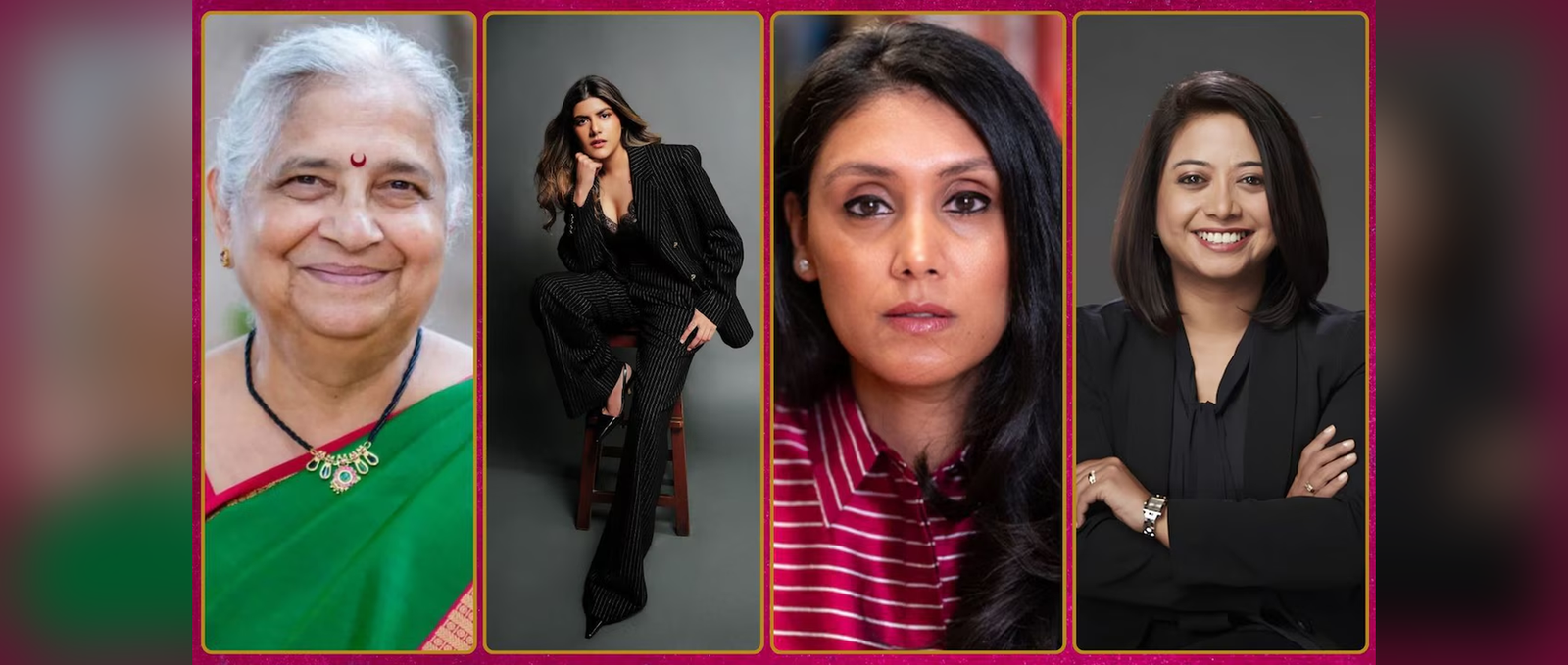
Candere and Hurun India unveiled the 2026 Women Leaders List on Wednesday, recognising 117 influential women across 12 categories. The number marks a 21 percent jump from last year’s 97 honourees. Together, this year’s list represents a combined wealth of Rs 39 lakh crore. This figure exceeds the approximate size of Finland’s entire economy.
BIBA founder and chairperson Meena Bindra, 83, leads the Indian Fashion and Lifestyle category with an annual revenue of Rs 758 crore. Para-shooter Avani Lekhara, 24, tops the Olympic and Paralympic Medallists category, having won three Paralympic medals. She stands out as the youngest name in the top 10 across categories.
Self-Made Leaders Now Dominate
The list’s biggest storyline sits beneath the headline names. Researchers found that 98 of the 117 women featured this year built their wealth or influence independently, rather than inheriting it. That works out to 84 percent of the entire list. Moreover, it means self-made women now outnumber inheritors by more than five to one.
Hurun frames this as a genuine shift rather than a one-off statistic. For decades, India’s rankings of influential women leaned heavily on business heirs and promoter families. In contrast, this year’s list features entrepreneurs, professional CEOs, startup founders, Olympic medallists, journalists, authors and digital creators occupying the same stage.
Who Leads Each Category
Several familiar names top their respective fields this year. Priya Nair, who takes over as CEO and Managing Director of Hindustan Unilever on August 1, leads the Professional CEOs category. Meanwhile, HCLTech Chairperson Roshni Nadar Malhotra tops the Wealth Multipliers category. Her net worth is Rs 2,84,120 crore.
Rajni Bector, founder of Mrs. Bector’s Food Specialities, leads the Heartland Founders category at 86, making her the oldest woman on the entire list. Sudha Murty tops the Authors category, recording the highest readership impact among the influential Indian women writers Hurun assessed. Vaishali Nigam Sinha ranks first in the New Economy category. In addition, Tushara Shankar, head of corporate social responsibility at Lupin, leads the Social Change Makers category on sustainability score.
Apollo Hospitals’ Preetha Reddy and Suneeta Reddy jointly top the Veterans category, with a group valuation exceeding Rs 1.21 lakh crore.
An Age Range Spanning Seven Decades
The list stretches across generations in a way its organisers clearly wanted to highlight. Para-archer Sheetal Devi, just 19, is the youngest woman featured this year. Rajni Bector, at 86, sits at the other end of that spectrum. This gives the list a span of roughly seven decades between its youngest and oldest honourees.
Beyond the category leaders, the list includes prominent names like Kiran Mazumdar-Shaw, Falguni Nayar, Nisaba Godrej, Anita Dongre, P.V. Sindhu, Mary Kom, Manu Bhaker, Faye D’Souza, Barkha Dutt, Palki Sharma Upadhyay, Namita Thapar, Kusha Kapila and Ananya Birla. These women span business, sport, journalism and digital media.
How the Rankings Break Down
Hurun classifies the women across five underlying pillars: Culture, Startups, Value Creation, Wealth Creation and Impact. Culture accounts for the largest share, with 42 women making up 36 percent of the list. Startups follow with 28 women, or 24 percent. Value Creation includes 19 women at 16 percent. Wealth Creation covers 18 women at 15 percent, and Impact rounds out the list with 10 women, or 9 percent.
Sanjay Raghuraman, Managing Director of Candere, said the partnership with Hurun India aimed to build an annual recognition celebrating women whose leadership and influence shape India in meaningful ways. He called this year’s edition a chance to recognise another remarkable group of leaders setting new benchmarks across diverse fields.
With the list now in its second year and growing by 21 percent, Hurun appears set to keep expanding both its category count and the sectors it tracks. These sectors range from AI and electric vehicles to deep tech and clean energy, areas the organisation says are increasingly producing India’s next generation of influential women. Whether next year’s edition pushes the self-made ratio even higher will be one of the clearer signals. This will show how India’s leadership landscape keeps shifting.

Curated news reports, in-depth analysis, and special features by India’s Opinion editorial team.