The Bharatiya Janata Party’s latest political objective is no longer being discussed only in terms of winning elections. Inside the National Democratic Alliance, attention has shifted to a larger question. Can the ruling coalition secure the numbers needed to reshape India’s legislative future?
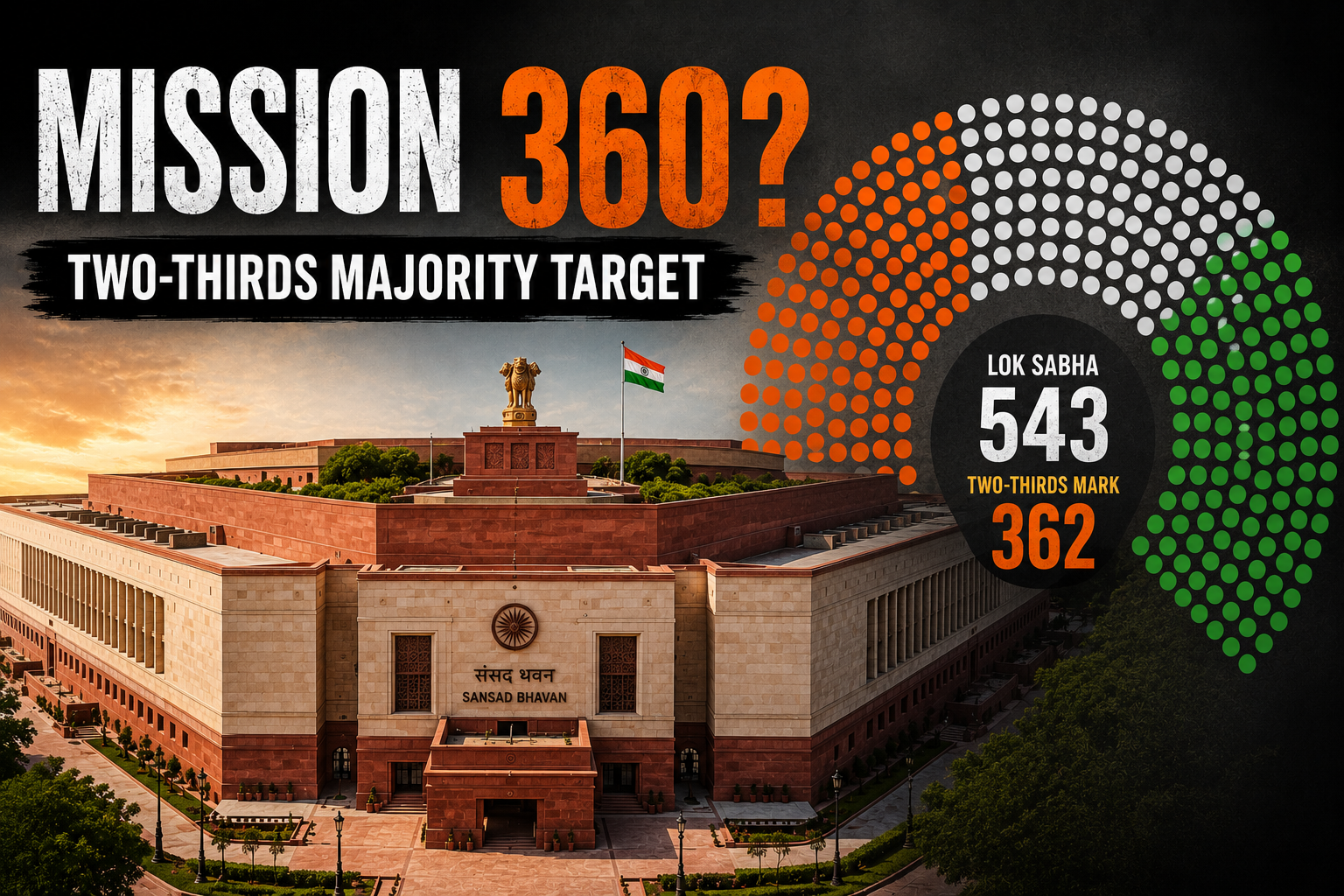
That debate has gained momentum ahead of the Monsoon Session of Parliament, where several politically sensitive issues, including delimitation and the eventual implementation of women’s reservation, are expected to remain central to national politics. Reports suggest the BJP has begun internal consultations around what is informally being called “BJP Mission 360”, an effort to expand the NDA’s strength in the Lok Sabha to a level that would comfortably cross the two-thirds mark required for major constitutional amendments.
The discussion has revived an old political question. Is this simply electoral planning for 2029, or the beginning of a broader constitutional and political strategy?
Why the Number 360 Matters
Under Article 368 of the Constitution, most constitutional amendments require the support of at least two-thirds of members present and voting, while also requiring a majority of the total strength of each House of Parliament.
In practical political terms, a larger majority offers governments greater flexibility to pass constitutional amendments without depending heavily on smaller allies or persuading sections of the Opposition.
For the BJP, crossing the 360-seat mark with its allies would create a far more comfortable parliamentary position than its current numbers. It would also reduce uncertainty during contentious legislative battles.
Political observers note that constitutional amendments often become difficult not because governments lack a simple majority, but because they fall short of the higher threshold required for structural reforms.
Delimitation Has Returned to the Centre of Political Debate
The renewed discussion around parliamentary arithmetic cannot be separated from delimitation.
Delimitation is the process of redrawing parliamentary and assembly constituencies based on population changes. India has not undertaken a nationwide delimitation exercise since 2008, using the 2001 Census, because seat redistribution has remained frozen under constitutional provisions.
The issue has become politically sensitive because population growth has varied sharply across states. Southern states argue that they should not lose political influence for successfully controlling population growth, while several northern states could gain additional representation if seats are redistributed purely on demographic changes.
This disagreement has transformed delimitation from an administrative exercise into one of India’s biggest political questions.
Why Supriya Sule’s Statement Matters
The latest twist came when Nationalist Congress Party (Sharadchandra Pawar) leader Supriya Sule indicated that her party could consider supporting the proposed delimitation legislation if every state received an equal 50 percent increase in Lok Sabha seats.
She later clarified that no final decision had been taken and that any official position would be discussed within the INDIA bloc before the party committed itself publicly.
Even so, the remarks attracted attention because they appeared more conciliatory than the party’s earlier opposition during previous parliamentary discussions.
Congress leaders, according to multiple reports, remain cautious about the evolving position of the NCP (SP), even though Sule has publicly rejected speculation about any move towards the NDA.
The Congress Sees a Larger Political Battle
For the Congress, delimitation is no longer only about constituency boundaries. The party has repeatedly argued that any attempt to alter parliamentary representation must protect federal balance and ensure that states which implemented successful population control policies are not disadvantaged.
Congress leaders have also linked the BJP’s pursuit of a stronger parliamentary majority with its broader constitutional agenda, although the BJP has consistently rejected such allegations.
This disagreement explains why delimitation has become one of the defining political issues before the next general election.
Women’s Reservation Is Closely Linked
The debate has another important dimension.
The Constitution (106th Amendment) Act, popularly known as the Women’s Reservation Act, provides for reserving one-third of seats in the Lok Sabha and state assemblies for women. However, its implementation is tied to a future delimitation exercise after the relevant Census process.
That connection means discussions on delimitation inevitably revive questions about when women’s reservation will actually come into force.
Women’s organisations have recently urged the government to ensure that the reservation is implemented without unnecessary delay, reflecting the growing political urgency surrounding the issue.
Parliament Numbers Are Only One Part of the Equation
Even if the BJP aims to reach the symbolic 360-seat mark, electoral arithmetic alone does not determine constitutional change.
Many constitutional amendments also require ratification by at least half of India’s state legislatures when they affect federal provisions. This gives regional parties substantial influence, regardless of the Lok Sabha numbers.
That reality explains why the BJP continues investing in expanding its footprint beyond traditional strongholds while simultaneously strengthening relationships with regional allies.
Political negotiations outside Parliament may ultimately prove as important as the numbers inside it.

Curated news reports, in-depth analysis, and special features by India’s Opinion editorial team.