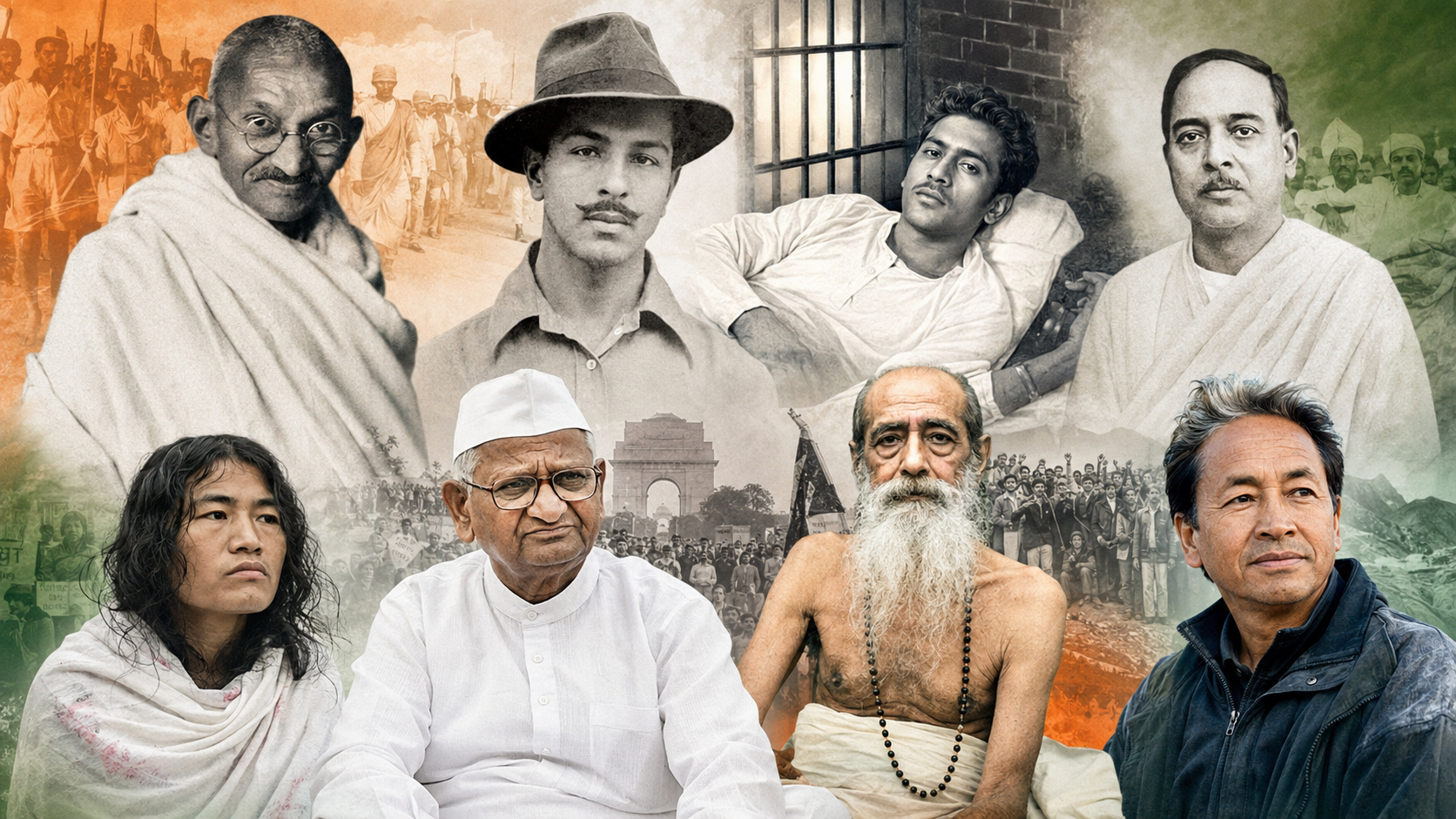
India has a long history of protest through fasting. The stories of famous hunger strikes in India show how, from the freedom struggle to modern campaigns over corruption, statehood, civil rights and government accountability, hunger strikes have repeatedly turned individual sacrifice into a national political question.
The issue has returned to public attention with activist Sonam Wangchuk’s ongoing hunger strike in Delhi. His protest has once again highlighted the place hunger strikes occupy in India’s political history, where fasting has been used by freedom fighters, social reformers, activists and political campaigners to pressure governments and draw public attention to their demands.
But the tradition is far older than the latest protest. Some hunger strikes lasted days, while others continued for months or even years. Several became turning points in India’s history.
Mahatma Gandhi and fasting as a political weapon
No discussion of hunger strikes in India can begin anywhere else but with Mahatma Gandhi.
Gandhi used fasting repeatedly during the freedom movement and later to address communal violence, social discrimination and political disputes. His fasts were based on the idea that personal suffering could create moral pressure on opponents and supporters alike.
One of his well-known fasts came in 1924, when he fasted for 21 days while appealing for Hindu-Muslim unity. He also undertook fasts connected to the campaign against untouchability and other social causes.
Gandhi’s approach made fasting a powerful form of non-violent political action. It could attract enormous public attention without the use of weapons or physical force.
His influence also helped establish fasting as one of the most recognisable forms of protest in India’s political culture.
Bhagat Singh and the 1929 jail hunger strike
Bhagat Singh’s hunger strike was not a protest against an elected Indian government. It took place during British rule and focused on the treatment of Indian political prisoners.In 1929, Bhagat Singh and fellow revolutionaries demanded better conditions and equal treatment for Indian prisoners.
They objected to what they regarded as discriminatory treatment inside colonial prisons.The hunger strike lasted 116 days, making it one of the most famous prison protests in India’s history.
Revolutionary Jatindra Nath Das died during the protest after a prolonged fast, triggering widespread anger and public sympathy.The protest helped turn prison conditions into a major political issue.
It also strengthened Bhagat Singh’s image as a revolutionary willing to endure extreme personal suffering for a political cause.
Potti Sreeramulu and the creation of Andhra State
Potti Sreeramulu’s hunger strike had consequences that reshaped India’s political map.In 1952, he began a fast demanding a separate state for Telugu-speaking people.
He died after fasting for 58 days.His death triggered widespread protests and public anger.
The movement eventually contributed to the creation of Andhra State in 1953, an event that accelerated the reorganisation of Indian states along linguistic lines.
Sreeramulu’s protest demonstrated the enormous political consequences a hunger strike could produce when a demand gained broad public support.
Darshan Singh Pheruman and the Punjab question
Darshan Singh Pheruman undertook a hunger strike in 1969 over demands connected to the inclusion of Chandigarh and Punjabi-speaking areas in Punjab.
He died after 74 days of fasting. His protest became part of the larger political history surrounding the reorganisation of Punjab and the demands of Sikh political movements.
His death also showed the potentially fatal consequences of indefinite hunger strikes when governments and protesters fail to reach an agreement.
Master Tara Singh and the demand for a Punjabi-speaking state
Master Tara Singh, a major Sikh political leader, also used fasting as a form of political pressure.In 1961, he went on hunger strike at the Golden Temple while demanding the creation of a Punjabi-speaking state. He ended the fast after 48 days.The movement eventually contributed to the creation of Punjab in its present form after the reorganisation of the state in 1966.
Irom Sharmila’s 16-year hunger strike
Among the longest and most extraordinary hunger strikes in modern history was the protest by Irom Sharmila in Manipur.She began fasting in November 2000 after the Malom incident, in which 10 civilians were killed. Her protest later became focused on the repeal of the Armed Forces (Special Powers) Act, or AFSPA, in Manipur.
Sharmila continued her fast for 16 years. She was repeatedly detained and was fed through a tube during her detention.
She ended the hunger strike in 2016 after 16 years of protest. Her campaign brought international attention to the debate over AFSPA and the conflict between security laws and civil liberties.
Although the fast did not lead to the repeal of AFSPA, Sharmila became one of the most recognised symbols of non-violent protest in modern India.
Anna Hazare and the anti-corruption movement
In 2011, Anna Hazare’s hunger strike became one of the largest political movements in India in the digital era.Hazare fasted in support of a stronger anti-corruption law and the creation of a powerful Lokpal institution.
His protest at Delhi’s Ramlila Maidan attracted widespread public attention and became the centre of the India Against Corruption movement.
The movement placed corruption at the centre of national political debate. It also helped create a new generation of political activists and contributed to major changes in India’s political environment.
Hazare’s fast showed how television news and social media could amplify a hunger strike across the country within days.
Surat Singh Khalsa and a prolonged protest
Sikh activist Surat Singh Khalsa began a prolonged hunger strike in 2015 demanding the release of Sikh prisoners who, according to his supporters, had completed their sentences.His fast continued for years, with reports stating that he was fed through a nasal tube during the protest. The hunger strike ended in January 2023.The protest drew attention to the complicated legal and political debate surrounding prisoners who remain incarcerated after completing their sentences.
Jagjit Singh Dallewal and the farmers’ movement
Farmer leader Jagjit Singh Dallewal began an indefinite hunger strike during the farmers’ protest movement over demands including a legal guarantee for minimum support prices for crops.His fast became a major point of attention during the continuing farmers’ agitation and raised concerns over the health risks associated with prolonged fasting.The protest also showed how hunger strikes remain a major tool in contemporary Indian movements, particularly when campaigners seek to create sustained public and political pressure.
G.D. Agarwal died after a 111-day fast to save the Ganga
G.D. Agarwal, a former IIT Kanpur professor and environmental activist who later became known as Swami Sanand, died in 2018 after a 111-day hunger strike demanding stronger action to protect the Ganga.Agarwal had campaigned against pollution and projects that he believed threatened the river’s ecological health.
He began his fast after repeatedly demanding government action on the issue.His health deteriorated during the prolonged protest, and he died on October 11, 2018. His death renewed debate over the condition of the Ganga and the government’s response to environmental activists who use hunger strikes to demand action.
Agarwal’s protest remains one of the most recent prominent cases in India in which an activist died after a prolonged hunger strike.
His death also added another name to the country’s long history of protest movements in which fasting became a final act of resistance.
Sonam Wangchuk and the latest chapter
Sonam Wangchuk’s current hunger strike has added a new chapter to India’s long history of fasting as protest.The activist’s campaign has been linked to demands involving accountability in India’s examination system and broader concerns raised by supporters about education and public examinations.
The protest has attracted political support and renewed attention to the use of hunger strikes as a method of public pressure.The immediate outcome of the protest remains uncertain. Its wider significance, however, is already clear.
Once again, a hunger strike has placed questions of government accountability, public trust and the limits of political protest at the centre of national debate.
Why hunger strikes continue to matter in India
The power of a hunger strike comes from its simplicity. A protester does not need a large organisation, weapons or significant financial resources to begin one.The method also creates a moral and political dilemma for governments. If authorities ignore a prolonged hunger strike, they may face public criticism if the protester’s health deteriorates. If they negotiate, they may be accused of allowing a protest tactic to dictate policy.
India’s history shows that hunger strikes do not always succeed. Irom Sharmila’s protest did not result in the repeal of AFSPA, while other fasts have produced major political changes.The outcome usually depends on several factors, including public support, the strength of the demand, the political environment and the government’s willingness to negotiate.
From Gandhi’s campaigns against social injustice to Bhagat Singh’s prison protest, Potti Sreeramulu’s statehood movement, Irom Sharmila’s 16-year struggle and Anna Hazare’s anti-corruption campaign, hunger strikes have repeatedly forced India to confront difficult political questions. As Sonam Wangchuk’s protest continues, the country’s long history of fasting as a form of resistance remains deeply relevant to the present.
Umar Khan is a writer driven by curiosity and a passion for understanding the world. Through thoughtful analysis and evocative storytelling, he seeks to make complex ideas accessible, inspire meaningful conversations, and encourage fresh perspectives on the people, places, and issues that shape our shared future.