
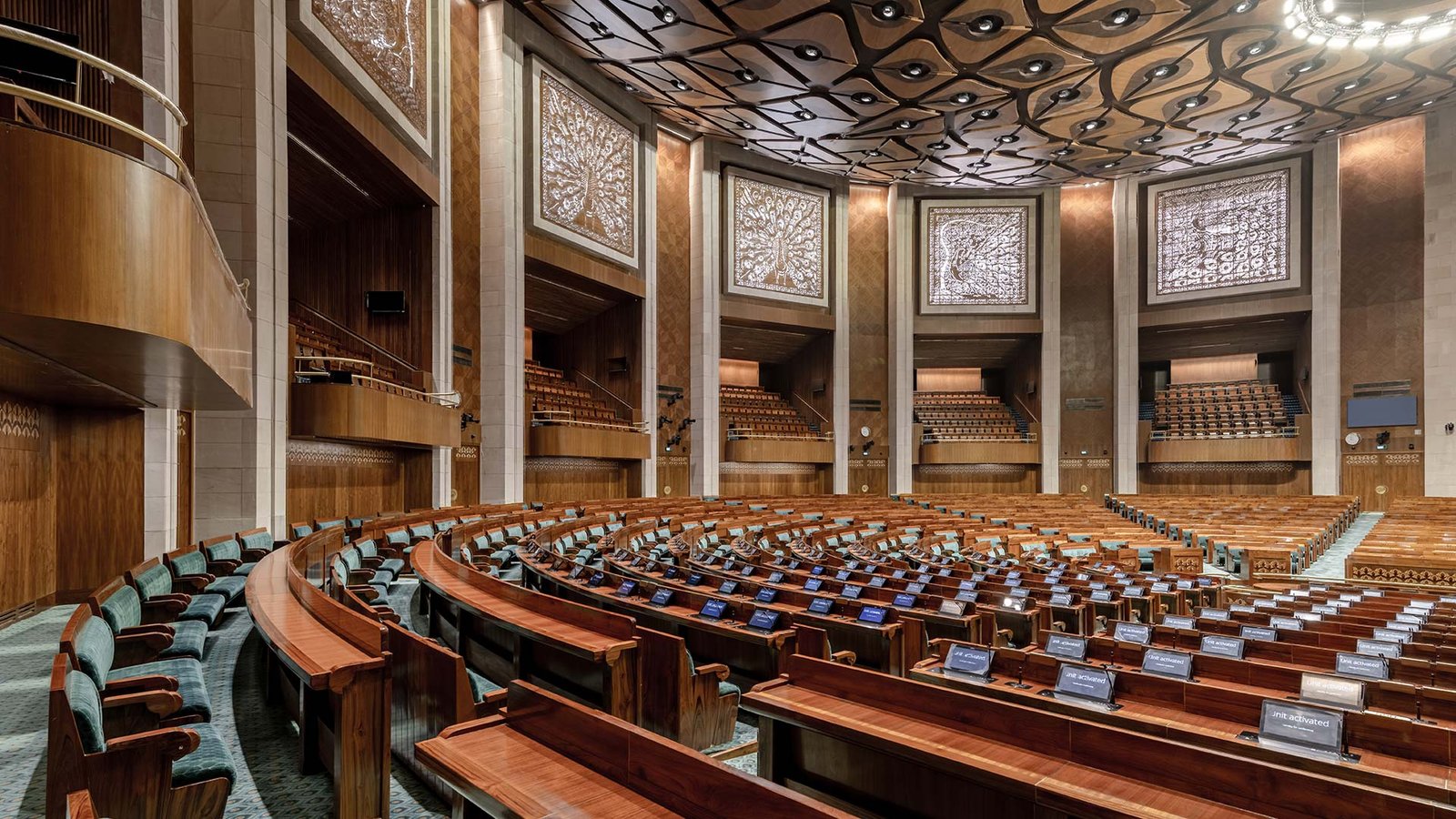
A proposed law does not become an Act simply because the government announces it. To understand how bills are passed in Indian Parliament, it’s important to look at the formal steps involved. Before most legislation can take effect, Parliament must examine the proposal, debate its provisions and approve the final text. The President then completes the constitutional process by giving assent.
Understanding how bills are passed in Indian Parliament helps explain where lawmakers can question legislation, suggest changes and influence the final law.
The Constitution provides the basic framework for this process. Parliamentary rules then establish the procedures that Lok Sabha and Rajya Sabha follow while considering legislation.
How bills are passed in Indian Parliament begins with introduction
A Bill is a draft proposal for creating a new law or changing an existing one. A minister can introduce a Government Bill, while a non-minister MP can introduce a Private Member’s Bill.
An ordinary Bill can usually begin in either Lok Sabha or Rajya Sabha. Financial legislation follows separate constitutional rules.
The introduction marks the first formal stage. The House must grant permission for the member to introduce the Bill. Once introduced, the proposal enters the parliamentary record and can proceed to further examination. (Digital Sansad)
Introduction does not mean Parliament has approved the proposal. Members still have several opportunities to examine its provisions.
What happens after a Bill is introduced?
The next stage allows Parliament to examine the proposal in greater detail. The House may consider the Bill directly or refer it to a parliamentary committee.
A Bill can go to a Select Committee of one House or a Joint Committee involving members from both Houses. Such committees can examine clauses, hear evidence and study the likely effects of proposed provisions.
Committee scrutiny can give lawmakers more time to examine technical details than floor debates usually allow. However, Parliament does not have to accept every committee recommendation.
The House then considers the Bill clause by clause. Members can propose amendments, and the House votes on those changes.
How bills are passed in Indian Parliament through debate and voting
The final stage in each House focuses on whether members should approve the Bill.
During the debate, MPs can raise objections, support provisions or seek changes. The presiding officer manages the proceedings according to parliamentary rules.
The House then votes on the Bill. If it passes, the proposal moves to the other House when the Constitution requires approval from both Houses.Article 107 of the Constitution provides the general framework for ordinary Bills.
Both Houses normally need to agree before such legislation can move to the President. (India Code)The second House can pass the Bill as received, reject it or agree to amendments. If it makes changes, the originating House must consider those amendments.
This process gives both Houses a role in ordinary lawmaking. Lok Sabha consists of directly elected representatives, while Rajya Sabha represents the states and Union territories within India’s federal parliamentary structure.
When both Houses disagree
Parliament can face a deadlock when the two Houses disagree over an ordinary Bill.Article 108 of the Constitution provides for a joint sitting in specified circumstances.
These include cases where one House rejects a Bill, where the Houses finally disagree over amendments, or where one House fails to pass a Bill for more than six months after receiving it. (India Code)
A joint sitting brings members of both Houses together to vote on the disputed legislation.The Constitution does not permit this mechanism for every type of Bill. Constitution Amendment Bills cannot go through a joint sitting. Money Bills also follow a separate procedure.
India has held only three joint sittings of Parliament. They concerned the Dowry Prohibition Bill in 1961, the Banking Service Commission (Repeal) Bill in 1978 and the Prevention of Terrorism Bill in 2002. (Digital Sansad)
How bills are passed in Indian Parliament when they involve money
Money Bills receive special treatment under the Constitution because Lok Sabha has greater authority over taxation and government expenditure.
A Money Bill can only originate in Lok Sabha. After Lok Sabha passes it, Rajya Sabha receives the Bill but cannot amend it. Instead, the Upper House can make recommendations.
Lok Sabha may accept or reject those recommendations. Rajya Sabha must return the Bill within 14 days. If it does not, the Bill is treated as passed by both Houses in the form approved by Lok Sabha. (Digital Sansad)
The Lok Sabha Speaker decides whether a Bill qualifies as a Money Bill. The Speaker’s certification accompanies the legislation during its parliamentary journey.
This arrangement reflects the constitutional principle that the directly elected House should exercise primary control over public finances.
How bills are passed in Indian Parliament before presidential assent
After Parliament passes a Bill in the required form, it goes to the President.Article 111 allows the President to give assent or withhold assent.
For a Bill other than a Money Bill, the President can also return it to Parliament for reconsideration.If Parliament passes the Bill again after reconsideration, the President cannot withhold assent. (India Code)
Presidential assent therefore forms the final constitutional stage for most parliamentary legislation.Once the President gives assent, the Bill becomes an Act of Parliament.
The legislation can then take effect according to its provisions, which may specify a commencement date or require a separate government notification.
Constitution Amendment Bills have stricter rules
Constitution Amendment Bills follow a different procedure because they seek to change the country’s highest legal framework.
Such a Bill can originate in either House. However, each House must pass it separately with the special majority required by Article 368. Some constitutional changes also require ratification by at least half of the state legislatures.
The President must give assent once Parliament has passed a Constitution Amendment Bill in accordance with Article 368.
There is no joint sitting for such Bills. If the two Houses disagree, the proposed amendment cannot move ahead through the ordinary deadlock mechanism.
Why the process matters
The parliamentary route creates several points where legislation can face scrutiny. MPs can challenge provisions, propose amendments and demand explanations from the government.
Parliamentary committees add another layer of examination. Their reports can provide lawmakers with detailed analysis before they vote, although the recommendations do not automatically bind Parliament.
Official parliamentary records also allow citizens to track the progress of legislation. Digital Sansad provides information on Bills, including their introduction, parliamentary status, passage and related legislative details. (Digital Sansad)
For citizens, how bills are passed in Indian Parliament is more than a procedural question. It shows how an idea becomes a proposal, how elected representatives scrutinise it and how the constitutional system turns an approved Bill into enforceable law.
When Parliament considers a major Bill, the most important stages to follow are its introduction, committee scrutiny, debate, amendments, voting, consideration by the other House where required, and presidential assent.
Each stage can shape the final legislation and determine whether the proposal becomes law.

Umar Khan is a writer driven by curiosity and a passion for understanding the world. Through thoughtful analysis and evocative storytelling, he seeks to make complex ideas accessible, inspire meaningful conversations, and encourage fresh perspectives on the people, places, and issues that shape our shared future.