
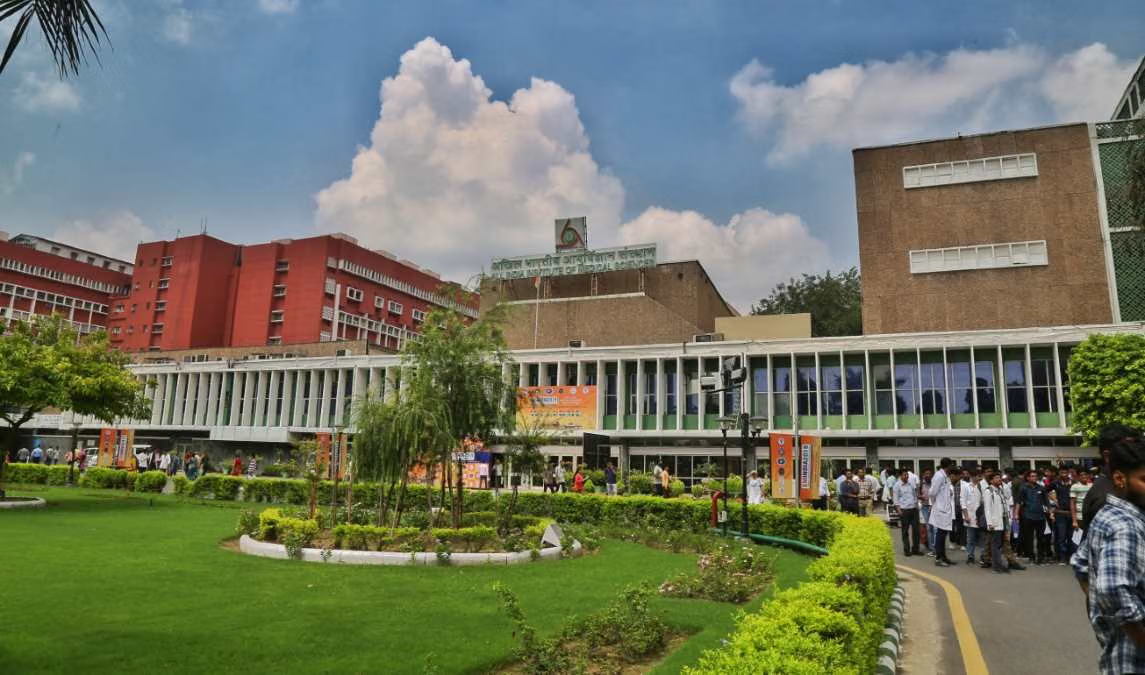
Nearly a third of faculty positions across India’s AIIMS network remain unfilled, the Ministry of Health and Family Welfare has told Parliament. The disclosure came in response to a question from Lok Sabha MP Murari Lal Meena of Dausa. He asked whether a large number of sanctioned faculty and non-faculty posts were lying vacant across the country’s AIIMS institutions.
Minister of State Prataprao Jadhav said that for 2026-27, against 6,304 sanctioned faculty posts across 20 AIIMS, 2,181 remain vacant. The shortage runs deeper on the non-faculty side: of 59,225 sanctioned posts, 15,159, or over 25 percent, are unfilled.
The picture at AIIMS Delhi
The flagship institute in the capital reflects the national trend closely. Of AIIMS New Delhi’s 1,313 sanctioned faculty posts, 877 have been filled, leaving 436 vacant. On the non-faculty side, 11,452 of 13,913 sanctioned posts are occupied, with 2,461 still empty.
A gradual improvement, even if the gap remains wide
The numbers aren’t moving in the wrong direction, at least. Across all 20 AIIMS, the faculty vacancy rate has declined from 39.22 percent in 2023-24 to 34.6 percent in 2026-27. Non-faculty vacancies have fallen even more sharply over the same period, from 39.19 percent to 25.6 percent.
That said, the pace of improvement varies significantly by institute. Newer AIIMS set up over the past decade continue to struggle far more than the original Delhi campus. For example, some report faculty vacancy rates well above 50 percent in recent years. However, the ministry’s data suggests this gap has narrowed only gradually. The network-wide average is improving.
Why the government says posts stay empty
The ministry attributed the persistent gaps to what it called a continuous and dynamic recruitment process. “Filling up of vacant faculty/non-faculty positions is contingent on various factors including availability of suitable/eligible/qualified doctors/health professionals, reservation roster, location of the Institute, etc.,” it said.
The ministry pointed to several measures aimed at speeding up recruitment. Each institute has a Standing Selection Committee, constituted under its respective Act, tasked with selecting faculty.
Beyond that, the government has introduced provisions allowing retired faculty at the level of Professor, Additional Professor and Associate Professor to be engaged on contract at the newer AIIMS, up to the age of 70. They may be drawn from Institutes of National Importance and Government Medical Colleges.
A Visiting Faculty Scheme has also been formulated. This lets professors and associate professors holding academic positions at government institutions in India, or at academic institutions abroad, teach at the newer AIIMS campuses. They can do so without a permanent transfer.
How recruitment actually happens
On the examination side, AIIMS Delhi conducts the Nursing Officer Recruitment Common Eligibility Test to hire nursing officers across the AIIMS network. Additionally, it ran the Common Recruitment Examination twice in 2025 for Group B and C non-faculty positions.
For resident doctors, AIIMS New Delhi conducts the INI-CET for junior residents. It also conducts the INI-SS exam for senior residents twice a year across all AIIMS institutes.
With vacancy rates still sitting above a third for faculty and a quarter for non-faculty staff, the government’s own data suggests recruitment mechanisms are working. However, they are not working fast enough to close the gap in newer AIIMS institutes.
Whether the current pace of improvement holds, or whether newer campuses continue lagging significantly behind Delhi, will likely come up again the next time Parliament asks for an update.

Curated news reports, in-depth analysis, and special features by India’s Opinion editorial team.