
India’s shift to cleaner transport fuels has raised new questions. Many motorists now wonder if using E20 petrol could affect their motor insurance.The concern grew after reports suggested insurers could reject claims if a vehicle using E20 fuel later suffered damage. The Union government has now clarified the issue. It said insurers cannot reject an E20 petrol insurance claim solely because a vehicle used E20 fuel. Importantly, this clarification is expected to reassure millions of vehicle owners. This reassurance comes as the country expands the availability of ethanol-blended fuel.
Government clarifies the E20 petrol insurance claim issue
The Ministry of Petroleum and Natural Gas has stated that the use of E20 petrol, by itself, is not a valid reason for an insurance company to deny a motor insurance claim. This clarification came in response to concerns raised in Parliament. Furthermore, it addressed the public debate surrounding the nationwide rollout of E20 fuel.
According to the government, insurers cannot refuse compensation simply because a policyholder filled their vehicle with petrol containing 20 percent ethanol. Instead, insurance claims will continue to be assessed according to the terms of the policy. The cause of the damage and the available evidence will also be considered. Consequently, they will be judged based on these factors rather than the type of fuel alone.
The ministry also pointed out that the country’s ethanol blending programme has been implemented in consultation with automobile manufacturers and other stakeholders. Many newer vehicles support E20 fuel. Manufacturers still advise caution for some older models. Meanwhile, manufacturers continue to issue guidance for older models that may require caution.
The government says E20 fuel does not invalidate an insurance policy. It also does not automatically create liability issues.
What E20 petrol means for vehicle owners
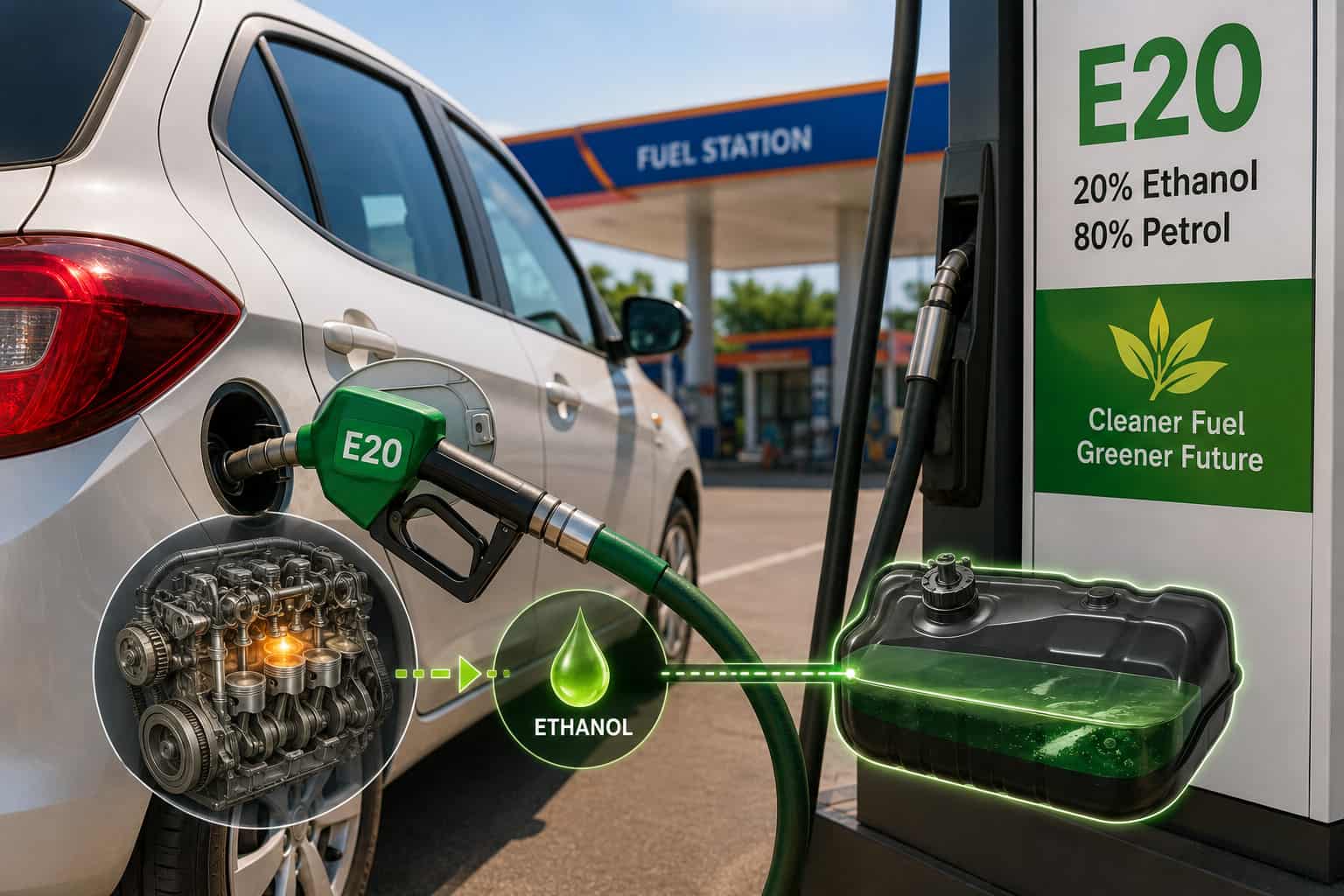
E20 petrol contains 20 percent ethanol and 80 percent petrol. India is expanding its ethanol blending programme to cut crude oil imports. The policy also aims to lower emissions and support domestic ethanol production. Fuel stations across the country are gradually increasing E20 availability.
Vehicle owners should still check whether their model supports E20 petrol. Most new vehicles are designed for the fuel. Some older models may need extra care. Manufacturers advise owners to read the vehicle manual or contact an authorised service centre before switching to E20.
Standard motor insurance policies already exclude certain types of damage, including normal wear and tear, mechanical failure, poor maintenance and damage resulting from negligence. If an insurer believes that a loss falls under one of these exclusions, the claim will be examined on those grounds. Therefore, it will not be judged on the simple fact that E20 petrol was used.
Debate over E20 compatibility continues
The clarification arrives at a time when questions about E20 compatibility remain part of a wider public discussion. During parliamentary proceedings, the government acknowledged that it has not carried out a nationwide assessment of how many vehicles currently on Indian roads are fully compatible with E20 petrol. At the same time, it has defended the ethanol blending programme by citing technical studies and consultations with industry. Additionally, it also mentions the long-term environmental and economic benefits of reducing fossil fuel dependence.
At the same time, it has defended the ethanol blending programme by citing technical studies, consultations with industry and the long-term environmental and economic benefits of reducing fossil fuel dependence.
Consumer groups have also argued that greater public awareness is needed so that vehicle owners clearly understand which models are suitable for E20 fuel and what precautions should be followed. In addition, legal disputes involving alleged fuel-related damage have further highlighted the need for transparent communication between manufacturers, insurers and consumers.
In addition, legal disputes involving alleged fuel-related damage have further highlighted the need for transparent communication between manufacturers, insurers and consumers.
For now, the government’s message is straightforward. An E20 petrol insurance claim cannot be rejected merely because E20 fuel was used. Insurance companies must continue to assess each claim based on the policy conditions and the actual cause of the loss.
As India expands ethanol blending across the country, the clarification removes one of the biggest misconceptions surrounding E20 petrol. However, questions about vehicle compatibility and long-term performance are likely to remain part of the conversation in the years ahead.

Curated news reports, in-depth analysis, and special features by India’s Opinion editorial team.