A month-long protest in Delhi that ended in a Union minister’s resignation has given the Cockroach Janta Party (CJP) something rare in Indian activism momentum. It now wants to carry it beyond the capital. The group is weighing an expansion of its footprint across the country, with core members planning visits in the coming months to states where students have been grappling with long-standing problems in the education system.
Speaking to The Indian Express, CJP spokesperson Ashutosh Ranka said the group intends to visit several states with large student populations facing persistent education issues. “If required, we can also hold protests in these states,” he said.
Not a political party, at least not yet
Asked whether CJP planned to formally evolve into a political party, Ranka said there were no such plans at present. The answer leaves the movement in familiar territory, a protest-driven force that has repeatedly resisted attempts to pin down its future shape.
At a press conference in Delhi on Monday, CJP announced a Rs 1 crore corpus to build a legal aid network for protesters facing cases across the country. It also launched SAAKSHI, an online platform meant to collect evidence related to the violence during the July 20 “Sansad Chalo” march. Senior advocate Kapil Sibal has extended his support to the effort.
Ranka said the party’s core leadership, founder Abhijeet Dipke along with spokespersons Saurav Das and Ratna Singh, will meet in the coming days to decide the movement’s next steps.
“Dipke is recovering from typhoid. We’ll take a few days’ rest before deciding our next steps. Meanwhile, our legal support for those detained or booked during the protests will continue until every protester across the country gets justice,” he said.
Who runs CJP
The organisation’s core team offers a window into how the movement came together. Dipke, 30, hails from Maharashtra and previously worked with the Aam Aadmi Party before pursuing a Master’s in Public Relations at Boston University.
Ranka, based in Rajasthan and a close friend of Dipke, is an IIT Kanpur engineering graduate who went on to complete a Master’s at the London School of Economics.
He runs Parivartan, a platform focused on social welfare and systemic reform. Das, the party’s chief spokesperson, is an investigative journalist, while Singh is a lawyer and former journalist. Both are based in Delhi.
CJP hasn’t run a formal membership drive, relying instead on volunteers who joined on their own. Its core team now numbers around 12, including public policy student Vaishnavi Gaur and Aafreen Nawaz, who left a corporate job to work on student welfare.
How it all started
CJP traces its origin to a remark reportedly made by Chief Justice of India Surya Kant during a hearing in May, in which he likened unemployed youth to “cockroaches.” Dipke responded by launching the Cockroach Janta Party on Instagram on May 16, framed as a satirical jab at the BJP.
Within days, the account had crossed 20 million followers on Instagram, reportedly overtaking every established Indian political party on the platform.
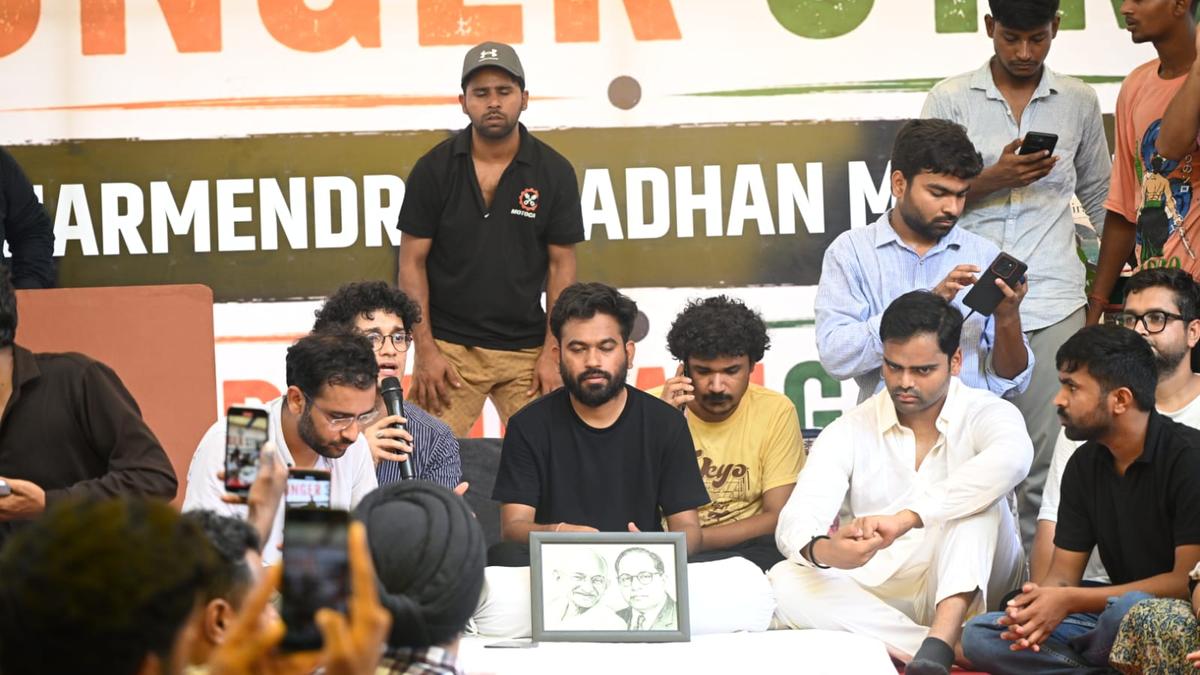
In June, following the NEET-UG paper leak, Dipke called for a protest demanding Dharmendra Pradhan’s resignation and asked supporters to gather at Jantar Mantar.
Activist Sonam Wangchuk joined the movement soon after and began an indefinite hunger strike in support of its demands. The protest eventually culminated in the July 20 “Sansad Chalo” march, which led to clashes with police. Thirty-six days after it began, the protest achieved its central demand: Pradhan resigned on July 25.
With Dipke recovering and the core leadership yet to meet, CJP’s next move remains genuinely open, expansion into new states, continued legal battles for detained protesters, or some combination of both.
Whether the movement can replicate its Delhi momentum in states with entirely different political dynamics will be the real test of whether this was a one-time flashpoint or the start of something more durable.

Curated news reports, in-depth analysis, and special features by India’s Opinion editorial team.