
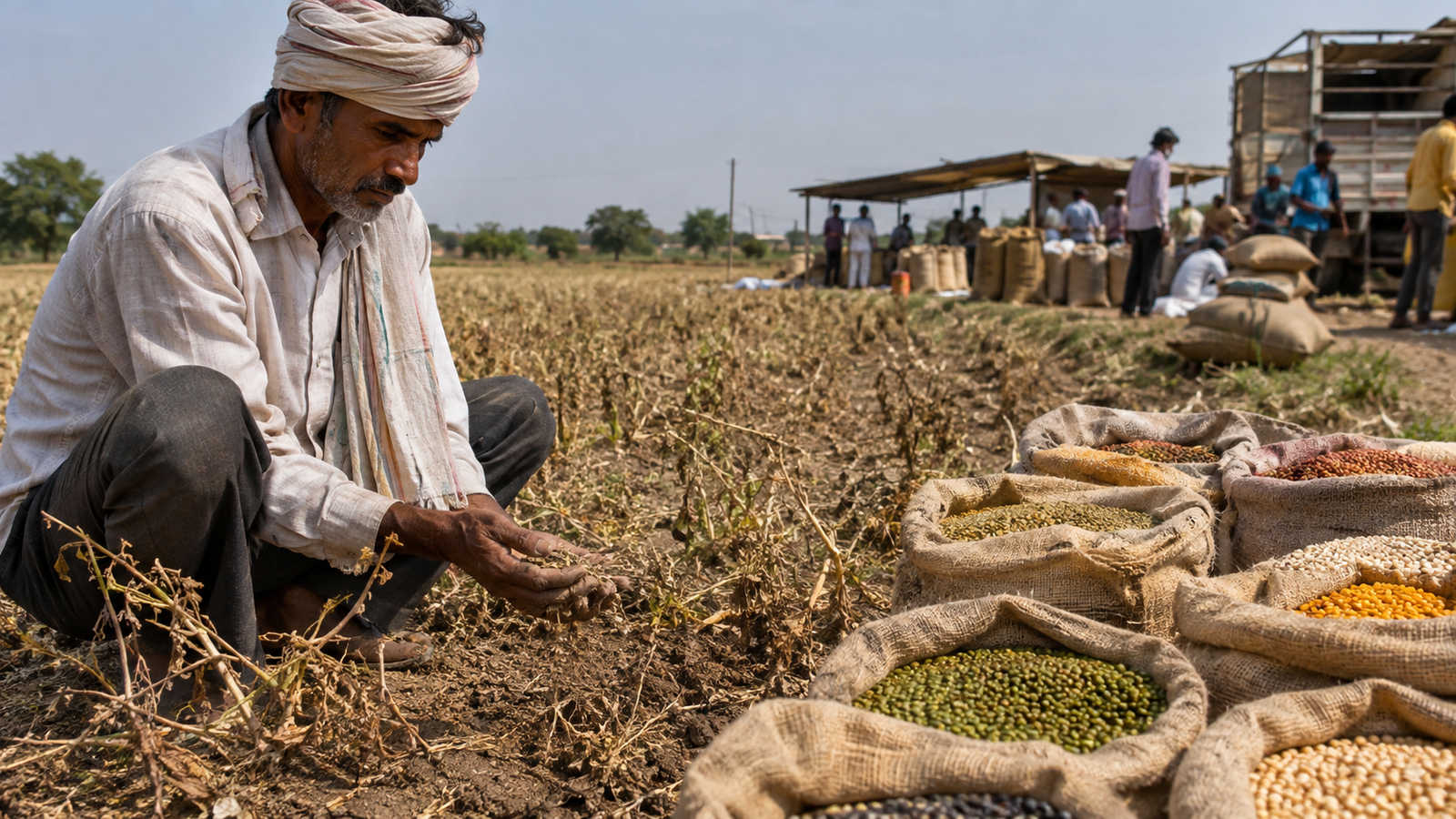
India is considering lowering import duties on selected pulses. A weak monsoon raises concerns over domestic production and food prices ahead of the country’s festive season.
Two government sources and an industry source told Reuters that the government is examining tariff reductions to increase supplies. As a result, these reductions would limit pressure on consumers.
The proposal could cover lentils and yellow peas, while chickpeas may remain outside the reduction. The move comes as India’s June-September monsoon ended with rainfall 12.6% below normal, according to the India Meteorological Department.
The season recorded 759.4 mm of rainfall. This makes it the fourth-lowest monsoon total since 2001, according to IMD data reported on October 1.
India Weighs Lower Pulse Import Duties
India currently imposes a 10% import duty on red lentils and chickpeas, while yellow peas face a 30% duty. The government has already permitted duty-free imports of pigeon peas and black gram until March 2027.
Any additional tariff reduction could therefore focus on other pulses where officials see a need to improve supplies.
A government spokesperson did not immediately respond to Reuters’ request for comment. This means the proposed reductions have not yet been formally announced as policy.
India is the world’s largest producer, consumer and importer of pulses. Imports accounted for around 23% of domestic consumption in 2024-25. In that period, the country produced 25.7 million tonnes and imported 7.3 million tonnes.
Weak Monsoon Adds Pressure
The monsoon is crucial for Indian agriculture because much of the country’s farming depends on rainfall. However, this year’s rainfall pattern was uneven.
Some major pulse-producing states received rainfall as much as 30% below average during the June-September season. Consequently, this raised concerns about the size of this year’s crop.
The weak monsoon has also begun to affect rural demand. Separate Reuters reporting on October 1 showed that Mahindra & Mahindra’s tractor sales fell 21% in September. Escorts Kubota reported a 16.7% decline.
Reuters linked the weaker sales to reduced rural spending following India’s weakest monsoon in more than a decade.
The combination of weaker farm incomes, uncertain crop production and higher food costs could therefore affect both farmers and rural consumers.
Food Inflation Remains a Concern
India’s food inflation has been rising since December and stood at 5.95% in August, according to Reuters. Additionally, pulse prices have also remained elevated.
Inflation in pigeon peas stood at 5.6% year-on-year, while black gram prices rose 7.4% over the same period.
The pressure comes at an important time for consumers because demand for pulses typically increases during India’s festive period.
Households, food processors and traders often increase purchases ahead of major festivals.
If domestic supplies remain tight, increased imports could provide another source of supply and potentially ease some price pressure.
However, the impact will depend on the final tariff decision, global pulse prices, import volumes and the domestic harvest.
Chickpeas Could Be Treated Differently
The government may retain import duties on chickpeas because farmers are expected to begin planting the crop in October.
Keeping the existing tariff structure could encourage farmers to expand chickpea cultivation during the upcoming winter. This may potentially improve domestic supplies later in the season.
This creates a policy balance between short-term consumer prices and longer-term farm production. Lower duties can make imported pulses more competitive and increase availability.
At the same time, cheaper imports can affect prices received by domestic farmers. Retaining some protection for crops entering their planting season could therefore support production incentives.
The government has previously used trade policy to manage food prices, including changes involving vegetable oils and sugar exports.
What Happens Next
The immediate focus will be on the government’s decision over pulse import tariffs. Policymakers will also watch the progress of the upcoming rabi sowing season.
Farmers are expected to begin planting winter crops from October. Weather conditions during the post-monsoon period will therefore remain important for production prospects.
For consumers, the government’s objective will be to maintain adequate supplies while limiting further food-price increases.
For farmers, policymakers will need to balance cheaper imports against incentives for domestic production.
The proposed pulse tariff changes remain under consideration rather than being a final policy decision.
But the discussion highlights how India’s weaker 2026 monsoon is already affecting agricultural markets and rural demand. It is also influencing the government’s approach to food inflation.

Curated news reports, in-depth analysis, and special features by India’s Opinion editorial team.