Chief Minister Mohan Yadav is fighting a battle on two fronts. Even as he worked to contain one of the biggest farmers’ protests of his tenure through negotiations and a newly formed ministerial panel, the Centre pushed back publicly on Wednesday. The Centre opposed the state’s contention that the moong procurement crisis stemmed from inadequate approvals from Union Agriculture Minister Shivraj Singh Chouhan.
In a detailed letter to Yadav, Union Agriculture Minister Shivraj Singh Chouhan defended the Centre’s procurement policy. He said the real problem wasn’t the quantity approved but the pace at which the state was actually procuring.
Citing figures available with the Centre until July 29, Chouhan said Madhya Pradesh had procured only around 60,000 metric tonnes of moong despite a far larger quantity already cleared. “Keeping in mind the larger interest of farmers, the state government is requested to ensure that procurement of moong is expedited at the earliest,” he wrote.
The letter that started it
Chouhan’s response came a day after State Agriculture Minister Aidal Singh Kansana wrote to him. Kansana had sought an increase in the moong quantity that could be procured under the Price Support Scheme (PSS) for the 2025-26 summer season.
Chouhan didn’t hold back in his reply. He opened by noting Madhya Pradesh had already received the country’s largest allocation under the scheme. “For the 2025-26 summer season, procurement of up to 4,54,580 metric tonnes of moong has already been approved for Madhya Pradesh under the PSS.
This constitutes 87% of the total 5,23,243 metric tonnes approved for procurement across all states during the current season. This makes Madhya Pradesh the largest beneficiary in the country,” he wrote.
He also directly corrected a claim in Kansana’s letter. “The letter of Agriculture Minister Aidal Singh Kansana states that the Centre has provided the state a procurement target of 4.54 lakh metric tonnes. The reality, however, is that the Central Government does not assign procurement targets to states,” Chouhan wrote.
How the Centre’s scheme actually works
Chouhan explained that approvals under PM-AASHA aren’t fixed targets but ceilings tied to production. He wrote, “Under the PM-AASHA scheme, approvals under the PSS are granted in accordance with the scheme’s guidelines, which provide for procurement up to 25% of the estimated production,” adding that anything beyond that 25 percent ceiling has to be handled by the state government itself. He said the Centre had “consistently extended the maximum permissible support to Madhya Pradesh under the PSS.”
To back that up, he pointed to a steady rise in approvals over the years. Approvals reached 2.75 lakh metric tonnes in both 2021-22 and 2022-23. In 2023-24, it was 3.30 lakh metric tonnes. For 2024-25, approvals rose to 4.19 lakh metric tonnes. This year, it is 4.54 lakh metric tonnes. “The remaining additional quantity was procured by the state government, and timely procurement of farmers’ moong was ensured,” he wrote.
The CM’s parallel effort to end the agitation
While the letter exchange played out, the Yadav government was working to defuse the protest on the ground. Kansana, State Minister of Cooperation Vishvas Sarang, and Minister of State (Independent Charge) Krishna Gaur held nearly two hours of talks with a 15-member delegation of the Samyukt Kisan Morcha at the Mantralaya.
Following that meeting, the state announced it would raise procurement from 25 percent to 60 percent of every eligible farmer’s moong produce. This translates to roughly three quintals per acre in districts like Narmadapuram, Sehore and Harda. The measure is effective immediately.
“The Madhya Pradesh government has always worked in the interests of farmers. Farmers are the foundation of the state’s economy and prosperity, and the government is fully committed to ensuring they receive fair prices for the crops they produce,” Kansana said.
On the agitation’s second major demand, the government said it would suspend the e-token system for fertiliser distribution with immediate effect until improvements are made.
Kansana described the online system as “an important reform” that would ultimately benefit farmers, while acknowledging the practical difficulties farmers had faced during its initial rollout. The government also extended the procurement slot booking window by 10 days.
Tension on Bhopal’s streets
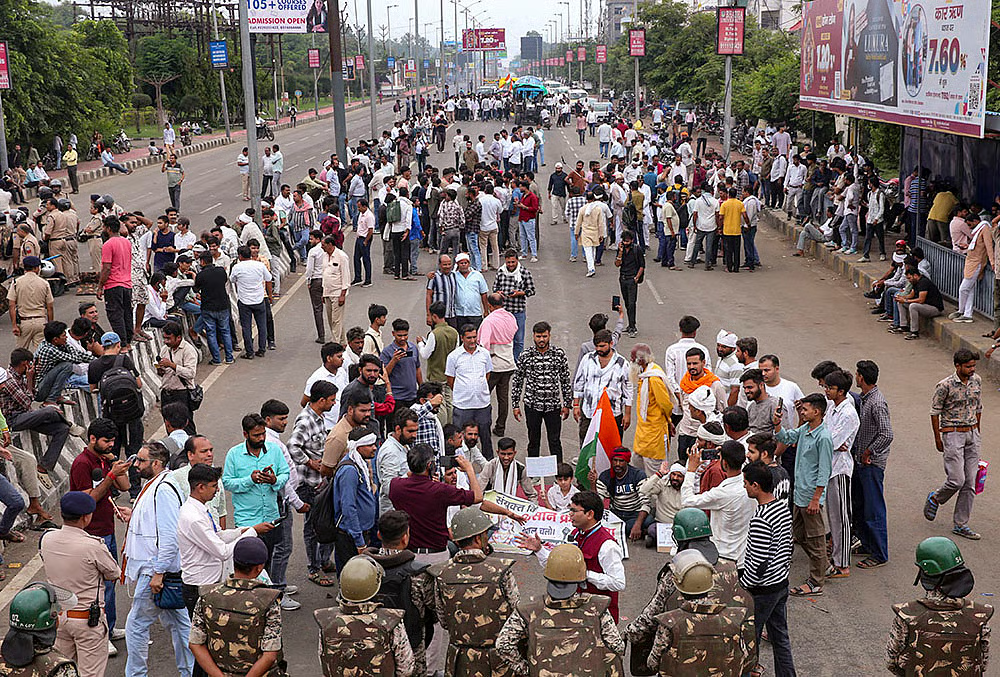
The concessions came against a backdrop of confrontation on the ground. Through the day, farmers clashed with police while trying to break through barricades in multiple parts of Bhopal. Police deployed large numbers of personnel. Meanwhile, buses, dumpers and multiple layers of barricades blocked roads leading to the CM House to keep the march from advancing.
The agitation started on July 27, when thousands of farmers under the Samyukt Kisan Morcha banner launched the Kisan Kranti Padayatra from Sethani Ghat in Narmadapuram toward Bhopal.
Carrying bedding, cooking utensils and food supplies for what was clearly planned as an extended stay, they demanded 100 percent procurement of moong at the Minimum Support Price. They also asked for the withdrawal of the state’s e-token fertiliser distribution system, alleging technical glitches had made fertilisers difficult to access during the sowing season.
With the state raising its own procurement share to 60 percent and suspending the e-token system, the immediate pressure on the ground may ease. But Chouhan’s letter leaves the underlying disagreement unresolved. The Centre insists Madhya Pradesh already has more approval than it’s using. The state has been pushing to raise the ceiling further.
Whether procurement speeds up enough to satisfy farmers before the slot booking extension runs out will determine if this round of talks holds. If not, the agitation may resume.

Curated news reports, in-depth analysis, and special features by India’s Opinion editorial team.