Europe’s seas experienced their hottest summer in at least 45 years in 2026. In fact, Europe’s seas record heat during this season had wide-reaching impacts. Unusually warm waters disrupted marine habitats, changed fish catches, and pushed some species into areas where they were previously uncommon. This article explores how Europe’s seas record heat affected the region and its ecosystems.
A Reuters analysis found that European waters averaged 21.6°C between June and August. This was the highest summer average in the available 45-year record.
Temperature records were reported across a wide area, from the English Channel to the Mediterranean.
The warming has been particularly pronounced in the Bay of Biscay. The average sea temperatures there reached 21.4°C during the summer, more than 2.4°C above the 1991–2020 average.
The US National Oceanic and Atmospheric Administration recorded a satellite-era peak of 23.2°C in the bay on August 13.
Record Heat Across European Waters
One of the most striking measurements came from the waters near Mallorca.
A Spanish port authority buoy recorded 33.02°C on August 5, the highest temperature ever measured across its monitoring network.
The buoy has been recording temperatures since 2006.
The broader pattern is consistent with other European and global ocean observations.
Copernicus reported that July 2026 produced the highest average sea-surface temperature ever recorded for July across the extra-polar global oceans.
The monthly average reached 20.96°C, surpassing the previous July record from 2023.
Mercator Ocean International also reported that the summer of 2026 was the warmest global ocean summer in its dataset. At the same time, large parts of the Mediterranean experienced unusually high temperatures.
About 95% of the Mediterranean was affected by strong or higher marine heatwaves during the summer.
Scientists say marine heatwaves are becoming more frequent, intense and widespread as the planet warms.
Oceans absorb most of the excess heat generated by human-driven greenhouse gas emissions. They can retain that heat for much longer than land surfaces or the atmosphere.
Kelp Forests Under Pressure
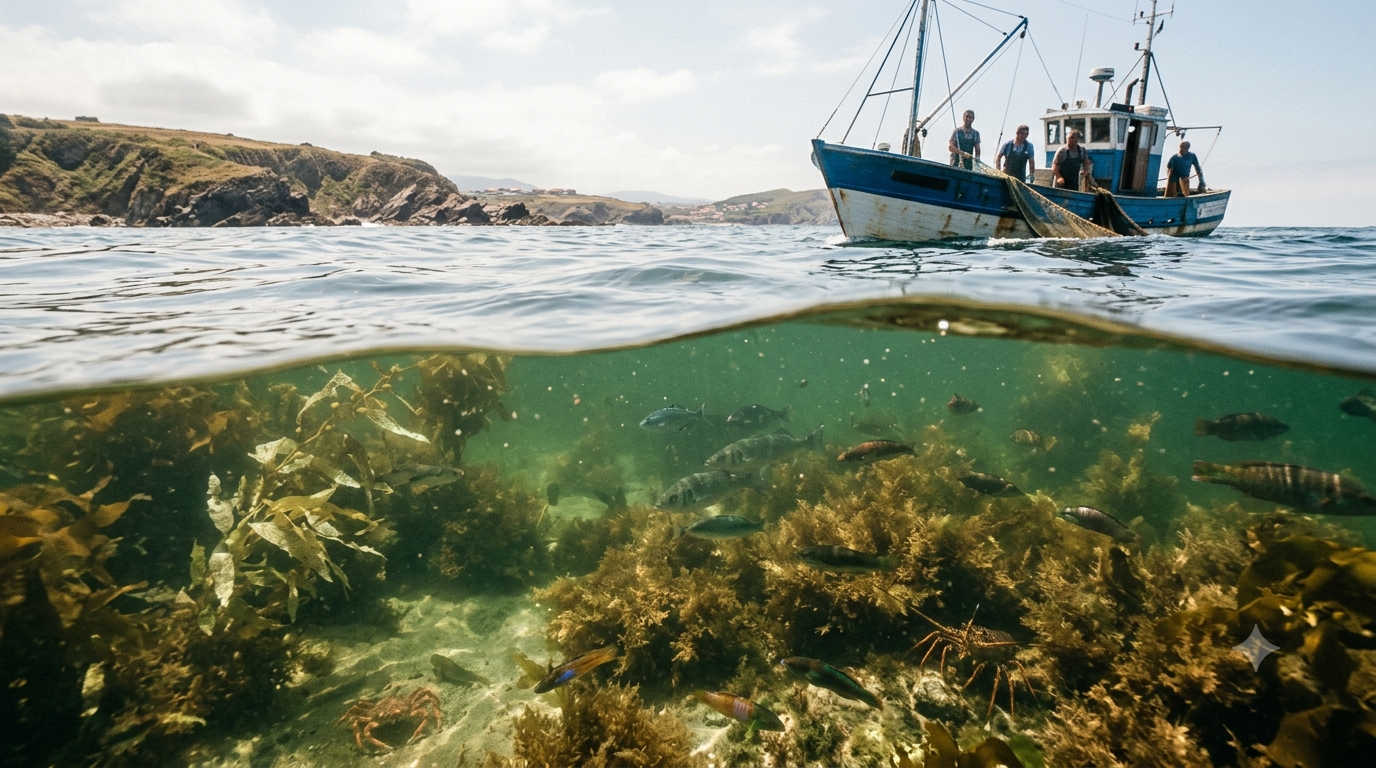
The consequences are becoming visible beneath the surface.The Bay of Biscay was historically known for extensive kelp forests.
These underwater ecosystems provide food, shelter and nursery areas for numerous marine species and support coastal fisheries.
Along parts of the Asturias coast in northern Spain, marine ecologist José Manuel Rico Ordás estimates that around 95% of large brown kelp stands sampled since 2010 have disappeared.
He has attributed the decline primarily to climate change and warmer waters. The loss of kelp can affect much more than the seaweed itself.
Kelp forests create habitat for species including sea urchins, lobsters and crayfish. When those habitats decline, the effects can spread through local food webs and fishing communities. Consequently, researchers and conservation groups are now working on restoration efforts. This includes growing kelp in controlled conditions before placing it back into the sea.
Octopus Numbers Surge in Southern England
At the same time, some warmer-water species are expanding into European waters. For example, southern England has seen a dramatic increase in common octopus catches. According to figures cited in the Reuters analysis, annual octopus landings were below 30 tonnes before 2025.
They reached roughly 2,600 tonnes in 2025 and have exceeded 3,000 tonnes in 2026. Warmer waters can make British coastal areas more suitable for octopuses to survive and reproduce. For some fishermen, the increase offers a new commercial opportunity.
But the ecological shift also creates problems because octopuses prey on species such as lobsters, brown crabs and scallops.
That can put additional pressure on fisheries already dealing with changing sea conditions.The result is an increasingly unpredictable fishing environment.
A species that was once relatively uncommon can become commercially important within a short period, while traditional catches decline.
Mediterranean Faces Another Shift
The Mediterranean is also experiencing major ecological changes. Warmer waters are helping some non-native marine species survive and expand into areas where they previously struggled.
More than 1,000 non-indigenous species have been recorded in the Mediterranean, with some entering through the Suez Canal. As a result, such changes can alter local food chains and increase competition with native species.
The effects are not identical everywhere. Some species benefit from warmer conditions, while others lose suitable habitat. This means that rising sea temperatures are not simply reducing marine biodiversity in one uniform way.
Instead, they are reshuffling marine ecosystems, changing where species live, reproduce and compete.
A Growing Challenge for Coastal Communities
For European fishing communities, the changes create both opportunities and risks. Fishermen may find new species becoming commercially available. However, established fisheries can suffer when traditional species decline or move elsewhere.
The uncertainty also makes long-term planning harder for coastal businesses. Notably, scientists interviewed by Reuters described the speed of the changes as particularly striking. Jean-Pierre Gattuso, a senior research scientist at France’s National Centre for Scientific Research, said records were being broken frequently in many locations.
The 2026 summer therefore represents more than another set of temperature records. The combination of prolonged marine heatwaves and shifting species is changing the ecological and economic conditions of European coastal waters.
Ultimately, the longer-term question is how quickly marine ecosystems and the communities that depend on them can adapt as unusually warm seas become more frequent.

Curated news reports, in-depth analysis, and special features by India’s Opinion editorial team.