
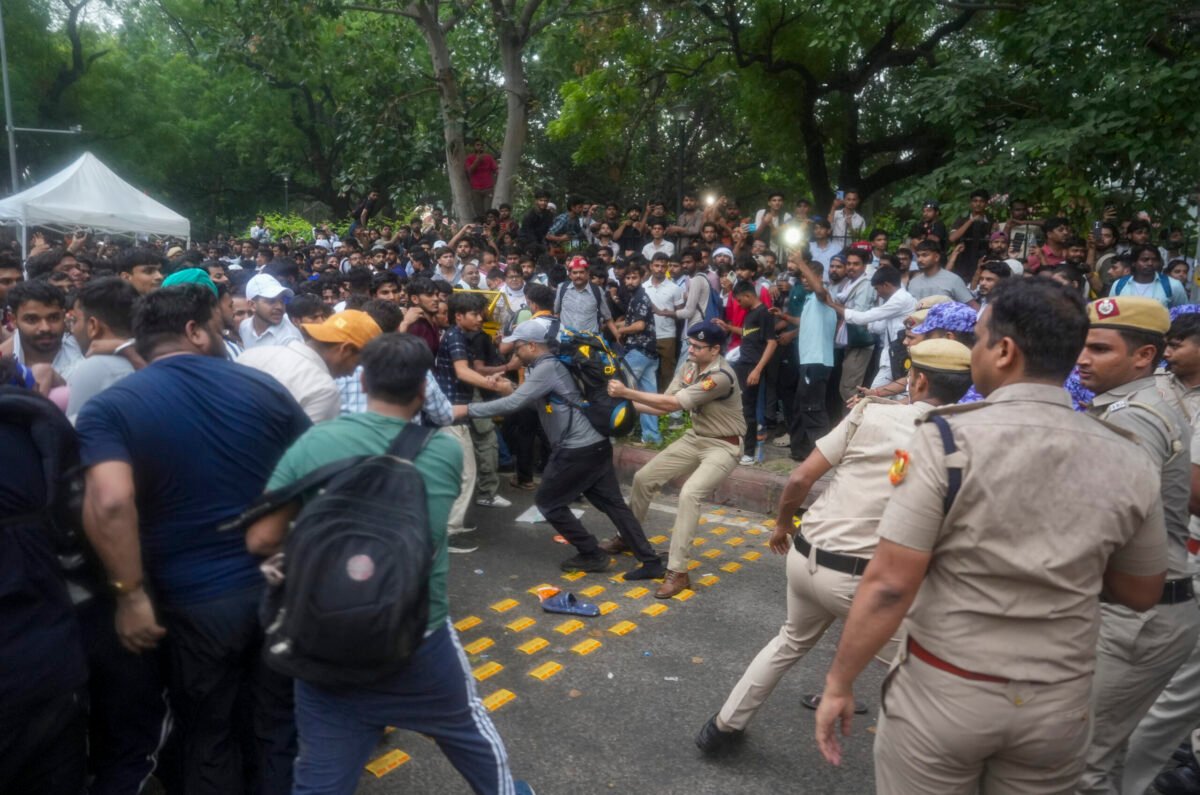
The Delhi Police strongly rejected allegations of conducting illegal mass surveillance on peaceful demonstrators gathered at the Jantar Mantar protest site. Responding to legal petitions challenging the use of advanced surveillance infrastructure, law enforcement authorities maintained that recording activities and running facial recognition checks are standard procedures. These procedures are executed solely to preserve law and order. Moreover, they are carried out to filter out habitual offenders.
“No Snooping, Only Law and Order”: Police Defense in Court
Appearing before the court on behalf of the Delhi Police, Solicitor General Tushar Mehta countered claims that the force was intruding on citizens’ privacy during demonstrations. Mehta argued that protests are a daily occurrence at Jantar Mantar. Therefore, police deployment, videography, and photography serve to prevent antisocial elements from causing disruption.
“At Jantar Mantar, some protest or another is always going on. These are always recorded. As a matter of fact, at this protest, hundreds of people made viral videos. This is only for the purpose of law and order. There is no snooping. There is no surveillance,” the Solicitor General submitted in court.
Police officials backed their argument by disclosing that the Facial Recognition System (FRS) and mobile surveillance vans deployed near the protest site helped identify and isolate over 2,500 individuals carrying criminal backgrounds.
Court Challenges and Privacy Concerns over AI Tools
The controversy triggered multiple Public Interest Litigations (PILs) in both the Delhi High Court and the Supreme Court. Former JNUSU president Aishe Ghosh and civil rights groups filed pleas challenging the deployment of AI-powered surveillance vans and drone feeds. In addition, they challenged body-worn cameras and smart glasses.
The petitioners argued that continuous biometric capturing creates a “chilling effect” on free speech and the fundamental right to peaceful assembly guaranteed under Articles 19(1)(a) and 19(1)(b) of the Constitution.
The Supreme Court agreed to examine the broader legal questions. These questions concern the lack of a explicit legislative framework for deploying real-time facial recognition and biometric tools against crowds in public spaces.

Curated news reports, in-depth analysis, and special features by India’s Opinion editorial team.