The Education Minister’s exit may have eased immediate political pressure, but only institutional reform can restore students’ confidence in India’s examination system.
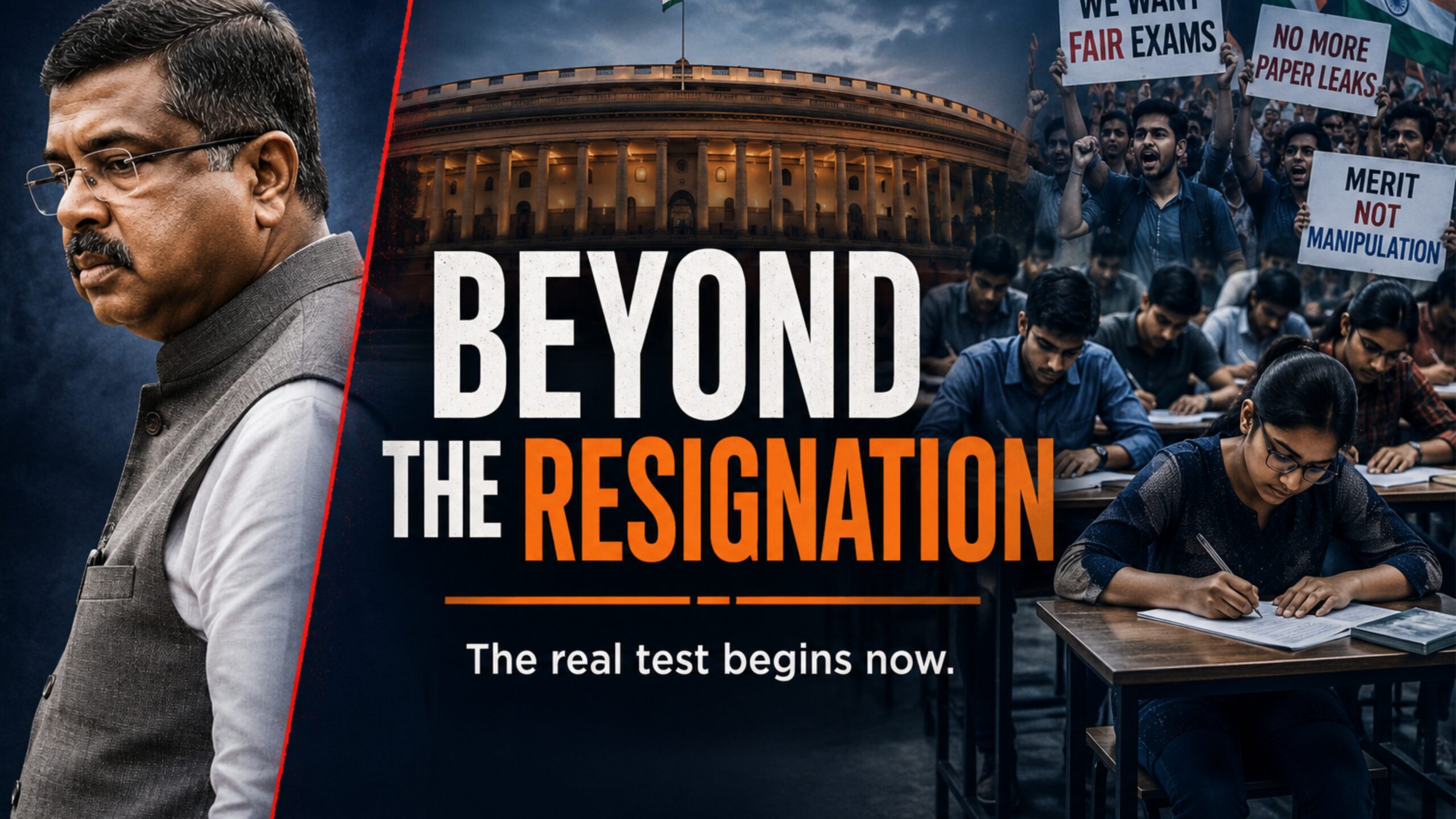
The resignation of Union Education Minister Dharmendra Pradhan has changed the politics of the student protests. Until now, the debate centred on whether the government would accept political responsibility. That question has been answered. A more important one now takes its place: will the resignation mark the end of the crisis, or the beginning of meaningful reform?
That distinction matters because the protests were never only about one minister.
The immediate trigger was the controversy surrounding the recent NEET examination. But the anger on the streets reflected something deeper. Across the country, students have repeatedly raised concerns about examination integrity, paper leaks, delayed recruitment, and the fear that systemic failures can undo years of hard work. Whether every allegation is ultimately proved is for investigators to determine. The larger anxiety, however, cannot be ignored.
More Than an Education Issue
For millions of young Indians, competitive examinations are not just tests. They are the gateway to opportunity. When confidence in that system weakens, the consequences extend far beyond education policy.
The resignation has acknowledged the political seriousness of the issue. It has also created an opportunity to move the conversation beyond personalities and towards institutions.
One lesson of democratic politics is that citizens do not always expect immediate solutions. They do expect to be heard. Governments often lose public confidence not because problems arise, but because people believe those problems are being ignored.
In that sense, the protests may have served a larger purpose. They brought into the open frustrations that had been building over time. Public anger, when expressed peacefully, can act as a corrective. It tells governments where institutions have fallen short and where reform is most urgently needed.
Listening, however, is only the first step. It must be followed by action.
Accountability Must Go Beyond Resignations
Prime Minister Narendra Modi’s statement that “Those who try to harm the future of our youth will not be spared” has now become the benchmark against which the government’s response will be judged. The significance of those words will depend not on the statement itself but on what follows.
The public will expect transparent investigations, swift action against those responsible for examination fraud, and reforms that make future controversies less likely. The resignation has raised expectations. It has not fulfilled them.
Sceptics have reason to be cautious. India has seen promises of reform after previous controversies, only for similar concerns to return years later. A change in leadership, by itself, does not guarantee stronger institutions.
That is why the government’s next steps matter more than its last one.
The Real Test Begins Now
If this moment results in tighter safeguards against examination fraud, greater transparency, faster investigations and a more credible examination system, the protests may ultimately be remembered as the catalyst for long-overdue reform. If not, the resignation will be seen as a political response to a political problem rather than a lasting solution to an institutional one.
Political crises rarely define governments on their own. The response to those crises often does.
Dharmendra Pradhan’s resignation has closed one chapter. It has not concluded the story.
When the protests fade and the headlines move on, one question will remain: will this moment strengthen India’s examination system or become another episode in its long history of reform promises?
That, more than the resignation itself, will determine the legacy of this crisis.

Amrit Pandey is a political researcher and political communication professional specialising in elections, political behaviour and campaign strategy. He holds an MSc in Election Campaign and Democracy from the University of London and an MA in Data, Culture and Society from the University of Westminster.