
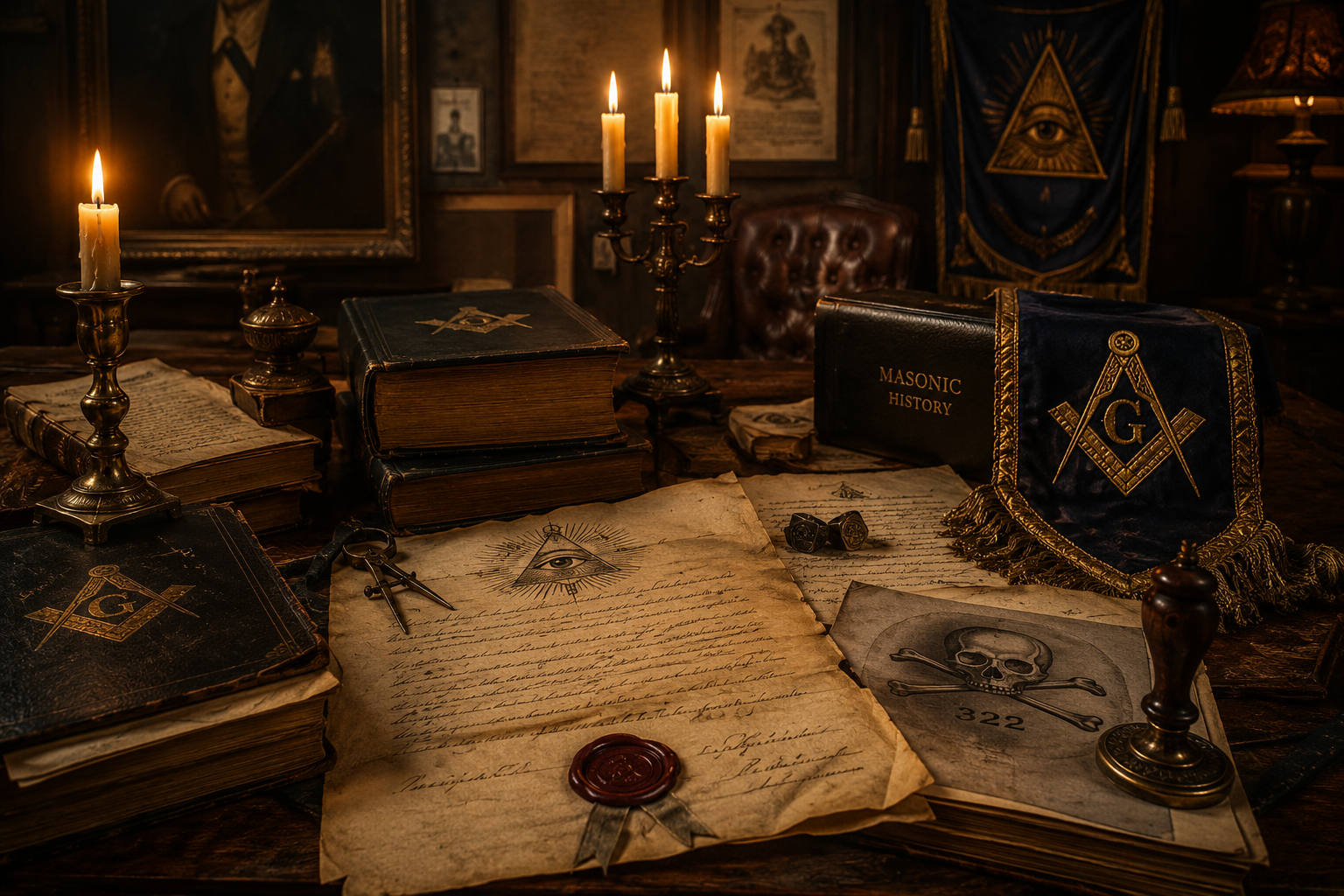
Secret societies have existed for centuries, but their secrecy has often created a gap between what historians can document and what popular culture imagines.
That gap has helped turn private clubs, political networks and fraternal organisations into the subjects of some of the world’s most persistent conspiracy theories.Some groups genuinely operated behind closed doors. Others conducted private rituals but maintained public records and institutions. In many cases, later claims about their influence have gone far beyond the available evidence.
The history of Secret Societies therefore requires a distinction between secrecy itself and allegations of secret control.
What are Secret Societies?
There is no single definition that covers every organisation described as a secret society. Historians generally use the term for groups that restrict membership, keep some activities private or use confidential ceremonies and symbols.
Secrecy can serve different purposes. A political organisation may use it to protect members from persecution. A fraternal group may use private rituals to create a sense of identity.
A revolutionary network may hide its membership because discovery could lead to arrest.That distinction matters because secrecy does not automatically prove criminal activity or a hidden political agenda.
Many organisations that acquired mysterious reputations also left behind documents, buildings, membership records and correspondence. These sources allow historians to reconstruct parts of their history without relying on rumours.
The Illuminati and its short history
Few names have become as closely associated with Secret Societies as the Illuminati.
The historical organisation was the Bavarian Illuminati, founded by Adam Weishaupt in Ingolstadt in 1776. It emerged during the Enlightenment, a period when European intellectuals debated reason, religion, political authority and social reform.The organisation attracted members from intellectual and professional circles.
However, the historical Illuminati did not survive for centuries as the powerful organisation portrayed in modern conspiracy theories.The Bavarian government banned secret societies in 1785, and the historical organisation disappeared soon afterwards.
Claims that the same Illuminati secretly controls modern governments, financial institutions or entertainment industries have not been established by credible historical evidence.
The difference between the documented Bavarian group and the modern mythology surrounding the word “Illuminati” is one of the clearest examples of how a historical organisation can acquire a second life through conspiracy culture.
Freemasonry became a global phenomenon
Freemasonry has a much longer and more complicated history. Modern Freemasonry developed in Britain during the early modern period and spread internationally through networks of lodges.Masonic organisations use ceremonies, symbols and private meetings.
Those features helped create an aura of secrecy around the movement.At the same time, many Masonic institutions have operated openly. Lodges, charitable organisations and public records provide substantial material for historians.
The organisation’s private rituals have nevertheless encouraged speculation about political influence. Individual politicians, businessmen and public figures have belonged to Masonic organisations at different points in history. That fact does not establish that Freemasonry itself directed governments or coordinated world events.
The distinction between individual membership and institutional control is essential when assessing claims about Secret Societies.
Skull and Bones at Yale
Another famous example is Skull and Bones, a senior society at Yale University.The organisation dates to 1832 and has operated from a building known as the Tomb. Yale’s historical records identify the Skull and Bones building at 64 High Street as a student society hall.
Yale University Library also holds archival material connected with the society and its associated Russell Trust Association.Its secrecy and membership among prominent Yale students helped fuel speculation about its influence.
Former members have included people who later became prominent in American public life. But the existence of influential alumni does not by itself establish a coordinated political network.The organisation’s real history is already unusual enough without adding claims that cannot be independently verified.
Why secret societies attract conspiracy theories
The appeal of Secret Societies is closely connected to the psychology of conspiracy thinking.Researchers describe conspiracy theories as explanations that attribute major events to secret plots, often involving powerful groups with hidden motives.
The American Psychological Association has highlighted research showing that people may become more receptive to such explanations when they seek certainty, control or a sense of belonging.Large and confusing events create fertile ground for these explanations.
People naturally want to know why something happened. When reliable information is incomplete, a simple hidden-cause explanation can feel more satisfying than an uncertain answer.Social identity can also influence belief.
Some conspiracy narratives give believers the feeling that they possess information that others have missed.This can create a powerful “insider versus outsider” dynamic.
How the internet changed conspiracy culture
The internet has made it easier to discover information about private organisations. It has also made it easier to mix reliable records with speculation.
A genuine historical document can appear alongside an anonymous claim, a manipulated image and a fictional story. Once these materials circulate together, readers can struggle to distinguish their origins.
Research discussed by the American Psychological Association shows that repetition can increase people’s willingness to accept false information, while emotionally charged claims can become especially persuasive.
This helps explain why old conspiracy theories continue to circulate in new forms.A theory does not need new evidence to become popular again. It may only need a new political controversy, celebrity connection or viral video.
When secrecy is real, evidence still matters
Not every allegation involving a secret organisation is automatically false. Governments, companies, political groups and private organisations have all kept information confidential at different times.
History also contains genuine conspiracies. Criminal groups can plan crimes secretly. Governments can conceal operations. Political organisations can coordinate actions without public knowledge.
The key question is evidence.A credible investigation should examine primary documents, court records, archival material, financial records, contemporaneous reporting and testimony.
It should also distinguish established facts from allegations.That standard becomes especially important when a theory involves real people who could be falsely accused of participating in a secret operation.
Why the myths survive
The modern fascination with Secret Societies is unlikely to disappear soon.
Their combination of hidden meetings, unusual symbols, influential members and incomplete information provides ideal material for books, films, documentaries and social media.But the historical record is often more complicated than the mythology.The Bavarian Illuminati existed, but its documented existence was brief.
Skull and Bones exists, but claims about its alleged control over world affairs require evidence beyond its membership and secrecy.
Freemasonry has a long history, but its private rituals do not prove the sweeping political conspiracies sometimes attributed to it.
The enduring mystery comes from the difference between what these organisations kept private and what people later imagined they were hiding.That distinction is likely to remain central as old conspiracy theories continue to find new audiences online.
The most useful approach is neither to dismiss every unusual claim nor to accept every mysterious story. It is to ask what can actually be demonstrated, what remains uncertain and where the evidence ends.

Umar Khan is a writer driven by curiosity and a passion for understanding the world. Through thoughtful analysis and evocative storytelling, he seeks to make complex ideas accessible, inspire meaningful conversations, and encourage fresh perspectives on the people, places, and issues that shape our shared future.