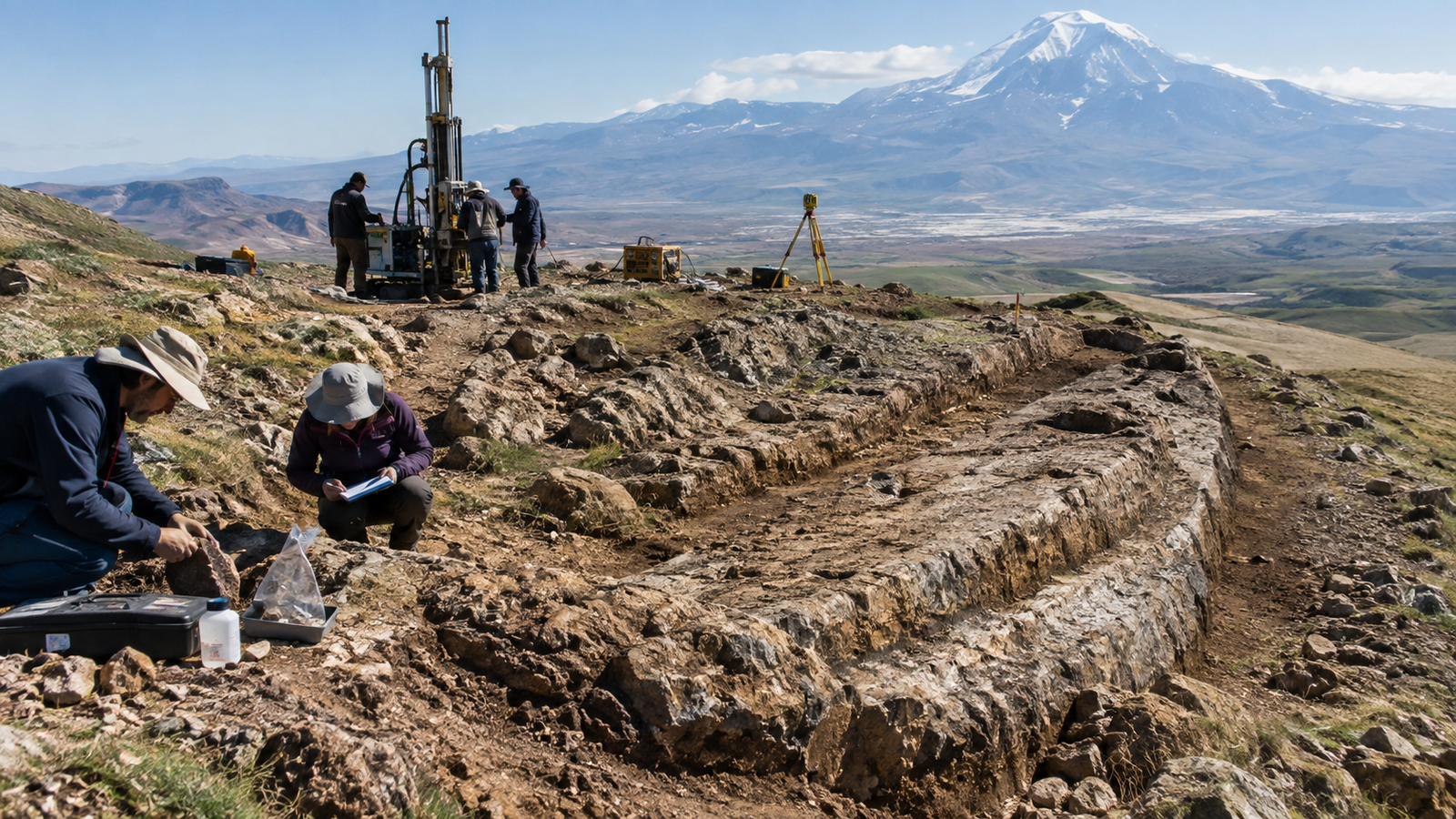
A new investigation into a boat-shaped geological formation in eastern Türkiye has entered a more intensive phase. Researchers are beginning drilling at the site long associated with the biblical story of Noah’s Ark.
The Durupınar formation, located in Ağrı province near Mount Ararat, has attracted attention for decades. This is because its unusual shape resembles a large ship.
Researchers are now collecting geological samples and using underground imaging and other techniques to examine what lies beneath the surface. Furthermore, the work has renewed interest in one of archaeology’s most debated mysteries. However, researchers have not established that the formation is the remains of Noah’s Ark.
Researchers Begin Drilling
The 2026 project is being directed by Prof. Dr. Cenker Atila of Sivas Cumhuriyet University in cooperation with Noah’s Ark Scans.
The project says it has received official authorisation from Turkish authorities for geological and archaeological investigations at the site.
The team has used geophysical methods, including ground-penetrating radar, electrical resistivity tomography and LiDAR, to examine the formation without initially disturbing it. Now, the latest phase involves core drilling.
Researchers hope the samples will provide more information about the geological structure. Additionally, they hope to learn whether any unusual material exists beneath the surface.
Reports from the 2026 field season say researchers collected roughly 1,000 soil samples from about 150 locations. Core samples were also sent for laboratory analysis, while pottery fragments were recovered during the investigation.
Why Is the Site Linked to Noah’s Ark?
The Durupınar formation became widely known after Turkish Army Captain İlhan Durupınar identified the unusual structure in aerial photographs in 1959.
The formation is roughly 157 to 164 metres long, depending on the measurement used. It has a distinctive boat-like outline. Its appearance led some researchers and religious groups to suggest that it could be connected to the Ark described in the Book of Genesis.
The biblical account says Noah’s Ark came to rest on the “mountains of Ararat.”
Some interpretations have connected that description with the region around Mount Ararat in modern Türkiye.
The location has therefore become a point of interest for both religious visitors and people searching for archaeological evidence related to the ancient story.
Radar Images Have Added to the Debate
One reason the site has attracted renewed attention is the use of modern geophysical technology.
The current research programme says its surveys have identified subsurface anomalies that require further investigation. Supporters of the Ark theory have interpreted some of these features as possible corridors or chamber-like structures.
But radar anomalies alone cannot establish that a structure is an ancient ship.
The project’s own description stresses that its findings are currently suggestive rather than conclusive. It also says the research programme does not authenticate historical or religious claims.
Its stated purpose is to document and study the geology and subsurface structure of the formation.
That distinction is important because unusual underground signals can have several geological explanations.
What Will the Drilling Show?
The drilling could provide researchers with physical material that can be analysed in laboratories.
Core samples can reveal layers of rock and soil beneath the surface. Scientists can then study their composition, age and formation processes.
Researchers are also interested in whether organic material is present. If investigators were to find material that could reliably be identified as ancient wood and establish that it came from a man-made structure, it would significantly change the discussion around the site.
However, even such a discovery would require careful dating and independent verification before scientists could connect it specifically to Noah’s Ark. At present, no such evidence has been publicly established.
A Debate That Has Lasted for Decades
The Durupınar formation has been investigated repeatedly since the 20th century.
Some researchers have argued that its shape and internal features could be consistent with a large ancient vessel.
Others have concluded that the formation is a natural geological structure.
Earlier investigations have therefore produced competing interpretations rather than a universally accepted identification.
The latest project is attempting to apply modern surveying and laboratory methods to the question.
Its research team says the work follows an evidence-first approach and that findings will be documented for scientific review.
What Happens Next?
The next important stage will be laboratory analysis of the collected samples. Reports indicate that preliminary findings could emerge within the coming months. Meanwhile, a more complete research report is expected later.
Until those results are available, claims that Noah’s Ark has been discovered remain unverified.
The formation’s unusual appearance makes it an intriguing archaeological and geological site. Still, resemblance to a ship is not sufficient evidence of its identity.
For now, the 2026 investigation provides a new opportunity to test the long-running Ark theory with modern scientific tools.
Whether the drilling uncovers evidence of human construction, an unusual geological structure or something else entirely remains an open question.

Curated news reports, in-depth analysis, and special features by India’s Opinion editorial team.