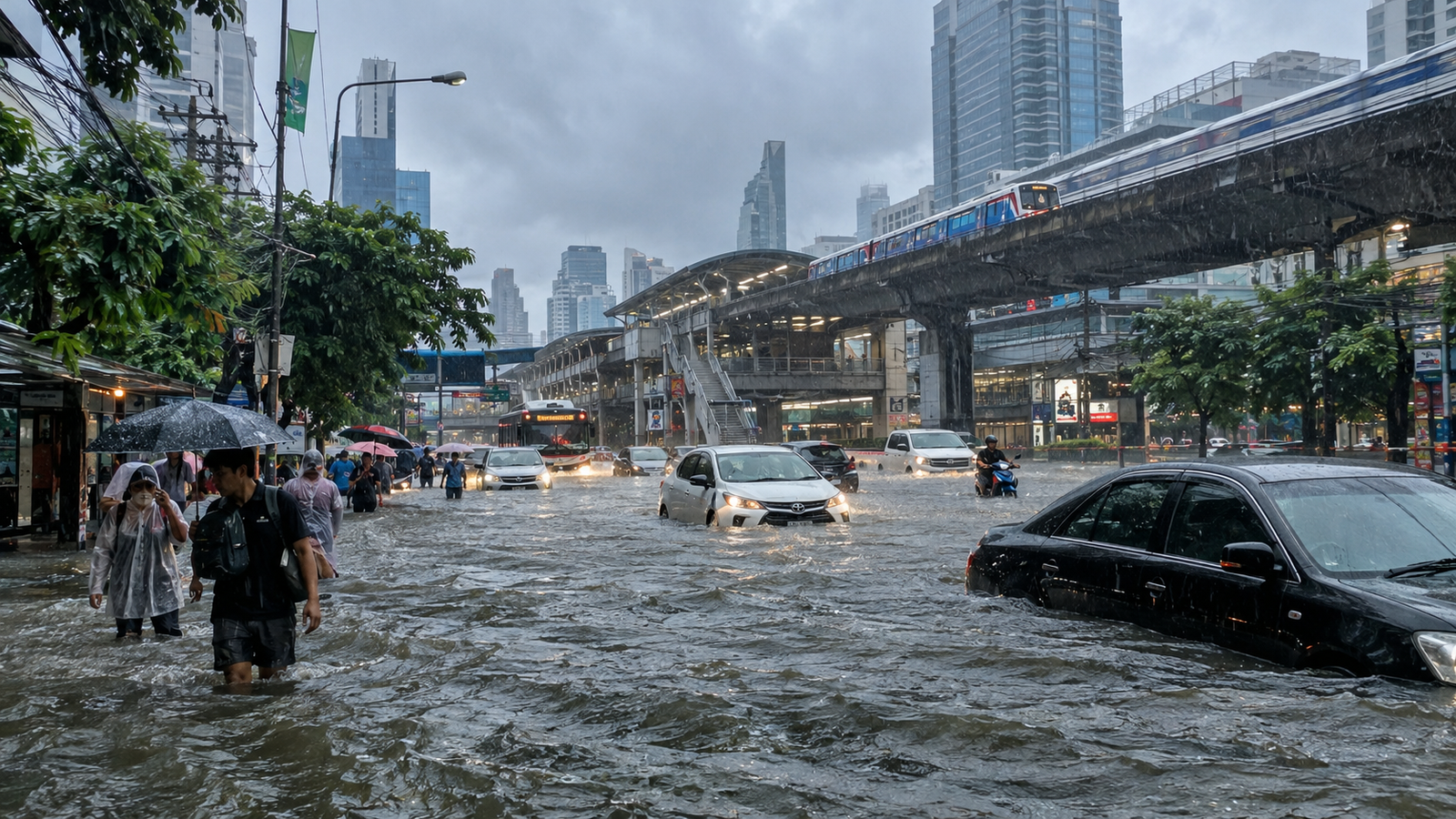
Bangkok has been hit by severe flooding after almost 300 mm of rain fell over roughly 48 hours, forcing authorities to declare all 50 districts of Thailand’s capital a disaster-affected zone on September 26. Roads were submerged, vehicles were partly underwater and residents in some areas had to move through waist-deep water.
The flooding has also renewed attention on a wider problem facing major cities across Asia: how urban drainage systems can cope when intense rainfall arrives faster than water can be removed.
Why Bangkok Flooded So Quickly
Bangkok received more than 150 mm of rain in some areas during more than 24 hours of continuous rainfall.
The Thai Meteorological Department warned that heavy to very heavy rain could continue through September 27 because of an active low-pressure system and strengthening southwest monsoon.
The amount of water falling in a short period put pressure on Bangkok’s drainage network.
Water experts have said that high canal levels can also slow the movement of rainwater away from roads and low-lying communities.
The problem becomes more serious when additional rain continues to enter the system before earlier floodwater has drained.Bangkok’s geography adds another challenge.
Large parts of the city are low-lying, while canals, drainage tunnels, pumping stations and floodgates form an interconnected system designed to move rainwater toward larger waterways.When rainfall exceeds the system’s capacity, water can accumulate rapidly.
Bangkok’s Drainage Network Is Under Pressure
The city has invested heavily in flood-control infrastructure.The Bangkok Metropolitan Administration operates pumping stations, drainage tunnels, floodgates and canals designed to move water away from vulnerable areas.
Authorities have also worked to clear drainage pipes and lower canal levels ahead of periods of heavy rain.
These measures can reduce flooding under many conditions, but they cannot eliminate the risk.
Bangkok Governor Chadchart Sittipunt said on September 25 that more than 200 of over 700 identified flood-risk locations still required improvements.
The city has also been increasing pumping and drainage operations as water levels in several canals approach critical levels.
The current flooding therefore highlights a basic limitation of urban drainage: infrastructure can only remove water at a certain rate.
If rainfall arrives faster than that rate, temporary flooding becomes difficult to avoid.
Extreme Rainfall Is Becoming a Major Urban Challenge
Bangkok is not alone.Cities around the world are increasingly dealing with short periods of very intense rainfall.
Such events can overwhelm drainage networks even when a city’s annual rainfall is not exceptionally high.
Scientists distinguish between the occurrence of an extreme rainfall event and its causes. A single flood cannot automatically be attributed to climate change.
However, climate research has established that a warmer atmosphere can hold more moisture, increasing the potential for heavier precipitation under suitable weather conditions.
This does not mean every individual flood is caused by climate change. Instead, climate change can alter the background conditions in which extreme rainfall occurs.
That distinction is important when assessing events such as Bangkok’s current flooding.
The Role of Urban Growth
Urban development can also influence flood risk.As cities expand, natural surfaces can be replaced by roads, buildings and other impermeable areas.
Rainwater that would previously have soaked into soil instead runs quickly across paved surfaces and enters drainage systems.
Rapid development can therefore increase the amount of water reaching drains during heavy storms.
Bangkok’s challenge is particularly complex because the city has grown around an extensive network of canals and waterways.
Maintaining those systems while accommodating a large urban population requires constant investment.
Waste and blocked drains can make the problem worse, while construction and changes in land use can alter how water moves through the city.
Why Flood Protection Requires More Than Bigger Drains
The Bangkok experience illustrates why flood management increasingly involves more than simply building larger drainage pipes.
Cities can combine conventional infrastructure with measures that slow and temporarily store rainwater.
These can include retention ponds, wetlands, permeable surfaces, green spaces, improved drainage channels and flood-resilient buildings.Early-warning systems are equally important.
When authorities can identify areas at risk before rainfall peaks, residents can move vehicles and belongings to higher ground.
Emergency shelters can also be prepared before roads become impassable.
Bangkok authorities issued warnings to people living near canals and advised them to move possessions to higher ground as water levels increased.
What Happens After the Rain Stops?
The immediate challenge is getting the accumulated water out of the city.
Bangkok’s governor said floodwaters could take two to three days to drain if heavy rainfall stops.
The city’s authorities are operating pumps and other drainage infrastructure to move water through the canal system.But another round of heavy rain could slow that process.
Thailand’s Meteorological Department has warned that heavy to very heavy rainfall could continue through September 27, with a risk of flash floods and overflowing waterways in vulnerable locations.
This makes the next several days important for determining how quickly Bangkok can recover.
A Warning for Other Asian CitiesBangkok’s flooding is relevant beyond Thailand.
Many large Asian cities face similar combinations of rapid population growth, dense construction, low-lying neighbourhoods and increasingly demanding drainage systems.
The lesson is not that urban flooding can be completely prevented.
Instead, the focus is increasingly shifting toward reducing exposure, improving drainage capacity, protecting natural water-storage areas and giving residents enough warning to respond.
For Bangkok, the immediate priority remains clearing the current floodwater and protecting vulnerable communities.
The longer-term question is how the city can continue adapting its infrastructure as rainfall patterns, development and population pressures change.
The September 2026 flooding shows the scale of that challenge.
Even a city with an extensive network of pumps, canals and drainage tunnels can come under severe pressure when extraordinary amounts of rain arrive in a short period.

Curated news reports, in-depth analysis, and special features by India’s Opinion editorial team.