
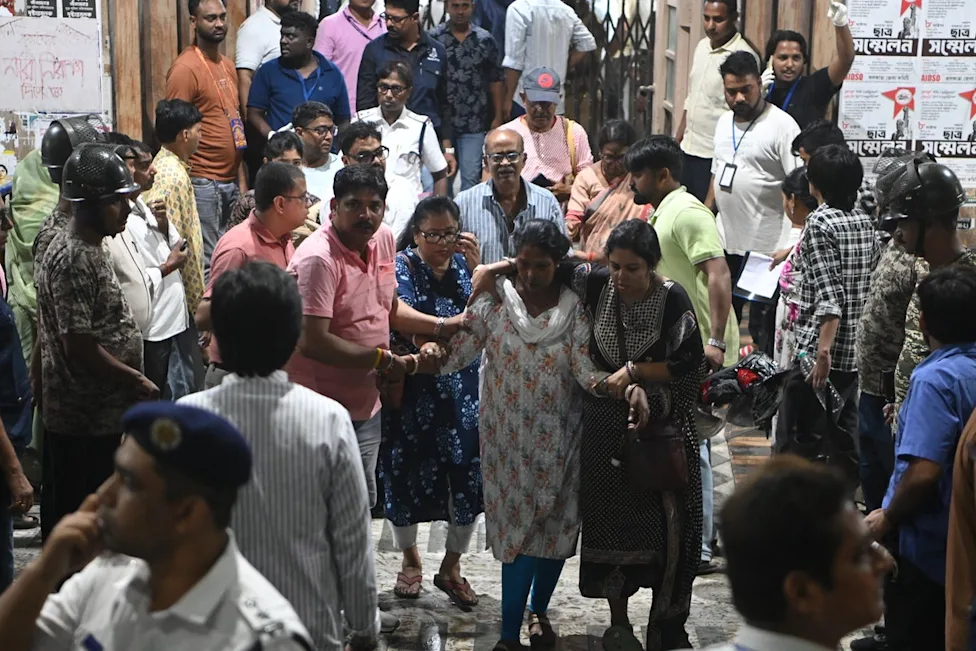
A horrific crowd disaster killed 19 devotees and injured 25 others in north Kolkata on Saturday evening. The tragedy unfolded at the popular Chorbagan Sarbojanin Durga Puja pandal near Girish Park. Tens of thousands of festive visitors had packed into narrow approach lanes to view the deity.
Sudden torrential rain triggered the initial crowd surge as worshippers rushed toward the covered pavilion for shelter. Chaos intensified when false rumors spread that a section of the bamboo structure was collapsing. According to comprehensive on-ground reporting by The Indian Express, panic erupted inside the narrow, barricaded corridor. Worshippers moving forward collided with visitors desperately trying to escape. Therefore, hundreds of people became wedged in an immovable human crush within minutes.
The Lethal Physics Behind Crowd Turbulence
Disaster management experts emphasize that the term “stampede” often misrepresents the real physical hazard. In major gatherings, human beings do not run wildly like animals. Instead, dense gatherings undergo a dangerous physical transition into a fluid-like state.
Crowd safety research demonstrates that a density below three people per square meter remains safe. However, when density climbs past six people per square meter, individuals lose control over their own bodies. As detailed by The Hindu, physical pressure ripples through dense crowds like tidal shockwaves. These invisible pressure waves can generate forces exceeding 4,500 Newtons. Consequently, the collective force easily bends heavy steel barriers and knocks standing adults off their feet.
Why Compressive Asphyxia, Not Trampling, Causes Deaths
Medical examiners confirmed that physical trampling did not cause the majority of deaths in Kolkata. Instead, victims succumbed to compressive asphyxia while standing upright or pinned against barriers. When bodies press tightly together, the human chest cavity cannot expand to take in oxygen.
Intense horizontal pressure cuts off air supply to the lungs without leaving visible bone fractures. Furthermore, victims can lose consciousness within thirty seconds and suffer irreversible brain death within six minutes. Medical reports cited by The Times of India revealed that women and young children suffered the highest casualties. Survivors trapped inside the crush described feeling an overwhelming loss of breath before passing out. As a result, crowd disasters turn fatal long before emergency rescue teams can push through the perimeter.
Panic and Bottlenecks Create Fatal Shockwaves
Structural design flaws and communication failures compound the danger during large religious festivals. The Chorbagan pandal featured narrow entry lanes that forced two-way pedestrian movement through a single access gate.
When visitors encountered dead ends and locked emergency exits, pedestrian flow ground to a complete halt. Meanwhile, arriving crowds outside continued pushing forward, unaware of the deadly blockage ahead. Detailed investigation updates from NDTV revealed that police arrested seven organizers for severe crowd management lapses. In addition, conflicting loudspeaker announcements deepened mass confusion in the dark. Consequently, administrative agencies must treat crowd geometry as a vital life-safety discipline.
Essential Blueprint to Prevent Mass Gathering Disasters
Safety engineers insist that authorities can eliminate crowd crush tragedies through scientific planning. Event managers must enforce strict one-way movement corridors that prevent opposing human streams from colliding.
Organizers should build wide, illuminated escape paths equipped with breakaway barriers. Furthermore, civic authorities must deploy digital cameras and drone monitors to measure crowd densities in real time. If density approaches four people per square meter, police must divert incoming visitors into spacious holding pens. On the other hand, public address systems must deliver calm, factual directions to neutralize spreading rumors. By implementing strict structural safety audits, festival organizers can safeguard millions of festive worshippers across Indian cities.

Curated news reports, in-depth analysis, and special features by India’s Opinion editorial team.