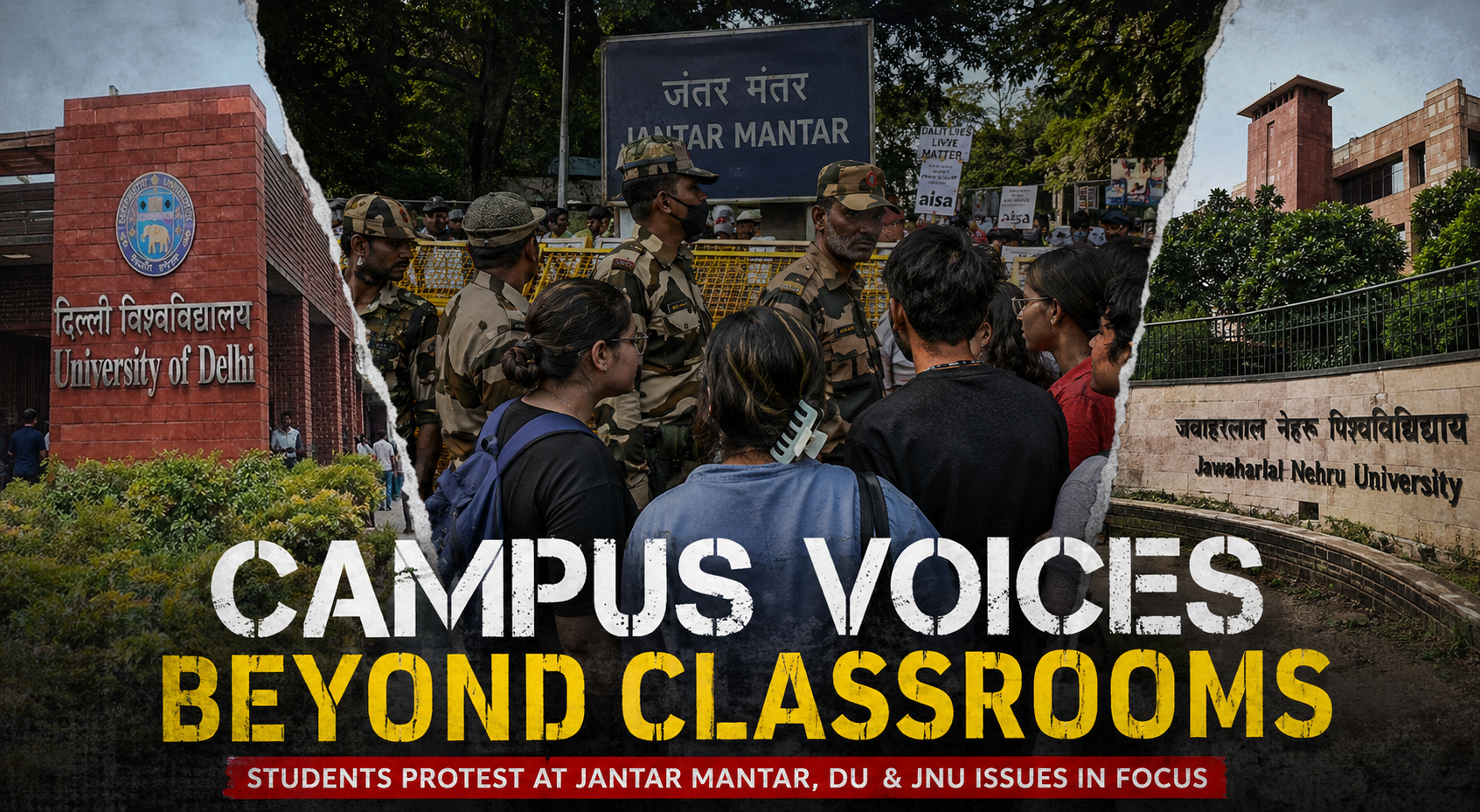
As protests continue at Delhi’s Jantar Mantar, a growing number of universities are asking students and staff to stay away from the demonstration, turning a student-led political controversy into a wider debate over campus autonomy, safety and the right to protest. In recent days, the DU JNU protest advisory has also sparked discussion among students and academic circles.
The latest warning came from Jawaharlal Nehru University on Friday, July 24, after Delhi University issued a similar advisory. The Association of Indian Universities had also appealed to higher education institutions to guide students towards their academic responsibilities amid the continuing unrest. The Times of India
The DU JNU protest advisory has drawn attention because both universities occupy an important place in India’s student politics. JNU has a long history of campus activism, while DU has one of the country’s largest and most politically active student communities.
DU JNU protest advisory cites safety and legal concerns
Delhi University first urged students and faculty members to avoid unlawful assemblies and demonstrations at Jantar Mantar. The university said the protest site operates under restrictions linked to Supreme Court directives and warned that participation in unlawful gatherings could lead to legal action. Hindustan Times
The university had earlier appealed for calm and asked students to focus on their studies and future. A senior DU official also told The Indian Express that students should not become a “political tool” while participating in protests. The Indian Express
JNU followed with a similar advisory on Friday. The university asked students, faculty members and staff to stay away from the Jantar Mantar protest and warned that violations could lead to disciplinary or legal consequences. It also cautioned members of its community against irresponsible activity on social media related to the protest. The Times of India
Why the JNU protest advisory has sparked debate
The JNU warning has generated particular attention because the university has traditionally been associated with political debate and student mobilisation. Critics argue that universities should protect peaceful political expression rather than discourage participation in public demonstrations.
University administrations, however, have pointed to safety, law and order and academic responsibilities. The difference between a lawful protest and an unlawful assembly remains central to the debate, especially because the advisories specifically refer to demonstrations that may violate applicable restrictions.
The DU JNU protest advisory therefore raises a broader question. Can universities warn students about legal risks without appearing to suppress dissent? The answer may depend on whether the advisories remain limited to safety and compliance with the law, or whether they are interpreted as broader restrictions on political participation.
Other universities also ask students to focus on studies
The warnings have not been limited to DU and JNU. The Association of Indian Universities appealed to vice-chancellors and directors of higher education institutions to guide students towards their academic pursuits amid the protests.
The association argued that students should not divert their energy from education while the government is addressing the concerns raised by protesters. The appeal reflects growing concern among university administrators about academic disruption and student involvement in political agitation.
Reports have also pointed to similar advisories or positions from IIT Roorkee and IIT Madras. The pattern suggests that university administrations are increasingly adopting a cautious approach towards student participation in demonstrations outside their campuses.
Universities face pressure from both sides
The controversy places universities in a difficult position. Administrations must protect students from possible legal or physical risks, but students and faculty members also retain rights to express political views within the limits of the law.
The dispute has also exposed differences within university communities. While some institutions and college bodies have expressed support for the government’s position, student forums and sections of students continue to back the protests. The divide shows that an official university advisory does not necessarily represent the views of every member of its campus community.
Political criticism follows university warnings
The advisories have triggered criticism from opposition figures. Congress leader Rahul Gandhi questioned the warnings and criticised attempts to discourage students from raising their voices.
Supporters of the university advisories argue that educational institutions should prevent students from becoming involved in politically driven mobilisation that could expose them to legal consequences. Critics counter that students are citizens and should not lose their ability to participate in peaceful democratic movements simply because they are enrolled in a university.
That disagreement is likely to continue as the protest develops. The debate has now moved beyond the original demands and into questions about the boundaries of institutional authority, student rights and political expression on university campuses.
What happens next in the DU JNU protest advisory row
The immediate focus will remain on the Jantar Mantar protest and how students respond to the warnings. The authorities will also face scrutiny over whether any action follows against students who participate in demonstrations or post about them online.
For universities, the challenge is to maintain safety and academic continuity without creating the perception that political dissent itself is being treated as misconduct. For students, the question is equally direct: how to participate in public life while remaining within the legal boundaries that govern protests.The DU JNU protest advisory has made that tension impossible to ignore.
As the demonstrations continue, the response of universities, students and authorities will determine whether the dispute remains a question of safety and discipline or becomes a larger confrontation over the place of dissent in India’s campuses.

Curated news reports, in-depth analysis, and special features by India’s Opinion editorial team.