
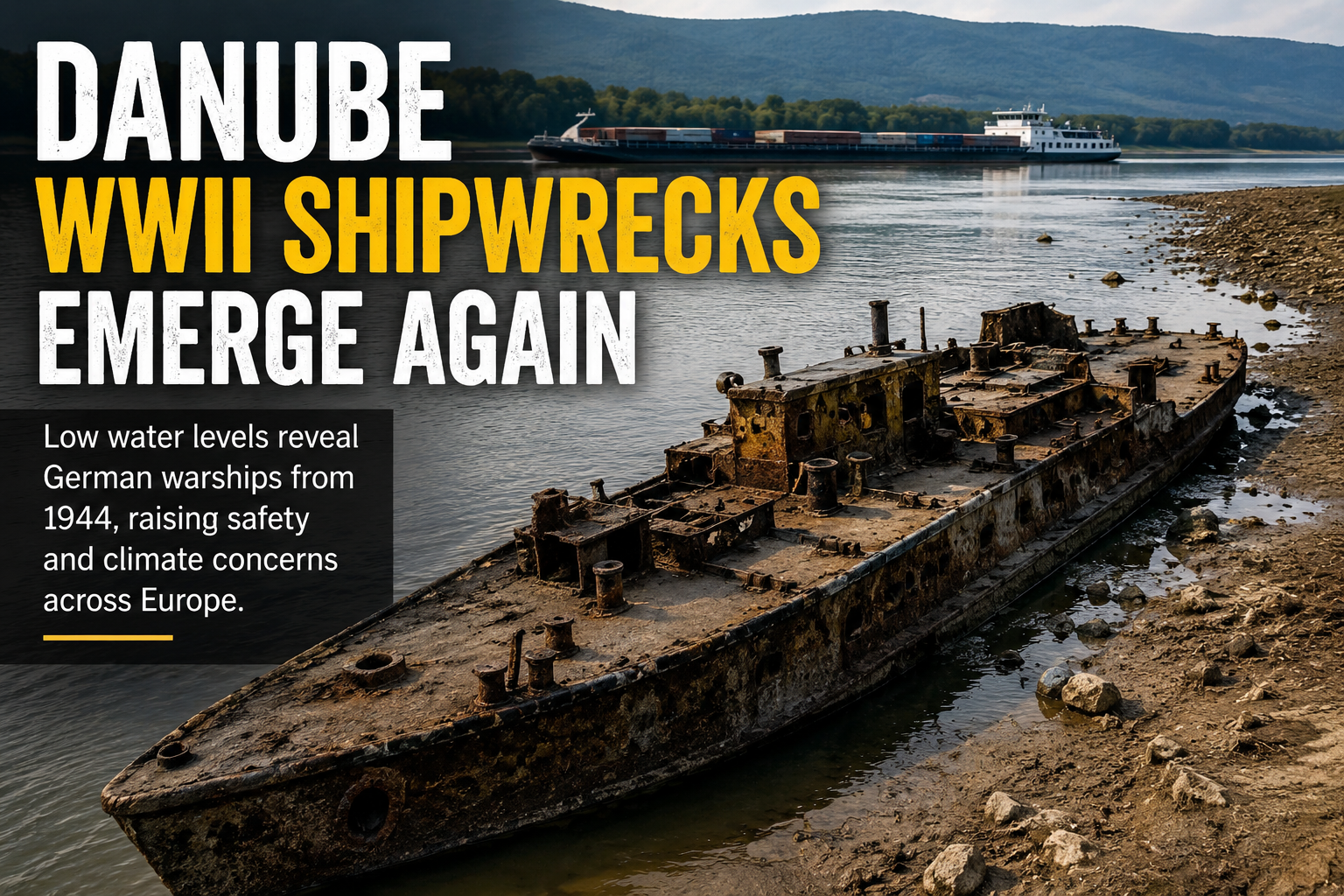
The Danube WWII shipwrecks are back in view as exceptionally low water levels expose parts of vessels that have remained beneath the river for decades. The unusual sight near Prahovo, Serbia, has drawn attention across Europe, but the wrecks are more than an eerie reminder of the past.
Some still contain dangerous wartime material, while the shrinking river is disrupting transport and raising fresh concerns about drought.Recent reports show that the Danube is carrying unusually little water across parts of Europe. Reuters reported that falling river levels have already affected transport and electricity production in several countries.The latest images from near Prahovo show rusty hulls and other sections of submerged vessels becoming visible as the river retreats.
The phenomenon has occurred before, including during severe droughts in 2022 and 2024. What makes the current episode striking is the combination of low water, intense European heat and the growing visibility of wrecks along the river.
Why Danube WWII shipwrecks are appearing now
The Danube WWII shipwrecks lie along a stretch of the river near Prahovo, close to Serbia’s border with Romania.
Many of the vessels were deliberately sunk in 1944 as German forces retreated during the final stages of the Second World War.
Historical accounts indicate that hundreds of vessels from Germany’s Black Sea fleet were scuttled along the Danube. The intention was partly to obstruct advancing Soviet forces and prevent the vessels from falling into enemy hands.
More than 20 wrecks became particularly visible near Prahovo during the severe drought of 2022. Reuters reported at the time that many vessels still contained ammunition and explosives, creating risks for shipping and nearby communities.
The wrecks did not disappear completely after the war. Instead, they became permanent obstacles beneath the river. Their visibility changes with water levels, making drought periods a recurring trigger for their reappearance.
The history beneath the river
The Danube WWII shipwrecks form part of a much larger wartime legacy along one of Europe’s most important waterways.
The Danube stretches from Germany to the Black Sea and connects major industrial and commercial regions. Its navigable channels carry cargo between several European countries. A large obstruction can therefore affect more than the immediate area around a wreck.
The vessels near Prahovo also illustrate how wartime decisions can create environmental and economic problems many decades later. Some wrecks contain ammunition, while others have deteriorated after years underwater.
A US Naval Institute account described more than 20 German vessels exposed near Prahovo during the 2022 drought. It also reported that the wrecks narrowed part of the navigable channel considerably.
Danube WWII shipwrecks create a modern safety problem
The biggest concern surrounding the Danube WWII shipwrecks is not their historical value. It is what may still be inside them.Serbia has been working to deal with unexploded wartime material in and around the wrecks.
In June 2026, Serbia’s Mine Action Centre reported the controlled destruction of a German depth charge discovered aboard the sunken vessel T-20 near Prahovo.The operation formed part of a project dealing with explosive remnants of war during the removal of 21 sunken vessels in the Danube near Prahovo.
Serbian authorities described the work as a high-risk operation requiring cooperation between several agencies.That effort shows why simply removing the wrecks is not a straightforward salvage exercise.
Authorities first have to identify potential explosives, secure the site and determine how material can be removed without endangering workers or nearby communities.
The danger can also increase when unusually low water exposes sections that are normally inaccessible.
A drought story as much as a history story
The Danube WWII shipwrecks have repeatedly become visible during periods of severe drought. That does not mean every appearance can be directly attributed to climate change.
Droughts have natural causes, including rainfall patterns, temperature and seasonal river conditions. Scientists therefore distinguish between individual weather events and longer-term climate trends.
At the same time, European climate monitoring agencies have documented increasingly severe drought conditions in parts of the continent. Earlier reporting on the Danube wrecks linked the low water conditions to a wider period of heat and drought across Eastern Europe.The current situation has a wider economic dimension.
Reuters reported in July that shrinking European rivers were reducing cargo transport, affecting hydropower generation and creating difficulties for businesses that depend on waterways.
The Danube is particularly important because it serves as both a transport corridor and a source of water and energy for communities across Europe.
What happens when the river falls further?
The appearance of Danube WWII shipwrecks can create problems for commercial vessels because low water already reduces the available depth of navigation channels.
Ships may need to carry less cargo to avoid grounding. Operators can face delays, while authorities may have to introduce restrictions on certain sections of the river.
The wrecks can make those problems worse by occupying parts of the navigable channel. Some vessels are partly buried in sediment, while others have become exposed as water levels decline.
The problem is therefore not simply that old ships have resurfaced. It is that the combination of shallow water and underwater obstructions can reduce the space available to modern vessels.
Serbia is working on removing dangerous wrecks
The Danube WWII shipwrecks have become the subject of long-running efforts to improve navigation and remove hazardous material.
Serbian authorities have already undertaken operations involving individual wrecks and unexploded ordnance.
The Mine Action Centre’s 2026 operation involving the T-20 vessel demonstrates the continuing nature of the problem.Earlier plans to remove larger numbers of vessels faced major technical and financial challenges.
Salvage crews cannot simply tow away deteriorating ships that may contain explosives.The work requires specialist equipment, detailed surveys and careful disposal procedures.
That makes removal expensive and slow, particularly when multiple wrecks lie close to an active shipping route.
The Danube’s disappearing water has wider consequences
The Danube WWII shipwrecks are attracting attention because they provide a dramatic visual symbol of a much larger problem.
Across Europe, low river levels have affected freight movement and energy production. Reuters reported that major rivers were experiencing unusually low water levels, forcing companies to adapt their operations.
The Danube is not an isolated case. Other European waterways have also experienced disruptions during periods of drought and extreme heat.
For countries dependent on river transport, prolonged low water can increase costs. Freight companies may have to reduce cargo loads or find alternative routes. Energy producers can also face difficulties when water availability affects power generation.
The resurfacing wrecks therefore offer an unusual window into two different timelines. Beneath the river are the remains of a conflict from the 1940s. Above them is a modern economy increasingly sensitive to changes in water availability.
A warning beneath the surface
The Danube WWII shipwrecks are likely to disappear again if rainfall raises the river level.
But the underlying problem will remain.The wrecks will continue to pose challenges for navigation and safety, while future droughts could expose them again.
Serbia’s ongoing removal and explosive-ordnance work shows that authorities cannot simply wait for the river to cover them.For residents and river operators, the immediate concern is safety.
For European policymakers, the wider issue is the resilience of inland waterways under increasingly difficult weather conditions.The sight of old warships emerging from the Danube may look like a strange historical discovery, but much of the story is about the present.
The river is revealing what has been hidden for generations while simultaneously showing how vulnerable modern Europe remains when its waterways run low.

Curated news reports, in-depth analysis, and special features by India’s Opinion editorial team.