At its height, the Mughal Empire controlled much of the Indian subcontinent and managed one of the largest economies of the early modern world. Its wealth did not come from a single source. Agriculture, taxes, trade, manufacturing and control of a large territory all played a role.
The empire grew rapidly from the 16th century. As Mughal rulers brought more land under their control, they also gained access to more farms, markets and trade routes. The state built a system that allowed it to collect large amounts of revenue from this growing economy.
Agriculture Was the Main Source of Wealth
Mughal India was mainly an agricultural society. Millions of farmers grew crops across the empire, making farming the main base of the economy.
The Mughal state collected revenue from agricultural production. Under Akbar, the administration developed systems to measure land, estimate crop output and set revenue rates.
Land revenue became a major source of state income.Farmers produced both food crops and crops that could be sold in markets. These included cotton, indigo, sugar cane and opium.
The growth of cash crops was important because these products could enter local and overseas trade.
Cambridge’s history of the Mughal economy notes that the revenue system often favoured higher-value crops such as cotton, indigo and sugar cane.
Akbar’s Revenue System
Emperor Akbar played an important role in building the Mughal revenue system.
His administration tried to create a more regular way of assessing agricultural income.
Officials collected information about land and crops and used it to set tax demands.
This helped the state plan its income and support its large army and administration.
The system was not simple or perfect. Tax pressure could be heavy, and the actual experience of farmers varied across regions.
Still, the revenue system gave the Mughal state access to a large share of the agricultural surplus.
Trade Connected the Empire
Agriculture was only one part of the story.Mughal India had large networks of inland and overseas trade.
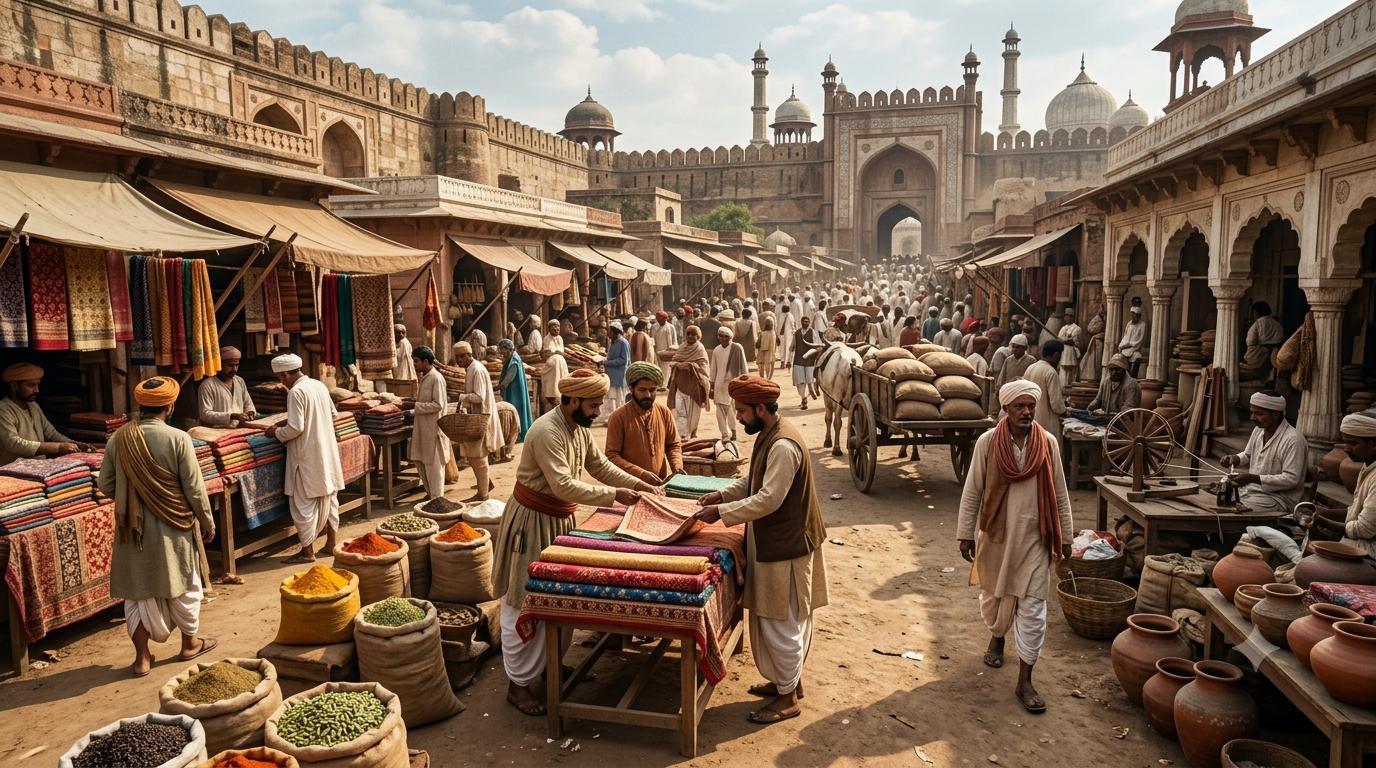
Goods moved between villages, towns, major cities and ports.Indian merchants traded products such as cotton cloth, silk, spices, indigo and other goods.
European traders also became increasingly interested in Indian products during the 17th century.
The growth of overseas trade brought more silver into India. European merchants needed Indian goods, but they often had limited products that Indian markets wanted in return.
As a result, precious metals became an important part of the trade flow into India.
Cities and Markets Grew
Mughal wealth also supported the growth of major cities.
Agra, Delhi, Lahore, Ahmedabad, Surat and other centres became important places for trade, crafts and administration.
Merchants, bankers, artisans and other workers formed part of the urban economy.
Goods from rural areas moved into cities, while imported products and money moved in the other direction.
The Mughal state also spent large amounts on buildings, roads, forts, gardens and cities.
This spending moved money through the economy and supported many craftsmen and workers.
The Mughal Empire Had a Large Consumer Market
The empire’s huge population created a large internal market.Farmers needed tools and clothing.
Soldiers needed weapons, horses and supplies. Nobles bought expensive clothes, jewellery, furniture and other goods.
The royal court itself was a major consumer.This demand supported craftsmen and merchants across different regions.
Manufacturing was not limited to large cities. Much production took place in villages and smaller towns as well.
A Strong Currency Helped Trade
The Mughal Empire also developed a strong money system.The silver rupee became an important coin for trade and tax payments.
Gold and copper coins were also used.A widely used currency made it easier for merchants to conduct business across different parts of the empire.
This mattered because the Mughal Empire covered a huge area. A farmer in one region and a merchant in another could take part in the same wider market system.
Geography Gave India an Advantage
India’s location also helped its economy.The subcontinent was connected to the Indian Ocean trade network.
Ports on the western and eastern coasts linked Indian merchants with markets in the Middle East, Southeast Asia, Africa and Europe.
Surat became one of the major ports connected to overseas trade.The Mughal Empire also controlled large areas of fertile land.
This gave it a strong agricultural base while its ports connected producers to foreign markets.
But Wealth Was Not Shared Equally
The wealth of the Mughal Empire should not be confused with widespread prosperity.
The state collected large amounts of revenue, but farmers could face heavy demands. Wealth was also concentrated among the ruling class, nobles, merchants and other powerful groups.
Cambridge’s economic history notes that Mughal rural society was not simply a mass of poor farmers. There were different levels of wealth and power within villages and the wider rural economy.
This is important when discussing Mughal wealth. The empire could have a strong economy while many ordinary people still lived with limited resources.
Why Did Mughal Wealth Matter?
The Mughal economy allowed the rulers to maintain a large administration and military.
It also helped fund major construction projects and a wealthy royal court.More importantly, India’s growing links with overseas markets connected the Mughal economy to a wider global trade system.
Cambridge historians have noted that Mughal political unity, inland trade and overseas commerce helped strengthen economic links across the empire.
The empire’s wealth also attracted European trading powers. Portuguese, Dutch, English and French merchants competed for access to Indian goods and markets.
The Bigger Picture
The wealth of Mughal India came from a combination of factors.
Agriculture provided the main base. The revenue system transferred a large share of agricultural output to the state.
Trade connected producers with markets across India and overseas. Textile production gave India valuable exports, while a large population created strong demand for goods.
But the system also had limits. Tax pressure, political conflict and the rising cost of military expansion created problems over time.
By the late 17th and early 18th centuries, the empire faced growing political and financial pressures.
The Mughal economic system did not simply disappear, but the political structure that supported it weakened.
The story of Mughal wealth is therefore more than a story about rich emperors and grand buildings.
It was built on millions of farmers, craftsmen, merchants and traders who connected India’s villages, cities and ports to one of the world’s largest early modern economies.

Umar Khan is a writer driven by curiosity and a passion for understanding the world. Through thoughtful analysis and evocative storytelling, he seeks to make complex ideas accessible, inspire meaningful conversations, and encourage fresh perspectives on the people, places, and issues that shape our shared future.