
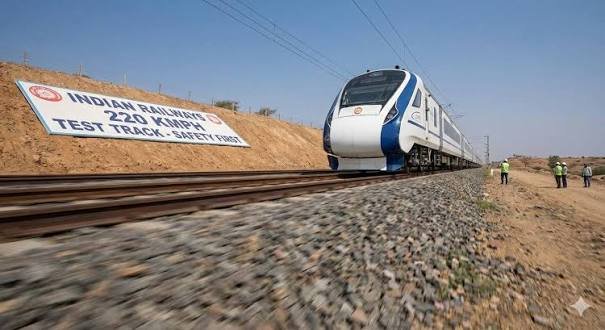
Indian Railways is close to finishing its first dedicated broad-gauge high-speed test track. Built in Rajasthan at an estimated cost of ₹967 crore, the 64-kilometre testing corridor is nearing civil completion. The facility will allow engineers to test newly built locomotives, passenger coaches, and freight wagons at speeds of up to 220 kmph. Full-scale operational trials will begin during the 2027-28 financial year. The project places India among an elite group of nations with dedicated railway testing tracks.
State-of-the-Art Testing Infrastructure in Rajasthan
The Research Design and Standards Organisation (RDSO) is developing the project near Sambhar Lake in Rajasthan. Located between Gudha and Thathana Mithri in the Jodhpur Division, the corridor features specialized rail engineering.
It includes seven major bridges, 129 minor bridges, and four specialized testing stations. The track has straight stretches, sharp curves, twist tracks, and high-speed switches.
These elements replicate diverse operational terrains. Rail engineers can thoroughly test train stability, bogie oscillation, and high-speed braking in a controlled environment.
Ending Speed Trial Disruptions on Regular Passenger Routes
Currently, Indian Railways conducts mandatory safety and speed trials on active passenger lines. Running experimental trains on working routes frequently disrupts regular timetables and delays passenger traffic. The new standalone corridor eliminates this major bottleneck entirely.
Testing teams can run continuous trial loops day and night without interfering with passenger or freight schedules. This independent setup drastically cuts the time needed to certify new train rakes and rail technologies.
Boosting Vande Bharat, Kavach, and Export Ambitions
The dedicated corridor will accelerate the testing of next-generation rolling stock. It will host rigorous trials for Vande Bharat sleeper trains, high-horsepower electric locomotives, and double-decker freight wagons.
Engineers will also use the facility to validate indigenous safety systems, including the Kavach automatic train protection technology. Furthermore, the test track meets global rail standards.
This compliance allows domestic manufacturers to test export-ready trains for international markets, boosting India’s engineering export goals.

Curated news reports, in-depth analysis, and special features by India’s Opinion editorial team.