
Why August 9, 1942 became a turning point
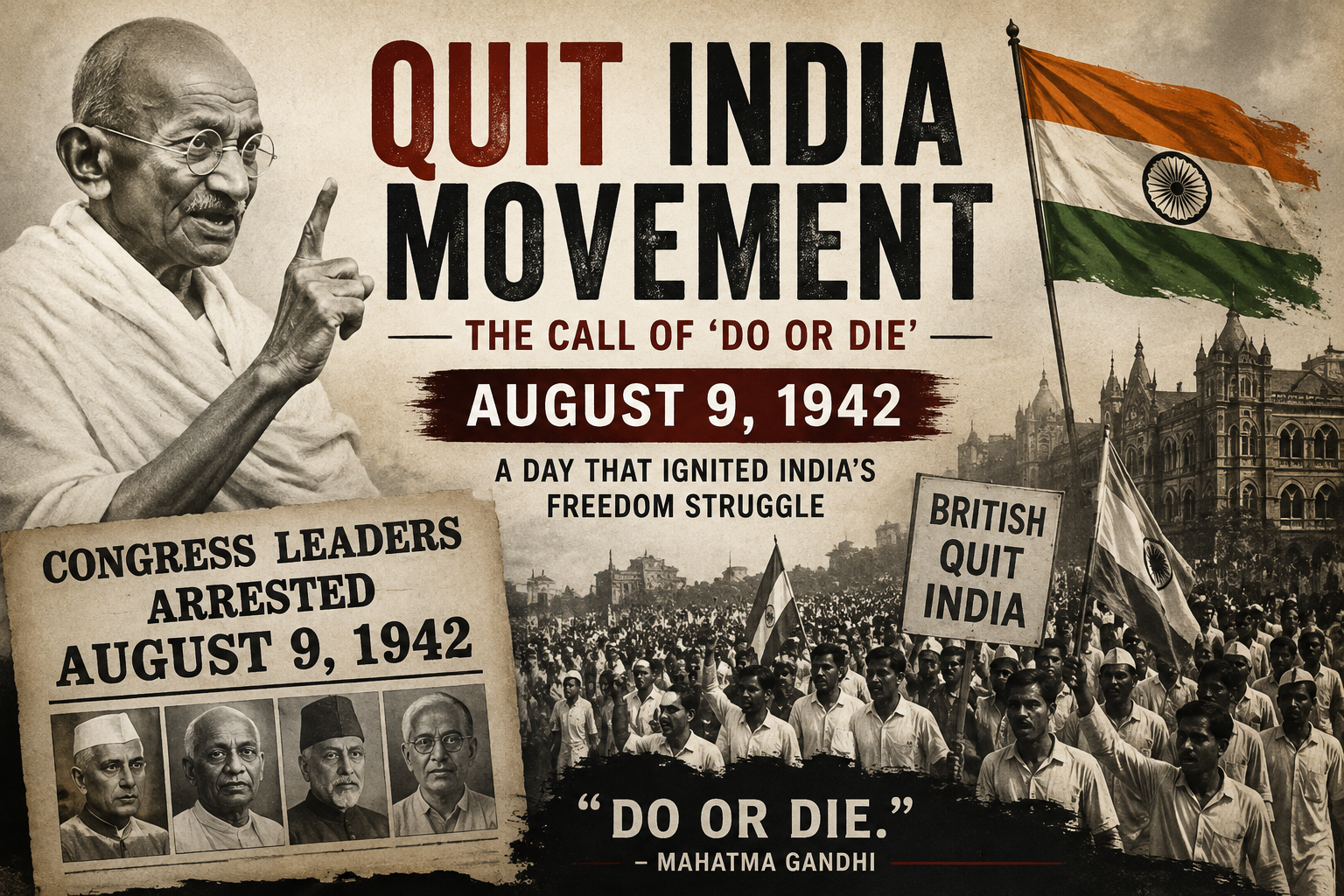
On August 9, 1942, the British government moved swiftly against India’s independence movement. Police arrested Mahatma Gandhi and other senior Congress leaders hours after the All India Congress Committee adopted the Quit India resolution in Bombay.
The arrests did not end the campaign. Instead, they pushed the Quit India Movement into a largely leaderless phase. Protests spread across towns, cities and villages. The crackdown came during the Second World War.
Britain had brought India into the conflict without consulting Indian political leaders. This deepened tensions between the colonial government and the Congress.
The failure of negotiations and growing frustration over wartime rule created the conditions. These conditions led to a much more direct demand for independence.
What happened on August 8 and 9?
The All India Congress Committee met in Bombay on August 8, 1942. Delegates approved a resolution demanding an immediate end to British rule. Gandhi addressed the gathering at Gowalia Tank Maidan, now known as August Kranti Maidan.
His message was uncompromising. He urged Indians to act with determination and gave the movement its most famous slogan: “Do or Die.” British authorities responded almost immediately. In the early hours of August 9, Gandhi was arrested and taken to the Aga Khan Palace in Pune.
Other Congress leaders, including Jawaharlal Nehru, Vallabhbhai Patel and Maulana Abul Kalam Azad, were also detained.
With the Congress leadership behind bars, ordinary activists and local organisers became central to the campaign.
Why did Gandhi launch the movement?
The Quit India Movement emerged after years of political tension. When the Second World War began in 1939, the British government declared India a belligerent without consulting elected Indian representatives.
Congress ministries in several provinces subsequently resigned.The situation became more complicated as Japan advanced across Asia.
British authorities needed Indian political support for the war effort, while Indian nationalists demanded a clear commitment to independence.
The British government sent Sir Stafford Cripps to India in 1942 with proposals for India’s constitutional future after the war.
Congress rejected the proposals. Gandhi and other leaders considered the offer inadequate because it did not provide immediate independence. By August 1942, Congress had concluded that waiting until the end of the war was unacceptable.
How the movement spread after the arrests
The arrests transformed the character of the campaign.Without its senior leadership, protests emerged across different parts of India.
Students, workers, farmers and local political activists participated in demonstrations, strikes and other forms of resistance. Railway lines, telegraph systems and government buildings became targets in some areas. These actions disrupted colonial administration and communications.
The movement was not uniform. Some participants followed Gandhi’s emphasis on non-violence, while others turned to more confrontational tactics after the leadership was imprisoned. The British government responded with arrests, censorship and force.
Thousands of people were detained during the crackdown. The exact number varies across historical accounts because arrests continued over an extended period and records differed by region.
The role of underground networks
The absence of Congress’s senior leadership did not completely silence the movement.Underground networks helped circulate messages and organise resistance.
Leaders such as Jayaprakash Narayan, Ram Manohar Lohia and Aruna Asaf Ali became associated with this phase of the struggle. Aruna Asaf Ali gained particular prominence after she hoisted the Congress flag at Gowalia Tank Maidan on August 9. Underground radio broadcasts also helped activists bypass colonial censorship.
These networks could not defeat British rule on their own. However, they demonstrated that the movement had developed beyond a campaign controlled entirely by Congress’s central leadership.
How did the British government respond?
The colonial administration treated the uprising as a serious threat to wartime stability. Authorities imposed restrictions, arrested protesters and used police and military forces to suppress demonstrations. The government also censored newspapers and limited public communication.
Gandhi remained imprisoned at the Aga Khan Palace for much of the movement’s early period. His wife, Kasturba Gandhi, died there in February 1944.
Mahadev Desai, Gandhi’s close aide, also died there in 1942. Gandhi was eventually released in May 1944 because of his deteriorating health. By then, the mass phase of the Quit India Movement had largely subsided.
Did Quit India directly win independence?
The relationship between the 1942 movement and independence in 1947 is more complicated than a simple cause-and-effect story. The movement did not force Britain to leave India immediately.
British authorities suppressed the uprising and retained control throughout the remainder of the war.Yet the campaign changed the political environment.
The movement demonstrated the depth of opposition to colonial rule. It showed that British authority could face widespread resistance even without the Congress leadership operating openly. The Second World War also weakened Britain economically and militarily.
The post-war political situation made maintaining the British Empire increasingly difficult. The Indian National Army trials, the Royal Indian Navy mutiny of 1946 and growing political pressure further complicated Britain’s position.
Why August 9 is remembered today
August 9 has become closely associated with India’s final major mass movement against British rule. The date is now observed as August Kranti Day, commemorating the 1942 uprising and those who participated in it. Its historical importance lies not only in Gandhi’s arrest.
The events showed how quickly a political campaign could become a nationwide movement when its central leadership had been removed. The movement also exposed the limits of colonial control.
Britain could imprison leaders and suppress demonstrations, but it could not permanently eliminate the demand for independence. Five years after the arrests of August 9, 1942, British rule in India ended. India became independent on August 15, 1947.
The road from the Quit India resolution to independence was not direct, and the movement was only one part of a much longer struggle. Yet August 9 remains a powerful reminder of the moment when India’s demand for freedom became an uncompromising call for the British to leave.

Umar Khan is a writer driven by curiosity and a passion for understanding the world. Through thoughtful analysis and evocative storytelling, he seeks to make complex ideas accessible, inspire meaningful conversations, and encourage fresh perspectives on the people, places, and issues that shape our shared future.