
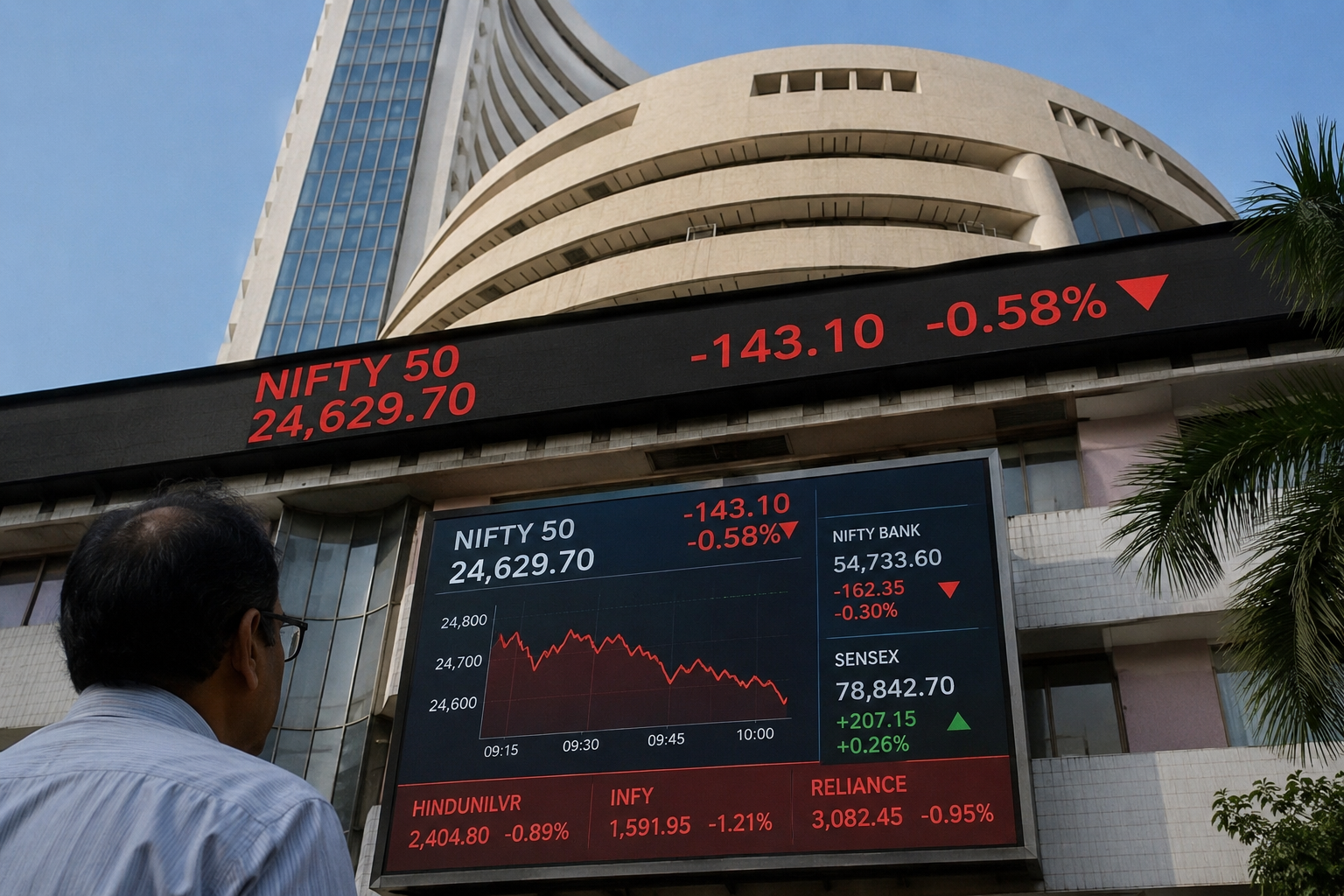
The Indian benchmark index reversed part of Monday’s sharp rally on Tuesday, exposing how quickly a new market rule can reshape headline prices. Nifty 50 falls 0.58% to 24,629.70 by 10:05 a.m. IST, while the Sensex gained 0.26% to 78,842.70.
The move followed an unusual first session for the new Closing Auction Session (CAS), which exchanges introduced for stocks with futures and options contracts. Nifty 50 falls after Monday’s 1.6% surge, which Reuters reported as a one-off distortion linked to the new mechanism.
Why Nifty 50 falls after Monday’s sharp rise
Monday’s market action created an unusual gap between India’s two leading benchmarks. The Nifty 50 rose 1.6% to 24,774.30, while the Sensex gained 0.7% to 78,639.03.The divergence emerged around the close, after the new auction process replaced the previous closing-price calculation for eligible F&O stocks.
Under the earlier system, exchanges calculated closing prices from a volume-weighted average of trades during the final 30 minutes of continuous trading.
Under CAS, buy and sell orders are brought together in a single-price auction near the end of the session. The price at which the greatest executable quantity can be matched becomes the closing price. The change aims to concentrate liquidity and create a more orderly reference price.
That distinction matters because index calculations depend on constituent prices. When several large stocks move sharply during the closing process, the effect can spread to the benchmark even if the broader session showed a different pattern. Nifty 50 falls therefore does not automatically mean that investors suddenly turned broadly bearish.
What caused the unusual market move
Reuters quoted Kranthi Bathini, director of equity strategy at Wealthmills Securities, as describing Monday’s move as a one-off distortion from the new mechanism that had normalised by Tuesday’s open.
Another market view suggested that traders were still trying to understand the first day’s price behaviour.The first session also came against a supportive market backdrop. Indian shares had gained for a fourth straight session on Monday. Falling crude prices, encouraging corporate earnings and a recovery in Asian technology shares helped sentiment.
Brent crude fell about 5% on Monday to $83.55 a barrel, according to Reuters. The decline followed comments about possible US-Iran talks. Those external factors provided a genuine reason for optimism, even as the closing auction added another layer to the day’s price action.
Nifty 50 falls on Tuesday should therefore be read against both forces. Part of the reversal reflects the unwinding of Monday’s unusual closing move, while sector-specific selling and higher oil prices added pressure.
Financial and technology stocks lead losses
The weakness was broad across the large sectors. Reuters reported that 13 of 16 major sectoral indexes were lower in early trading.Financial stocks, which carry substantial weight in the benchmark, fell 0.4%. Information technology shares dropped 1.2%.
Small-cap stocks moved in the opposite direction, rising 0.8%, while mid-cap shares remained broadly flat.Nifty 50 falls also coincided with sharp moves in several heavyweight stocks. Life Insurance Corporation of India dropped 6.6% after the government announced an offer to sell up to a 6.5% stake at a floor price of Rs 382 per share.
That price represented a 10.9% discount to Monday’s close.Reliance Industries declined 1% after the government raised windfall taxes on fuel exports. Higher export taxes can reduce the company’s net realisations and pressure refining margins.
Real estate major DLF also declined 2.3%. Reuters reported that brokerages raised concerns over subdued pre-sales and weaker cash collections after the company reported its June-quarter results.
Why the new closing auction matters
The new system was designed to address concerns around the way closing prices form. A closing price serves more than a record of the final trade. It can influence index values, derivatives settlement, portfolio valuations and other market references.
Nifty 50 falls after an unusual closing surge highlights the adjustment period that can accompany a change in market structure. Traders need time to understand how orders behave inside the auction and how the resulting prices interact with derivatives.
The first session also showed why the closing process matters beyond individual stocks. A sharp movement in the benchmark can affect futures and options even when the underlying market does not experience a comparable move during ordinary trading hours.
Market participants will now watch whether the first-day anomaly fades as liquidity builds in the auction. A single session cannot establish whether the new method produces persistent distortions or simply reflected the unfamiliarity of its launch.
Oil and global cues add another layer
The domestic market also faces pressure from crude prices. Brent crude rose 1.3% on Tuesday to about $85 a barrel after a sharp fall in the previous session.
For India, a major oil importer, sustained increases in crude prices can influence inflation, the trade balance and corporate costs.Nifty 50 falls in this setting is not solely a technical story about the closing auction. Investors are also weighing oil, global risk sentiment, corporate earnings and policy developments.
The Sensex’s rise while the Nifty declined further shows that the two benchmarks can respond differently when their constituent stocks and closing-price effects diverge. That difference does not necessarily signal a contradiction. It reflects the composition and weighting of each index.
What investors will watch next
The immediate test will come through the next few trading sessions, particularly as derivatives activity continues under the revised closing framework. Nifty 50 falls could remain volatile if traders adjust their strategies around the auction.The more important question is whether the new process produces stable and credible closing prices once participants become familiar with it.
Regulators and exchanges will also have to monitor market quality and address concerns if unusual price gaps persist.For investors, Tuesday’s move offers a reminder that headline index changes can sometimes reflect market structure as much as shifts in economic expectations.
Nifty 50 falls is therefore best understood in context, rather than treated as a simple verdict on investor confidence.The coming sessions should provide a clearer picture. If trading depth increases and closing prices converge more closely with broader market conditions, the initial volatility may prove temporary.
If large divergences continue, exchanges and market participants may face renewed questions about how the auction operates and how its prices feed into derivatives and index calculations.

Curated news reports, in-depth analysis, and special features by India’s Opinion editorial team.