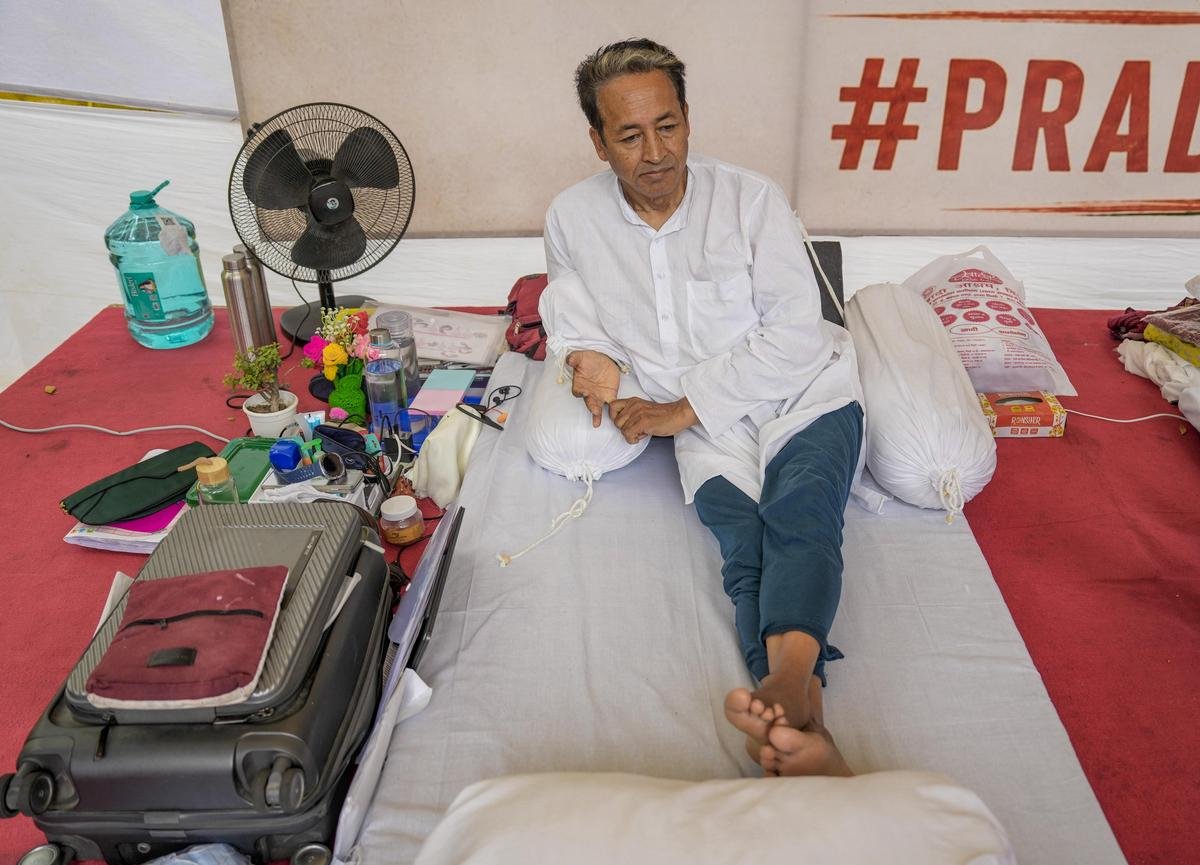
Renowned climate activist and educationist Sonam Wangchuk on Saturday issued a stern warning to the Union government. He cautioned that he will launch an indefinite hunger strike unless authorities release all protesters detained in New Delhi. Condemning the heavy-handed police crackdown across the national capital, Wangchuk stated that India has slipped into a state of “undeclared emergency.”
The Ladakh-based reformer expressed profound shock over the preemptive detention of students, youth organizers, and political figures who gathered to demand the resignation of Chief Election Commissioner Gyanesh Kumar. In an emotional video address shared on social media, Wangchuk noted that he had originally appealed for peace and unity ahead of the demonstration. However, as documented by The Indian Express, he lamented that authorities responded to peaceful democratic assembly with disproportionate force. They responded with mass arrests, and arbitrary communication blackouts.
Sunday Ultimatum for Release of Detained Leaders
Setting a clear deadline for the administration, Wangchuk announced that he would be compelled to commence an “Anshan” fast or embark on a foot march. This would occur if authorities do not free all detainees by Sunday, October 11. He emphasized that punishing citizens for exercising their constitutional right to demand institutional accountability undermines the core foundations of Indian democracy.
The activist voiced particular distress over the detention of Cockroach Janta Party (CJP) convener Abhijeet Dipke, All India Students’ Association (AISA) president Neha Bora, and senior political leaders. Furthermore, reporting by The Hindu highlighted that Wangchuk urged authorities to recognize youth idealism. In particular, he said not to treat peaceful dissenters as law-and-order threats. Consequently, he called upon civil society groups nationwide to maintain moral pressure on the administration.
Massive Police Roundup Stifles Jantar Mantar Stir
Wangchuk’s ultimatum came on a day when Delhi Police transformed the heart of the capital into a fortified zone. Over 25,000 security personnel enforced stringent prohibitory orders under Section 163 of the Bharatiya Nagarik Suraksha Sanhita (BNSS). Law enforcement agencies intercepted trains, sealed roads leading to Jantar Mantar, and temporarily shuttered operations at 45 Delhi Metro stations.
By Saturday afternoon, police personnel had detained over 5,000 individuals across railway terminals, bus depots, and central corridors. Officers pulled Dipke and fellow organizers off a domestic flight at Delhi airport immediately upon landing. Meanwhile, police rounded up Left leaders, including former Kerala Chief Minister Pinarayi Vijayan and CPI(M) leader Brinda Karat, outside Kerala House. In addition, as detailed by The Federal, transit camps at Chhatrasal Stadium and local police stations overflowed with detained student activists.
Widespread Backlash Across Civil Society
The aggressive administrative response triggered intense criticism from rights organizations, legal bodies, and Opposition parties. Legal representatives from the Supreme Court Bar Association appealed directly to Chief Justice Surya Kant over the detention of junior advocates near court premises. Similarly, civil rights monitors condemned the seizure of phones belonging to student representatives and the denial of access to legal counsel.
Therefore, Wangchuk warned that suppressing democratic expression through coercion will inevitably ignite broader grassroots resistance across states. On the other hand, ruling party representatives defended the police action. They argued that preventive measures averted widespread public disruption in the capital. Nevertheless, as the Sunday deadline approaches, political attention remains tightly focused on whether authorities will de-escalate tensions. It also remains focused on whether they will trigger a renewed fast by one of the country’s most prominent civil society voices.

Curated news reports, in-depth analysis, and special features by India’s Opinion editorial team.