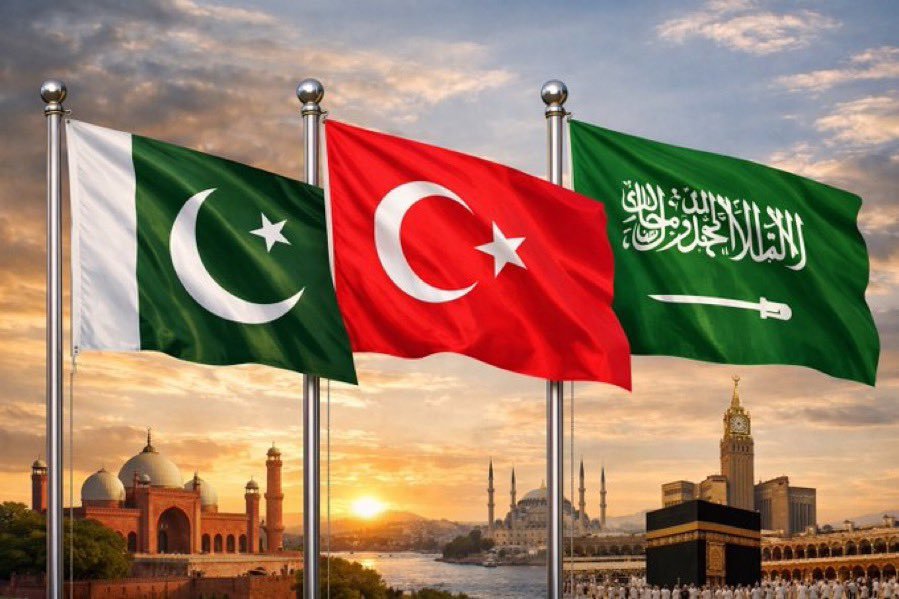
Saudi Arabia, Türkiye and Pakistan are preparing to sign a joint defence agreement in Saudi Arabia, according to two regional sources with direct knowledge of the matter. The proposed pact, known as the Saudi-Turkey-Pakistan defence pact, comes as governments across the Middle East reassess security arrangements. They also seek stronger regional coordination.
The agreement is expected to be signed on Friday, August 7. Reuters reported that the sources did not provide details on the pact’s precise scope or objectives. That leaves an important question unanswered: whether the arrangement will mainly deepen military cooperation or create a broader security framework between the three countries.
The timing gives the announcement added weight. Saudi Arabia faces heightened security concerns. Pakistan already has a strategic defence agreement with Riyadh. Türkiye has spent years expanding its defence relationships across the region.
Saudi-Turkey-Pakistan defence pact comes at a sensitive moment
The three countries already maintain close political and security relationships, but their interests are not identical.
Saudi Arabia has traditionally relied heavily on partnerships with major external powers for its security. In recent years, Riyadh has also sought greater regional military capacity. In addition, it wants stronger relationships with countries that can contribute to defence production, intelligence and military expertise.
Pakistan has maintained a longstanding military relationship with Saudi Arabia. The two countries signed their Strategic Mutual Defense Agreement in September 2025.
Saudi authorities later confirmed that Pakistani military aircraft arrived at a Saudi air base in April 2026 under that agreement. Türkiye brings a different set of capabilities.
Its defence industry has expanded rapidly, particularly in drones, naval systems, electronic warfare and other military technologies.
The proposed trilateral arrangement therefore brings together three countries with different strengths and strategic priorities.
What is already known about the agreement?
The most important fact is that the agreement was expected to be signed on August 7. However, its final text and operational provisions had not been publicly released in the Reuters report.
That means claims about automatic military intervention, troop commitments or a collective-defence clause should be treated cautiously until the governments publish the agreement. The distinction matters because defence cooperation can take many forms.
Countries can establish joint exercises, intelligence-sharing arrangements, training programmes, defence-industrial partnerships or broader commitments to coordinate during security crises.
Saudi Arabia and Türkiye already have a formal framework for expanding defence cooperation.
During Turkish President Recep Tayyip Erdoğan’s visit to Saudi Arabia in February, both sides agreed to activate existing defence agreements and strengthen defence relations, including through multilateral cooperation. They also discussed security coordination, counterterrorism and cybersecurity.
Pakistan’s role is central
Pakistan’s position gives the proposed pact a particularly important South Asian dimension. Islamabad and Riyadh have deep military ties that extend back decades. Their relationship became more formalised with the 2025 Strategic Mutual Defense Agreement.
Saudi Arabia has already used that partnership to increase military coordination with Pakistan. In April, Riyadh announced the arrival of Pakistani fighter and support aircraft at King Abdulaziz Air Base.
Saudi Arabia said the deployment was designed to strengthen military coordination and operational readiness.
Pakistan also has close defence ties with Türkiye. Islamabad and Ankara have expanded cooperation in military technology, training and defence production while their political relationship has deepened.
The proposed trilateral arrangement could therefore connect two existing bilateral relationships rather than create an entirely new strategic partnership.
Why Türkiye matters to Saudi Arabia
Türkiye has emerged as an increasingly important defence supplier and strategic partner for Gulf states. Saudi Arabia has already worked with Turkish defence companies on developing its domestic drone industry.
In 2023, Saudi and Turkish companies signed agreements aimed at localising drone production and related components inside the Kingdom.
That relationship has continued to develop alongside wider political ties. For Riyadh, cooperation with Türkiye can support its ambition to expand domestic defence manufacturing.
For Ankara, deeper relations with Saudi Arabia provide access to a major defence market and strengthen its position in Gulf security affairs. The proposed pact could give those bilateral defence links a wider political framework.
A changing regional security structure
The agreement also reflects a broader shift in how regional powers approach security. Saudi Arabia has spent years balancing relations with the United States, China, Russia, Türkiye, Pakistan and other regional actors.
Riyadh’s strategy increasingly combines traditional alliances with greater independent defence capacity.Türkiye has followed its own path.
Ankara remains a NATO member while developing stronger security relationships outside the traditional Western alliance structure. Pakistan, meanwhile, has sought to maintain relationships with Saudi Arabia, Türkiye, China and Western powers at the same time.
A trilateral defence framework could give all three governments another channel for coordination without necessarily replacing their existing partnerships.
The Iran factor remains difficult to ignore
The proposed pact is also emerging amid heightened tensions involving Iran and several regional actors.
Reuters reported on August 6 that Saudi Arabia expected possible attacks from Iranian-backed groups. It was working with the United States and other partners to assess threats to civilian and economic infrastructure.
The report also linked the expected defence agreement to Riyadh’s wider security concerns. Saudi Arabia has also publicly supported diplomatic efforts to reduce regional tensions.
In June, the Saudi Press Agency reported that Riyadh welcomed an agreement between the United States and Iran aimed at ending military operations and beginning negotiations. This creates an important contradiction. Riyadh is pursuing diplomacy while simultaneously strengthening its defence relationships.
Those two policies are not necessarily incompatible. A stronger defensive position can give governments greater confidence during negotiations, while diplomacy can reduce the need for military escalation.
What happens next?
The immediate focus will be on the agreement’s wording and the commitments made by the three governments after the signing.
If the pact concentrates on military exercises, defence technology, intelligence cooperation and industrial partnerships, it could gradually create a deeper three-way security network. However, if it contains stronger mutual-defence provisions, its strategic importance would be considerably greater.
For now, the safest assessment is that Saudi Arabia, Türkiye and Pakistan are moving toward closer defence coordination. This comes at a time when regional governments are reassessing their security relationships.
The agreement could become an important pillar of that process, but its real significance will only become clear once its terms are made public.

Curated news reports, in-depth analysis, and special features by India’s Opinion editorial team.