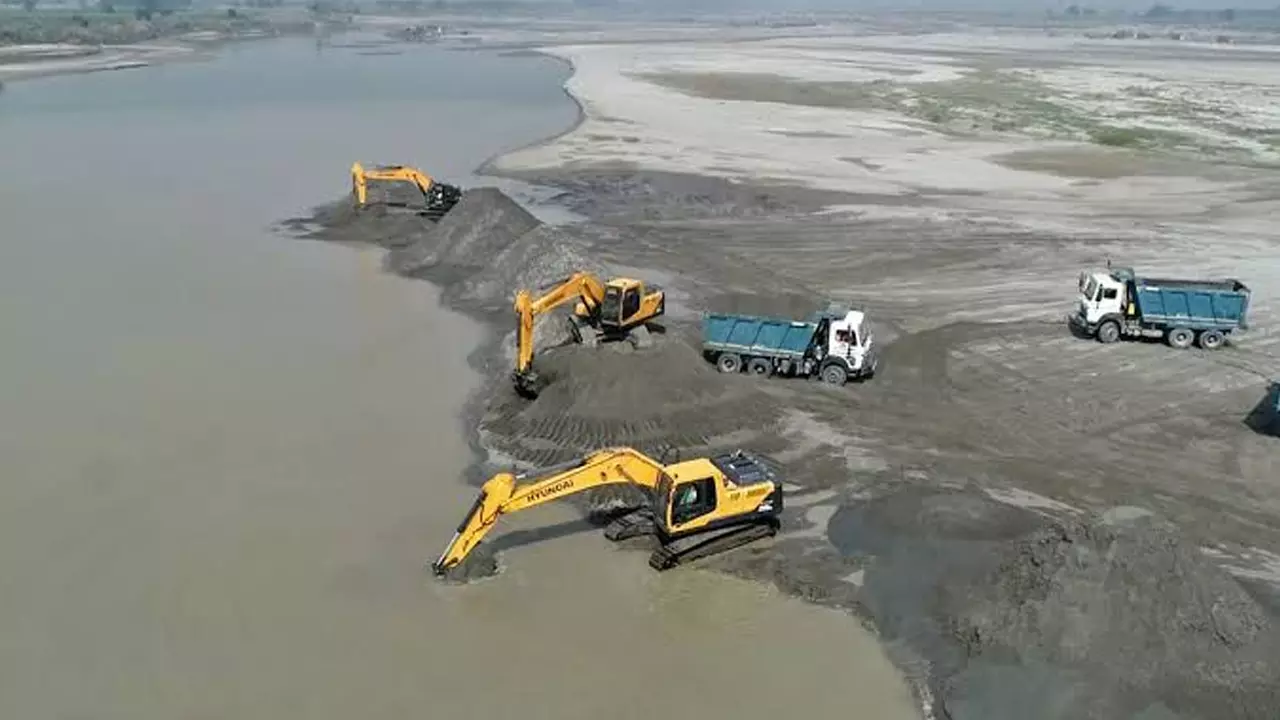
The National Green Tribunal (NGT) expressed grave concern on Monday over unchecked illegal sand mining in Madhya Pradesh. The environmental court observed that local administration officials and illegal mining syndicates appear to be working together. The tribunal raised the red flag while examining ecological destruction along river basins in the Chambal region.
The green bench reviewed field inspection reports from Matiyawali village in Bhind district. According to investigative findings published by The Indian Express, commercial operators use heavy earthmovers and dumpers without valid environmental clearances. The court noted that mining syndicates operate openly near local police stations without facing seizures. Therefore, the tribunal criticized district authorities for turning a blind eye to systematic riverbed pillaging.
Field Inspections Reveal Disparity in State Seizure Records
A joint environmental inspection committee visited active mining tracts along riverbanks in northern Madhya Pradesh. The expert team discovered vast mechanized excavation pits stretching across protected riparian zones.
However, official district registers recorded only minimal vehicle confiscations and minor fines. As reported by The Hindu, the tribunal identified an alarming disparity between actual river destruction and administrative penalties. Inspecting officers found evidence that local surveillance posts frequently tip off mining mafias ahead of surprise raids. Consequently, commercial operators move heavy excavators across state borders before enforcement squads arrive.
Promised Task Force Fails to Halt Riverbed Destruction
The judicial rebuke follows repeated commitments made by the state government to enforce environmental laws. The state administration had previously promised to establish a dedicated statewide anti-mining task force.
Earlier this year, the Supreme Court pulled up state authorities over mechanized mining in the National Chambal Sanctuary. Top court judges had even warned of deploying central paramilitary forces to protect critically endangered gharials. Furthermore, village whistleblowers and local forest guards faced deadly vehicular attacks when attempting to stop illegal tractor convoys. In addition, local river ecosystems suffered irreversible bank erosion and groundwater depletion. As a result, the tribunal concluded that paper promises failed to halt ground-level extraction.
Tribunal Mandates Monthly Surveillance and Official Accountability
The green panel recommended the immediate formation of a permanent district surveillance committee. The tribunal directed state authorities to submit mandatory monthly action-taken reports detailing mechanized seizures.
Moreover, the court demanded a high-level departmental inquiry to fix criminal accountability on colluding revenue and mining inspectors. On the other hand, the state government assured the bench that it will enforce satellite tracking on registered sand trucks. Nevertheless, environmental advocates emphasized that river conservation requires prosecuting corrupt field officers alongside mining kingpins. The tribunal will review the state’s progress report next month to assess strict compliance.

Curated news reports, in-depth analysis, and special features by India’s Opinion editorial team.