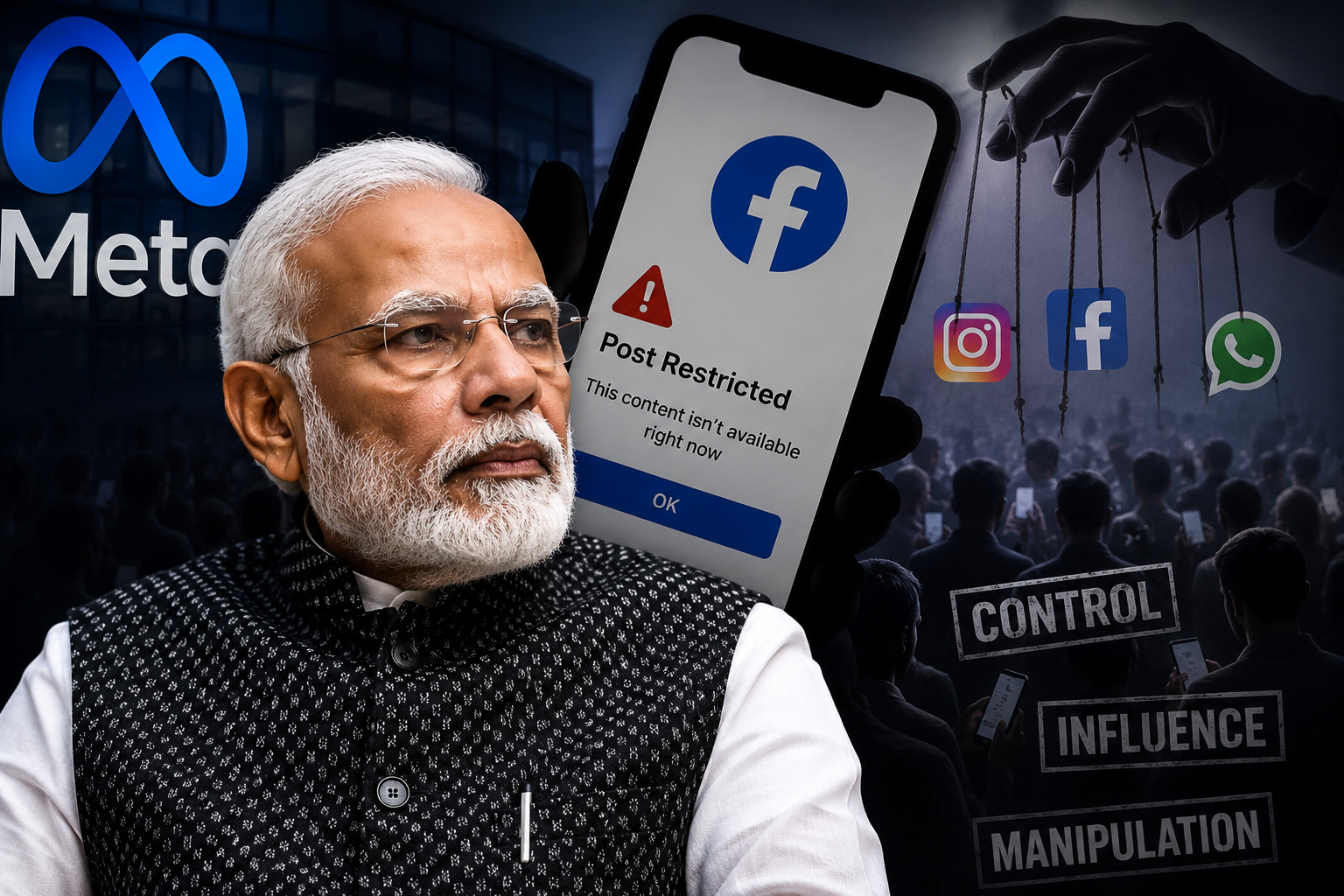
When Meta briefly restricted Prime Minister Narendra Modi’s Facebook post before restoring it, the immediate debate centred on why it happened. Was it an automated error? Was it a moderation issue? Was it a technical glitch? Meta may have its explanation.
But perhaps we are asking the wrong question.
The bigger question is this: should any private corporation have the power to interrupt the communication of the elected Prime Minister of the world’s largest democracy, even if only for a few hours?
This is no longer about Narendra Modi alone. It is about who controls the modern public square.
For most of human history, governments controlled information. Newspapers decided the headlines, television channels chose the prime-time debate, and radio shaped public opinion. Today, that power has quietly shifted into the hands of a handful of technology companies headquartered thousands of kilometres away from the countries they influence.
Every morning, billions of people wake up and open Facebook, Instagram or YouTube. Most believe they are choosing what to read and watch. They are not.
An algorithm decides what appears first. It decides which video deserves another million views, which political speech should reach a wider audience, which news story should disappear from public attention within hours and which topic should dominate dinner-table conversations. We know these decisions are being made. What we do not know is exactly how.
That lack of transparency is becoming one of the biggest democratic challenges of our time.
Supporters of Prime Minister Modi have naturally viewed the recent incident with concern. His critics may dismiss it as a routine moderation mistake that could happen to anyone. Both arguments miss the larger issue.
If Meta can temporarily block or limit the visibility of the Prime Minister’s communication, it possesses enormous influence over democratic discourse. Tomorrow, the same power could affect an opposition leader, a journalist, a social activist or an independent news organisation. The principle remains the same regardless of political affiliation.
The question is not whether the power will always be misused.
The question is whether such power should exist in the first place without meaningful public accountability.
This debate did not begin in India. Around the world, governments have become increasingly uneasy with the influence of large technology companies. The European Union has tightened regulations. American lawmakers from both political parties regularly summon technology executives for questioning. Australia fought with Big Tech over payments to news publishers. Brazil has debated stricter rules for online platforms.
Different countries disagree on the solutions, but they increasingly agree on the problem.
Information has become a strategic asset.
Technology companies insist they are neutral platforms. Yet neutrality becomes difficult to define when invisible algorithms determine what billions of people see every day. These recommendation systems are among the most influential pieces of software ever created, but they remain largely hidden from public scrutiny.
No editor in history ever possessed this kind of reach.
No television network ever knew so much about its audience.
No newspaper ever had the ability to personalise political messaging for every individual reader.
Social media platforms do.
Their algorithms learn our habits, understand our interests, predict our reactions and increasingly influence what captures our attention. The more time we spend online, the more these systems shape our understanding of the world.
This is why concerns about algorithmic power cannot simply be dismissed as conspiracy theories. That does not mean every viral post is manipulated or every moderation decision is politically motivated. Evidence should always matter. But it also means citizens are justified in asking how these systems work and who holds them accountable.
India, with more than a billion internet users, cannot afford to ignore this conversation. The country has become one of the largest markets for American technology companies, yet almost all our digital public conversations depend on platforms designed, governed and ultimately controlled outside India.
That should concern every Indian, regardless of political preference.
The issue is bigger than Modi. Bigger than the BJP. Bigger than the Opposition.
It is about whether the digital spaces where Indians debate politics, consume news and shape public opinion should be governed by opaque corporate decisions that the public neither understands nor oversees.
Democracies have always accepted scrutiny from voters. Governments answer to Parliament. Judges explain their judgments. Public institutions function within constitutional limits.
Technology companies, despite wielding influence comparable to institutions of state, answer primarily to shareholders.
That imbalance deserves serious attention.
Meta’s temporary restriction of the Prime Minister’s post may ultimately prove to have been nothing more than a technical error. If so, the incident should still serve as a reminder of how much power has quietly accumulated in the hands of a few global corporations.
When a foreign platform can interrupt the communication of an elected leader, even briefly, the real story is not about one post.
It is about who controls the conversation.

Amrit Pandey is a political researcher and political communication professional specialising in elections, political behaviour and campaign strategy. He holds an MSc in Election Campaign and Democracy from the University of London and an MA in Data, Culture and Society from the University of Westminster.