Police arrested Bijendra Gupta just in time. If his plan had worked, he wouldn’t have stopped at leaking the school teachers’ exam paper. He was already lining up the next target: the test for recruiting assistant professors in colleges and universities across Maharashtra.
Gupta is the alleged mastermind behind the Teachers Eligibility Test (TET) 2026 paper leak case. He told investigators from the Thane City police about his plans for the next leak. The Indian Express has learnt this new information. He and other accused also explained how gangs like his operate, both offline and online. For example, they stake out printing presses. Then, they help candidates cheat through fake computer centre registrations.
A Leak Stopped Two Days Before the Exam
Police busted Gupta’s gang just two days before the TET exam. Nearly 6 lakh teachers were set to take the test across 1,028 centres on June 28. Police action forced the state to postpone the exam.
The next big exam on Gupta’s radar was the State Eligibility Test (SET) for assistant professors. That exam was originally set for July 26. Authorities postponed it to September instead. But it was for unrelated reasons. Many candidates asked for a delay because the date clashed with the Pandharpur Wari pilgrimage. Additionally, officials wanted to avoid overlapping with the Maharashtra State Public Commission exams.
The Plan for the SET Paper
During questioning, Gupta gave police a specific lead. “During interrogation, Bijendra Gupta told us that Sanjay Kumar Sharma, a former employee at the Agra-based printing press from where the TET paper was leaked, had promised to get him the SET paper as well, which was to be printed and dispatched in July,” a police officer said.
Police are now checking whether the SET papers were also printed at Mahim Patran Pvt Ltd, the same press linked to the TET leak. The press did not respond to an email from The Indian Express seeking comment.
Gupta also gave police a wider claim about Sharma’s reach. “He has also claimed that Sharma has been in touch with gangs linked to leaking papers across the country and would promise to get them papers in advance in exchange for money,” the officer said.
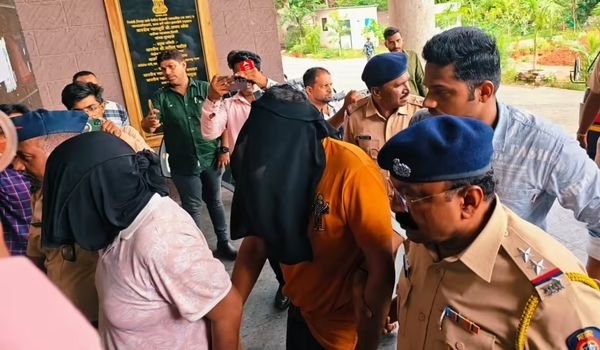
Gupta was arrested on July 25. Sharma and two other printing press employees were arrested earlier, on July 4.
How These Gangs Actually Work
Interrogations gave police a much fuller picture of the methods these networks use, both offline and online.
On the offline side, gang members travel across the country scouting printing presses that print question papers. They watch these presses closely. Then, they target junior staff who can be persuaded to hand over papers. An officer pointed to the Bihar Public Service Commission leak in 2024. This leak involved a press in Kolkata. It was an earlier example of the same pattern.
Presses have tightened security in response, checking staff closely and even removing belts and shoes before they leave the premises. That’s pushed some accused to get creative.
“Strict checking at printing presses, including removal of belts and shoes, has led accused persons to hide papers below the insole of a shoe to smuggle them out,” the officer said. Another offline method involves cultivating people inside the paper-setting process itself. In fact, the same approach was used in the NEET 2026 leak.
The online method works differently. Gangs get permission to run computer centres where candidates take their exams. Corrupt operators then let paying applicants complete biometric verification and leave. This allows a stand-in to take the actual test in their place.
There’s an even more advanced version of this. “In some cases, the accused obtains remote access to the candidate’s computer using a software and answers the questions while the applicant sits at the terminal pretending to do so.
This modus operandi does not relate to the [TET] case at hand. However, the information will be passed on to authorities to plug such loopholes,” the officer said.
How the TET Leak Actually Started
Police traced the TET leak back to June 2. Babulal Kushwaha, an employee at the Agra press, claimed he overheard his superiors talking about the Maharashtra papers being due for printing.
Kushwaha passed that tip to Sharma. Sharma then reached Gupta through another accused named Sonu, promising to smuggle the paper out. Gupta paid roughly Rs 8,000 for four TET papers.
Once Gupta had the papers, he turned to his old contacts. A former coaching class teacher, he used his network across Maharashtra to sell the papers for anywhere between Rs 80,000 and Rs 1.5 lakh each.
How Police Caught the Gang
Thane City police DCP (Zone II) Dr Pavan Bansod got the first break: a tip-off that the paper was being sold in Bhiwandi city. Police sent in decoy personnel posing as buyers. On June 26, they arrested three people from Haryana and Bihar. They caught them with the actual exam paper.
The investigation grew from there. Police have now made more than 15 arrests. They traced the leak back to junior employees at the Agra printing press. These junior employees smuggled the papers out in the first place.
“Papers of one state are usually printed at a press in another state, mainly to maintain secrecy,” an officer explained.
The University’s Response
The Indian Express contacted Savitribai Phule Pune University (SPPU), which conducts the SET exam for assistant professors. An official there pushed back on any link to the police case. “We have not received any communication from the police. The SET has been postponed purely because of technical reasons.
The exam on July 26 was postponed because there was demand from many candidates, especially those from areas along the Pandharpur Wari [pilgrimage] route. They would have faced difficulties in commuting,” the official said.
What Happens Next
Police still need to confirm whether the SET papers actually passed through the same compromised press. This detail would turn Gupta’s claim from an interrogation-room statement into a verified second leak plot.
With more than 15 arrests already made and Sharma’s alleged nationwide contacts still under investigation, the case looks likely to widen well beyond Maharashtra’s borders. This will happen before it’s fully unravelled.

Curated news reports, in-depth analysis, and special features by India’s Opinion editorial team.