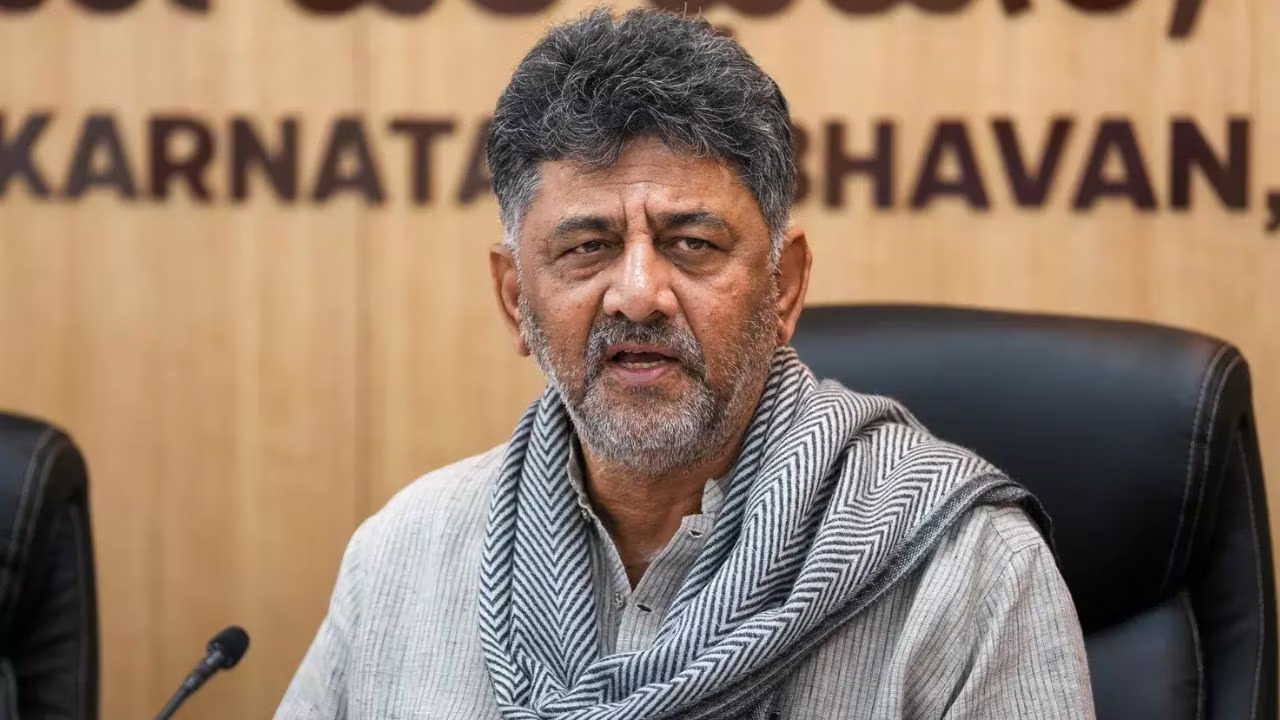
Karnataka Chief Minister D K Shivakumar is heading back to Delhi. Several problems are pushing him there. These include no woman minister in the Cabinet, an MLA facing corruption charges who got in anyway, and an OBC leader close to former CM Siddaramaiah left out. Additionally, senior MLAs are upset about being passed over, and portfolios remain unassigned for the 19 ministers sworn in on August 3.
The Congress CM is expected to meet the party’s central leadership in the coming days. Top of the agenda: adding a woman minister and making a few other changes before discontent starts hurting the party. The state’s Monsoon Session begins August 13. Moreover, the Opposition, BJP and JD(S), is already lining up to target Congress over how the Cabinet expansion played out.
“There will be some changes carried out. A woman minister will be inducted soon,” a Congress legislator said.
A Cabinet Built Around Caste Math
Every Congress Cabinet formation brings some level of discontent from those who miss out. For this Cabinet, there is an added complication: multiple power centres, in the state and at the Centre, are all lobbying for berths at once.
One thing hasn’t changed. Congress still wants its Cabinet to reflect the coalition of castes and communities that have backed the party for decades. The current 33-member Shivakumar Cabinet looks slightly different from the 34-member Siddaramaiah Cabinet that came before it. No woman minister. More representation for SCs and Muslims. Less for Lingayats.
How the Woman’s Berth Fell Through
The AICC’s original list of 20 ministers, released August 3, included one woman: first-time MLC Gayathri Shantigowda. She never took the oath. A dispute over her candidature got in the way. Siddaramaiah backed a different name for the seat: his former Cabinet colleague Umashree.
Both women are OBC MLCs. Siddaramaiah reportedly backed Umashree over Gayathri for her prior administrative experience. This mattered even though Gayathri belongs to his own Kuruba community. “There will be some changes in the woman candidate for the Cabinet. Umashree is likely to be sworn in,” Congress sources said.
Where the Caste Numbers Stand
Here’s how the current Cabinet breaks down: seven Lingayats (20%), six Vokkaligas (17%), seven from SCs (20%), three from STs (9%), three Muslims (9%), one Christian. Additionally, there will likely be six from OBC groups (17%) once a woman OBC minister is added.
Compare that to 2023. Siddaramaiah’s Cabinet then had eight Lingayats (23%), six Vokkaligas (17%), six SCs (17%), two Muslims (6%), three STs (9%), six OBCs (17%). It also had one each from Christian, Brahmin and Jain communities.
The 2023 Assembly election results explain some of this math. Congress won 135 of Karnataka’s 224 seats overall. Its strike rate varied sharply by candidate community: 37 of 48 seats with Lingayat candidates (80%), 21 of 43 with Vokkaligas (45%), 10 of 15 with Kurubas (65%), and 9 of 15 with Muslim candidates (60%). Out of 36 SC seats, Congress won 21 (60%). Out of 15 ST-reserved seats, it won 14, a striking 93%.
The Caste Survey Behind the Numbers
According to Congress sources, this Cabinet’s caste balance follows the state’s recent caste survey and its findings on population share.
Siddaramaiah wants a third Kuruba minister added: two-time MLA Basavaraj Shivannavar from Haveri. He had proposed Shivannavar’s name, which reportedly got dropped from the AICC list at the last moment. Adding Shivannavar would push Kuruba representation in the Cabinet to 9%. Furthermore, overall OBC representation would rise to 20%.
There was already one swap before the final list. An earlier version on August 3 had included ex-minister Mankal Vaidya, the Bhatkal MLA from the Mogaveera group. His name got dropped in favour of S S Mallikarjun, a powerful Lingayat leader whose wife and son are also Congress lawmakers.
Siddaramaiah’s Quiet Frustration
Siddaramaiah offered his Cabinet picks when the party leadership asked for them, then went quiet. “He has been of the opinion that the government must be given a free hand to function and pick ministers of their choice,” a Congress legislator close to him said.
His son, Dr Yathindra Siddaramaiah, joined the Cabinet when Shivakumar became CM on June 3. He has been more direct about what got rejected. “My father recommended Mahadevappa’s name in the list.
But, the high command has not considered him. Since they wanted new faces from the SC right community, they decided to go with (PM) Narendra Swamy. But father had recommended Mahadevappa’s name both in the first list and the recent list,” he said.
Shivakumar’s Reversal on the Caste Survey
Shivakumar has made his own significant shift. He’s now committed to implementing the caste survey conducted under Siddaramaiah, one Siddaramaiah accepted right before leaving the CM post.
That’s a change in position, since Shivakumar had previously opposed the survey during Siddaramaiah’s tenure, arguing it favoured OBCs.
“Our government conducted a socio-economic survey, and we are committed to implementing it to deliver social justice,” Shivakumar told a meeting of the Congress OBC panel on August 7.
He framed the broader Cabinet composition in similar terms. “Two-thirds of the ministers in our Cabinet belong to the backward classes, Scheduled Castes/Tribes, and minorities.
This is the guidance given to me and Hariprasad (state Congress chief) by our leaders Rahul Gandhi and Mallikarjun Kharge,” he told the meeting.
The survey itself produced numbers that reshuffled long-standing assumptions. It put the OBC population at 42%, well above the previously assumed 32%. Vokkaligas and Lingayats, traditionally dominant, came in lower than expected at 15% each. Muslims were pegged at 12%, Dalits at 19%, and STs at 9%.
Why So Many MLAs Feel Shut Out
Much of the frustration among Congress MLAs comes down to a simple problem. The Cabinet is already full of people from their own caste or region, Congress sources said. Youth and the ability to influence votes within a community have reportedly mattered too in who got picked.
Two inductions have drawn particular scrutiny. Ballari Rural MLA B Nagendra, accused by the CBI of misappropriating funds from an ST development board, and ex-minister B Z Zameer Ahmed Khan, accused by the Karnataka Lokayukta of amassing disproportionate wealth, both made it in. According to sources, this is thanks to their popularity within their communities and deep pockets.
Others didn’t make it, despite strong profiles. Six-time Bengaluru MLA Dinesh Gundu Rao, a Brahmin and former state Congress chief, and multi-term Bengaluru MLA M Krishnappa, a wealthy Vokkaliga, both lost out. The reason cited: the Cabinet already had five Bengaluru MLAs.
Congress has since reached out to its disgruntled Bengaluru MLAs, who’ll matter when the city holds civic polls next year. It’s also approached veterans like H K Patil and T B Jayachandra. These two lost out to younger candidates from their own Reddy Lingayat and Vokkaliga communities.
State Congress chief B K Hariprasad summed up the balancing act. “We gave representation to almost all districts, and some of those who became ministers last time were not given a chance this time due to the criteria of giving opportunities to others,” he said.
What Happens Next
With the Monsoon Session starting August 13 and the Opposition ready to pounce, Shivakumar’s Delhi trip is likely to settle at least the woman minister question, if Umashree’s induction goes through as expected.
Whether it also resolves the deeper tension, Siddaramaiah’s rejected picks, senior MLAs left out, and portfolio allocations for 19 new ministers, will determine whether this becomes a quiet fix or a fresh round of public friction within Karnataka Congress.

Curated news reports, in-depth analysis, and special features by India’s Opinion editorial team.