From Kashmir to Kerala, India’s Textile Heritage Lives in Its Clothes
A Kashmiri shawl, a Punjabi Phulkari dupatta and a Kanjeevaram silk saree may appear to belong to different worlds. They do. Yet together, they reveal one of India’s clearest cultural stories: Indian traditional textiles show how clothing changes with geography, climate, history and the hands that make it.
India’s traditional textiles are not simply fabrics sold as ethnic fashion. They carry regional memory. Their colours, motifs and techniques often connect to local landscapes, religious ceremonies, trade routes and generations of artisan knowledge.
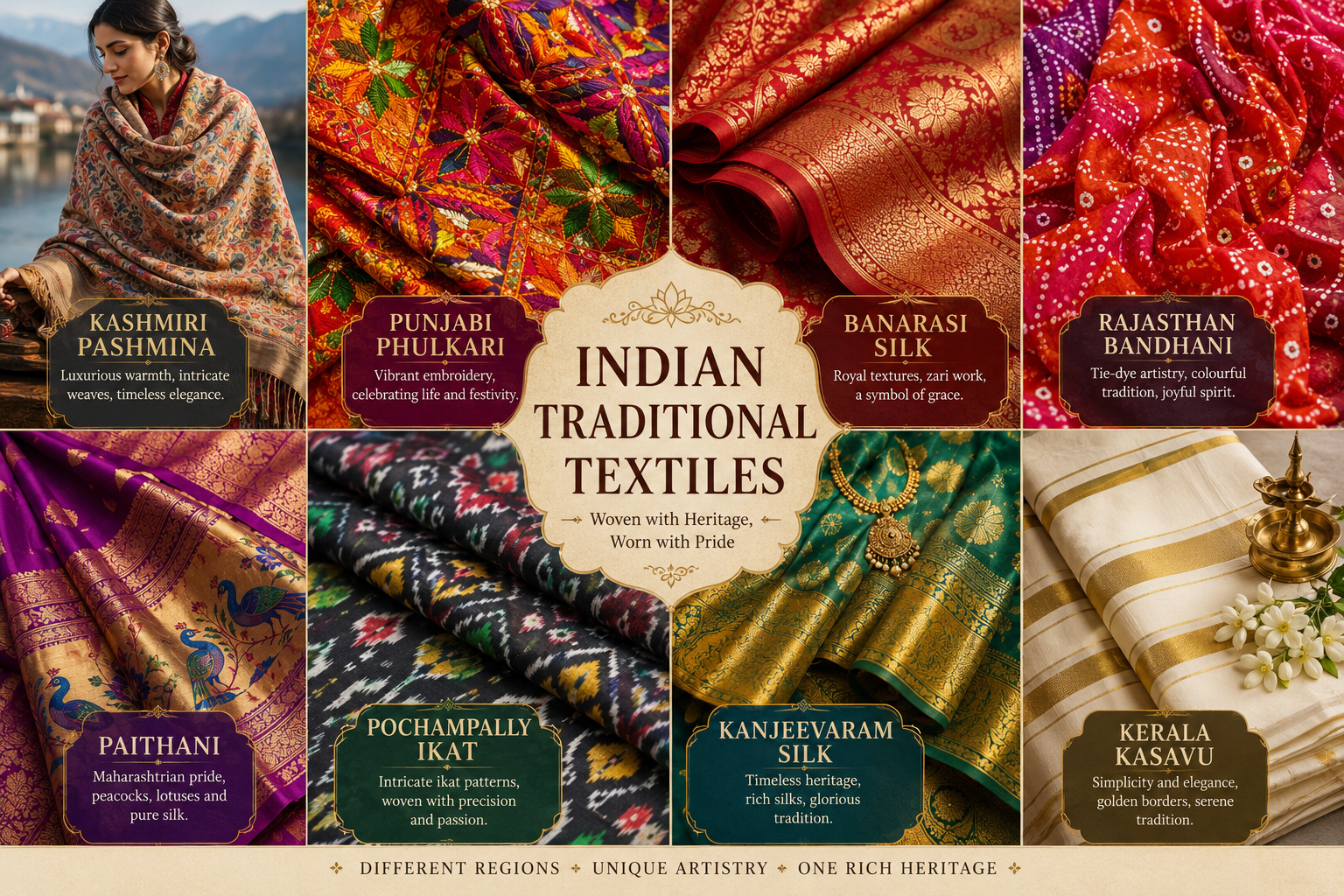
The country’s handloom traditions also show how widely textile culture varies across India. Official handloom material lists Pashmina and Kani shawls from Kashmir, Banarasi brocades, Paithani, Mysore silk, Andhra and Odisha ikats, Kanjeevaram silk and Kasavu among the country’s major textile traditions.
Indian traditional textiles begin in Kashmir’s mountain craft
In Kashmir, clothing has long carried both practical and artistic value. The region’s cold climate helped create a strong tradition of woollen textiles, while centuries of cultural exchange shaped the techniques used to decorate them.
Pashmina and Kani shawls carry Kashmir’s textile legacy
Pashmina is among the most recognised textiles associated with Kashmir. Kani shawls represent another highly specialised tradition. Artisans use small wooden spools called kanis instead of conventional shuttles to create intricate patterns on fine wool. The craft also relies on a system of design instructions known as talim. Handicrafts
Sozni embroidery adds another layer to Kashmiri clothing. Artisans use delicate stitches to create floral and natural motifs, including the chinar leaf, cypress tree and various flowers. The craft is used on Pashmina shawls and other garments. Handicrafts
These traditions show how a single garment can become a record of place. The fabric reflects the climate, while the motifs draw from the natural world around the artisan.
Punjab turns embroidery into a language of colour
As the textile journey moves south from Kashmir, Punjab brings a different visual vocabulary. Phulkari, whose name refers to floral work, is known for bright embroidery and geometric patterns.
Traditional Phulkari uses darning stitches on khaddar, a handspun and handwoven cotton fabric. Artisans create patterns from the reverse side of the cloth. Different forms, including Bagh and Chope, have been associated with ceremonies, weddings and important moments in family life. Handicrafts
Phulkari has also moved beyond traditional garments. Today, its motifs appear on dupattas, stoles, bags, footwear and contemporary clothing. The craft remains closely connected to Punjab’s textile identity, while new forms have helped it reach a wider market. India.gov.in
Banarasi silk connects clothing with India’s history of trade
In Uttar Pradesh, Varanasi’s Banarasi brocades represent another major chapter in the history of Indian traditional textiles. Rich silk, intricate patterns and metallic zari work have made Banarasi sarees closely associated with weddings and formal occasions.The craft’s importance extends beyond fashion.
Banaras brocades and sarees hold a Geographical Indication registration, alongside several other Indian textile and embroidery traditions. The official GI list also includes Kashmir Pashmina, Kashmir Sozani Craft and Lucknow Chikan Craft. Handicrafts
A Banarasi saree is often recognised for its elaborate surface design. Its appeal comes from the relationship between the base fabric and the woven decoration, a process that demands technical skill and time.
Lucknowi Chikankari brings delicacy to everyday clothing
Lucknowi Chikankari brings delicacy to everyday clothingFurther into Uttar Pradesh, Lucknow’s Chikankari offers a different aesthetic.
The craft is known for delicate embroidery and has become widely associated with kurtas, dupattas and other garments.Unlike the heavy visual richness of some brocades, Chikankari often depends on subtle texture and fine needlework.
Its popularity has allowed the craft to move from traditional clothing into contemporary wardrobes.The contrast between Banarasi silk and Chikankari reflects a wider truth about Indian textiles.
Regional identity does not always appear through bold colours or heavy decoration. Sometimes, it survives through the smallest stitch.
Rajasthan and Gujarat turn colour into a textile tradition
Western India offers some of the country’s most recognisable textile techniques. Rajasthan and Gujarat are particularly known for tie-dye, block printing and embroidery traditions shaped by strong colour and distinctive pattern.
Bandhani is created through a tie-dye process that produces small, patterned formations across the fabric. The technique has long been associated with colourful clothing and ceremonial wear.
Gujarat also has a rich range of textile traditions, including Kutch embroidery and other regional crafts. The government handicrafts portal lists Kutch embroidery among India’s recognised embroidery traditions. Handicrafts
The region’s textile culture also demonstrates how craft adapts to different communities. Patterns, materials and techniques vary across areas, creating a wide range of clothing traditions rather than one single regional style.
Maharashtra’s Paithani carries centuries of silk history
The story changes again in Maharashtra with Paithani. The textile is associated with Paithan and later became strongly connected with weaving centres such as Yeola.
UNESCO’s tentative heritage documentation records Paithan’s long history of textile production and describes the tradition’s survival through different political eras. It also notes the importance of weaving households and the craft’s historical connection with trade. UNESCO
World Heritage CentrePaithani sarees are known for rich silk and distinctive woven motifs. The tradition has survived because it has remained both a ceremonial textile and a living craft.
Its history also shows why textile heritage cannot be separated from the communities that produce it. A technique may be centuries old, but its survival depends on whether artisans can continue to earn a livelihood from it.
Odisha and Andhra Pradesh make geometry and storytelling part of fabric
Eastern and southern India bring some of the most technically distinctive traditions in the country. Ikat, for example, creates patterns by resist-dyeing yarns before weaving them into fabric.
Pochampally Ikat from Telangana is particularly known for geometric designs. UNESCO describes the tradition as a major weaving practice centred on Bhoodan Pochampally, where the distinctive patterns become part of sarees and dress materials. UNESCO
World Heritage CentreOdisha also has a strong Ikat tradition. Its textiles often use carefully planned patterns that emerge through the relationship between dyed yarn and loom.Andhra Pradesh’s Kalamkari offers a different approach. Machilipatnam Kalamkari uses hand painting or block printing, with designs that include mythological scenes, floral patterns and paisleys. India.gov.in
Together, these traditions show the range of Indian textile craft. One technique builds an image through dyed threads. Another creates it with a pen or block.
Southern India turns silk and cotton into ceremonial identity
In Karnataka, Mysore silk has become one of the country’s best-known silk traditions. The fabric is associated with a smooth finish and formal clothing.
Tamil Nadu’s Kanjeevaram silk holds a particularly strong place in South Indian ceremonial dress. Kancheepuram remains recognised for silk and cotton textiles that reflect the region’s long craft heritage. India.gov.in
Kanjeevaram sarees are closely associated with weddings, religious ceremonies and major family occasions. Their importance goes beyond appearance.
For many families, a silk saree becomes part of a ceremony’s memory and may pass between generations.The southern textile tradition also includes a wide range of cotton weaving.
These fabrics demonstrate that regional clothing does not depend only on luxury silk. Everyday materials can carry just as much cultural meaning.
Kerala’s Kasavu ends the journey in white and gold
At the southern end of this journey, Kerala’s Kasavu offers a striking contrast to the intense colours associated with many northern and western textiles.
The traditional combination of a light-coloured fabric with a gold border has become closely linked with Kerala’s cultural identity and ceremonial clothing. The style is especially visible during festivals and important occasions.
Kerala also has recognised weaving traditions such as Balaramapuram sarees and fine cotton fabrics. The official GI handicrafts list includes Balaramapuram Sarees and Fine Cotton Fabrics among registered products. Handicraft
The visual simplicity of Kasavu can be misleading. Its strength lies in restraint. The fabric shows how a textile tradition can build a powerful identity through a limited colour palette and a distinctive border.
Why Indian traditional textiles still matter in modern fashion
The survival of these traditions now depends on more than cultural pride. Artisans need access to markets, fair income and consumers who can distinguish genuine craft from imitation.
The Ministry of Textiles has created initiatives such as IndiaHandmade to showcase traditional crafts and provide artisans and weavers with access to online markets. The government also maintains a national repository aimed at documenting and digitally preserving India’s textile and craft traditions.
Digital platforms have changed how consumers discover regional clothing. A buyer in one part of India can now find a textile made thousands of kilometres away. That wider access can help artisans, but it also raises questions about authenticity, quality and whether the original maker receives a fair share of the value.
The challenge is not to freeze traditional clothing in the past. Many of these crafts have survived precisely because they adapted. Phulkari appears on modern garments, Kalamkari continues to enter contemporary fashion, and traditional silks remain part of changing wardrobes.
From Kashmir’s woollen shawls to Kerala’s cotton and gold-bordered garments, Indian traditional textiles show that clothing can function as both art and history. The techniques may differ, but the central story remains remarkably consistent.
A region’s climate, landscape, trade, community and memory can all find their way into the fabric.The next chapter will depend on whether younger consumers continue to value that story and whether the artisans who carry these skills can build sustainable livelihoods from them.
If they can, India’s textile heritage will not remain a museum piece. It will continue to evolve, one loom, stitch and garment at a time.
Umar Khan is a writer driven by curiosity and a passion for understanding the world. Through thoughtful analysis and evocative storytelling, he seeks to make complex ideas accessible, inspire meaningful conversations, and encourage fresh perspectives on the people, places, and issues that shape our shared future.