
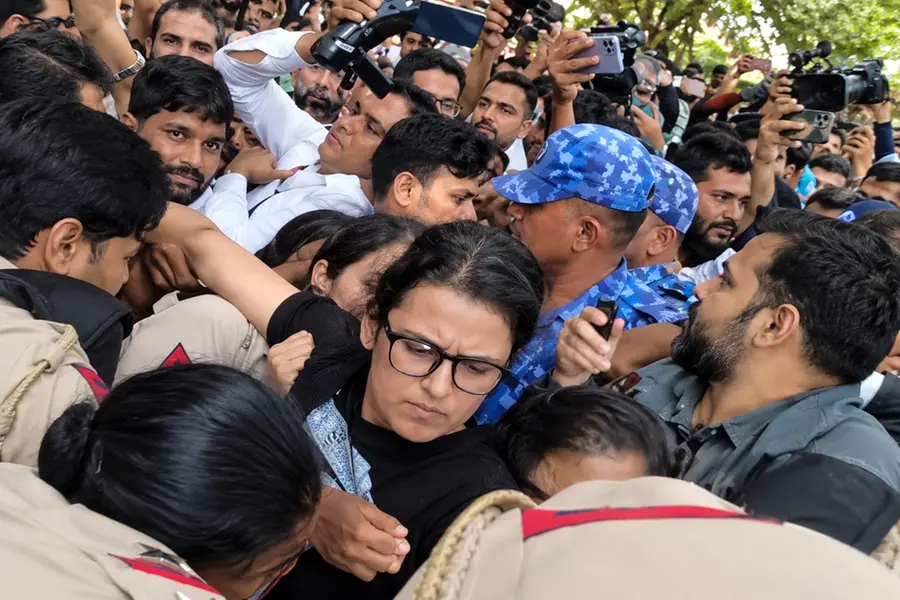
Tensions flared in central Delhi for the second consecutive day on Saturday. Delhi Police detained roughly 150 demonstrators, including Swaraj India leader Yogendra Yadav, AISA national president Neha Bora, and senior advocate Prashant Bhushan, as they marched toward Jantar Mantar.
The demonstrators continued their agitation demanding the immediate resignation of Chief Election Commissioner (CEC) Gyanesh Kumar. Furthermore, protesters raised sharp slogans against alleged voter roll deletions during the ongoing Special Intensive Revision (SIR) exercise, according to a report by The Hindu.
Fresh Protests Erupt Near Patel Chowk
Following Friday’s large-scale detentions, student groups and civil society organizations regrouped near Patel Chowk on Saturday afternoon. Demonstrators attempted to march toward the central protest ground carrying placards that labeled the SIR exercise as “vote theft.”
However, security forces intercepted the procession within minutes. Delhi Police maintained prohibitory orders under Section 163 of the Bharatiya Nagarik Suraksha Sanhita (BNSS), which strictly bans unauthorized gatherings of five or more people across New Delhi district.
Consequently, police cordoned off the march route and directed protesters to disperse immediately, as detailed by The Indian Express.
Senior Activists and Legal Minds Join the Frontline
Unlike preliminary student gatherings, Saturday’s march drew significant participation from senior public intellectuals and legal figures. Prominent advocates, including Kapil Sibal, Nitya Ramakrishnan, and Prashant Bhushan, walked alongside youth leaders.
Speaking before his detention, Yogendra Yadav asserted that the movement will continue until authorities address electoral transparency concerns. In addition, he emphasized that citizens must defend the institutional autonomy of the Election Commission of India.
Meanwhile, police personnel loaded detained leaders into transport buses and transferred them to local police stations for formal booking, according to coverage by Hindustan Times.
Legal Challenge Reaches Delhi High Court
As police clampdowns continued on the ground, student bodies and opposition groups escalated their battle to the judiciary. The Indian Youth Congress (IYC) moved the Delhi High Court challenging the police department’s blanket refusal to grant protest permits at Jantar Mantar.
Petitioners argued that peaceful assembly remains a fundamental constitutional right under Article 19. Furthermore, lawyers submitted that invoking emergency prohibitory sections across entire municipal districts unnecessarily criminalizes lawful democratic dissent.
Therefore, legal observers expect the high court to review the operational guidelines governing protest clearances in the national capital early next week.
Pressure Mounts Ahead of Supreme Court Hearing
The two-day street agitation in Delhi precedes a critical judicial review scheduled at the Supreme Court. The apex court agreed earlier this week to hear a formal writ petition challenging the CEC’s administrative decisions and the nationwide SIR drive.
With national opposition parties also planning a massive march to Nirvachan Sadan on October 6, public focus on the election authority remains intense.
Ultimately, Saturday’s detentions prove that grassroots anger over voter list revisions is expanding rapidly from digital forums into determined street action.`

Curated news reports, in-depth analysis, and special features by India’s Opinion editorial team.