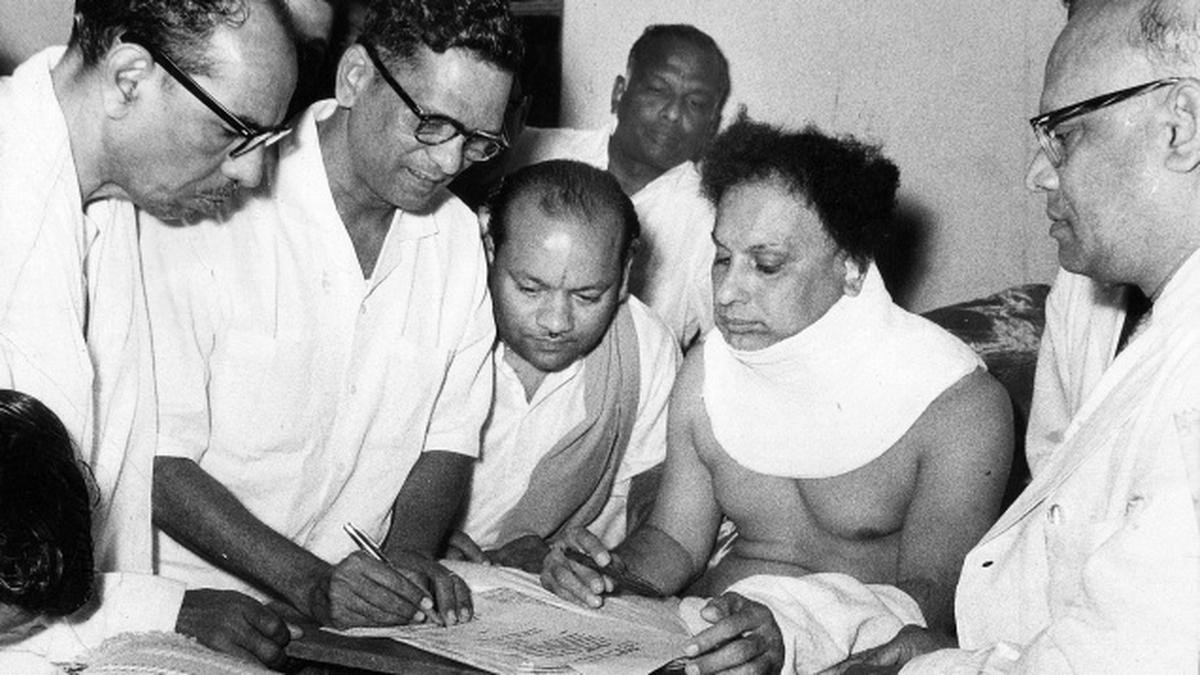
On the evening of January 12, 1967, a sudden gunshot shattered the peace of a quiet Chennai suburb. Inside his Nandambakkam home, Tamil cinema’s greatest superstar, M.G. Ramachandran (MGR), collapsed with a bullet lodged in his neck.
The man holding the smoking gun was veteran actor M.R. Radha, famous on screen for playing cunning villains. Radha turned the weapon on himself immediately after shooting the film icon.
The assassination attempt shocked millions of cinema lovers. Furthermore, it permanently altered the course of South Indian politics, according to a historical retrospective by The Indian Express.
A Tense Meeting That Turned Violent
Radha visited MGR’s residence alongside film producer K.K. Vasu to discuss a planned cinema project. However, the private conversation quickly turned into a heated argument over money and political rivalries.
Without warning, Radha pulled out a loaded revolver and fired point-blank at MGR’s left ear. Moments later, he fired twice at his own head in an apparent suicide bid.
MGR survived the attack through sheer willpower. Bleeding profusely, he walked to his car and instructed his driver to rush him to the nearest hospital.
Meanwhile, emergency doctors at the Government General Hospital worked tirelessly to stabilize both actors, as detailed in trial archives published by The Hindu.
Streets Erupt Across Madras
News of the shooting spread like wildfire across Tamil Nadu. Consequently, massive crowds of grief-stricken fans converged outside the hospital within hours.
The emotional shock soon turned into widespread street unrest. Angry mobs threw stones at public buses and clashed with police across Madras.
Furthermore, agitated supporters marched to Radha’s residence in St. Thomas Mount and set vehicles ablaze. The police deployed tear gas shells and baton charges to regain control over the rioting crowds.
Doctors successfully stabilized MGR after complex surgery. Nevertheless, the bullet damaged his vocal cords, leaving him with a permanently altered voice and partial hearing loss.
Campaigning from a Hospital Bed
The assassination attempt occurred just weeks before the crucial 1967 Tamil Nadu Legislative Assembly elections. MGR was running as a marquee candidate for the Dravida Munnetra Kazhagam (DMK), led by C.N. Annadurai.
Because MGR remained confined to his hospital ward, party workers took his campaign to the public in a unique way. They printed and pasted thousands of black-and-white posters showing the wounded star lying in bed with heavy neck bandages.
The sight of their injured hero created a massive wave of public sympathy. Voters lined up in record numbers across rural and urban constituencies to cast their ballots for the DMK alliance.
The Political Realignment of Tamil Nadu
The election outcome transformed Indian regional politics permanently. The DMK swept the polls in a historic landslide, decisively ousting the long-ruling Indian National Congress.
MGR won his own legislative seat with an overwhelming margin while still recovering in the hospital. The victory established Dravidian political parties as the dominant force in Tamil Nadu, a reign that continues unbroken to this day.
Moreover, the sympathy wave established MGR’s invincible personal bond with ordinary citizens. Years later, he founded the AIADMK and served as the state’s Chief Minister for a decade until his death.
Ultimately, the bullets fired on that January evening did not silence MGR; instead, they helped catapult him from a cinematic icon into an unshakeable political legend.

Curated news reports, in-depth analysis, and special features by India’s Opinion editorial team.